Most teams I talk to evaluate their AI the same way. They put another LLM in the loop and ask it to grade the first one.
I do it too. The final phase of my own eval pipeline is an LLM judge scoring real production conversations. It works, and for some questions nothing else will do.
But LLM-as-a-judge has quietly become the default answer to every evaluation question, including the ones that never needed a paragraph. And when you look at what the application actually does with the judge's output, the pattern is almost always the same: it throws the paragraph away and keeps one word.
Same AI. Different way to judge. That's the shift this post is about.
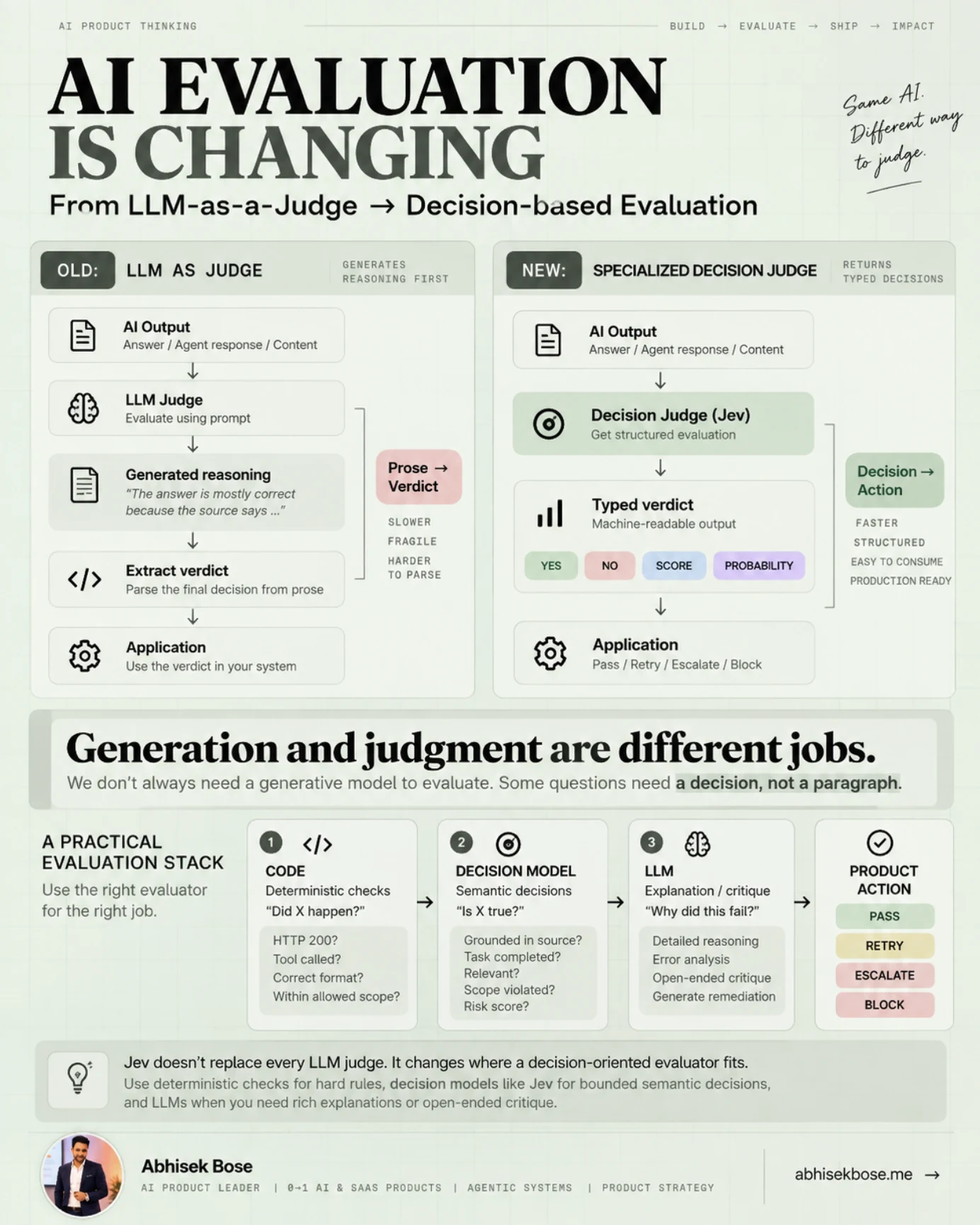
The old way: LLM as judge
Here's the flow most eval setups run today:
AI output → LLM judge → generated reasoning → extract verdict → application
Walk through it step by step.
- AI output. Your model produces an answer, an agent response, or a piece of content.
- LLM judge. A second model gets a prompt: "Evaluate this answer against the source. Is it correct?"
- Generated reasoning. The judge writes something like "The answer is mostly correct because the source says the refund window is 30 days, although it omits..."
- Extract verdict. Your code now has to parse a decision out of that prose. Is "mostly correct" a pass or a fail?
- Application. Only then does your system do something with the result.
The judge generates reasoning first and the decision second. For a human reviewer that's great. For software it's a detour.
What goes wrong with prose-first judging
None of these problems show up in a demo. All of them show up when the judge runs on every request.
It's slow. Every evaluation is a full generation call. If you want to check every agent step, every commit, or every support answer, you're adding seconds of latency and a generation bill to each one. So teams sample, and sampling means the failure you care about slips through on the request you didn't check.
It's fragile. The verdict lives inside free text. You end up writing parsers for "mostly correct", "largely accurate", "correct with minor issues", and whatever phrasing the model picks after its next update. Your eval now has its own bugs.
It's hard to act on. Software needs a threshold. "Mostly correct" isn't one. You can ask the judge for a 1–10 score, but a score written by a generative model drifts with the prompt, the context length, and the order of the examples.
It mixes two jobs. The judge is being asked to decide and explain in one pass. When the explanation is the part nobody reads, you're paying for it anyway.
The new way: a specialized decision judge
The alternative flow looks like this:
AI output → decision judge → typed verdict → application
The difference is the output type. A decision judge doesn't write a paragraph. It returns a machine-readable verdict:
- Yes / No: is the answer grounded in the source?
- Score: how relevant is this retrieved chunk?
- Probability: how likely is it that this commit matches the approved spec?
And because the output is typed, the application can map it straight to an action:
| Verdict | Product action |
|---|---|
| Grounded, high confidence | Pass: ship the answer |
| Borderline | Retry: regenerate with more context |
| Low confidence on something that matters | Escalate: route to a human |
| Violates a hard boundary | Block: stop it here |
Prose → verdict becomes decision → action. No parsing step, no guessing what "mostly" means.
The model I've been working with here is Jev AI from TypeSafe, a typed decision model. You describe the decision you need and it returns a structured result from the inputs you give it, not a generated explanation.
What this looks like in production
We use this pattern in Ultipad's spec-drift check. Every commit an AI coding agent makes gets compared with the approved product spec for that idea.
The obvious build would have been an LLM reading every diff and writing a review. We didn't do that. Agents commit often, and a generation call on every commit would make the check too slow and too expensive to run continuously.
Instead the decision model returns one number: an alignment probability.
- On-spec commit: ~89% aligned, passes
- Unrelated commit: ~25% aligned, drift flagged, owner notified
Two things made this work. The output is cheap enough to run on every commit, not a sample. And the check is advisory, not a gate. A low score never blocks the agent. It gives a human an earlier signal, before code review instead of after it. I wrote up the details in Claude broke the ADLC, our AI decision layer caught it.
Generation and judgment are different jobs
This is the real point underneath the tooling.
Generating an answer and judging an answer are different tasks. We don't always need a generative model to evaluate, because many evaluation questions need a decision, not a paragraph.
| Generative judge (LLM) | Decision judge (e.g. Jev) | |
|---|---|---|
| Output | Free-text reasoning, then a verdict | Typed verdict: yes/no, score, probability |
| Speed & cost | A full generation per check | Light enough to run on every request |
| Parsing | You extract the verdict from prose | None, it's already structured |
| Thresholds | Soft; phrasing drifts | Explicit numbers you can calibrate |
| Best at | Explaining why, open-ended critique | Bounded questions with a clear answer |
Once you separate the two jobs, the design question changes. It stops being "which judge model should we use?" and becomes "what kind of question is this?"
A practical evaluation stack
I now think about evaluation as three layers, each answering a different kind of question, with the product action at the end.
1. Code: "Did X happen?"
Deterministic checks. If a rule can be written as code, write it as code. It's instant, free, and never hallucinates.
- Did the API return HTTP 200?
- Was the right tool called?
- Is the output in the correct format / valid JSON?
- Is the action within the allowed scope?
A surprising share of "eval" work belongs here. Teams send format checks to an LLM judge all the time.
2. Decision model: "Is X true?"
Bounded semantic decisions. These need language understanding, but the answer is still a decision.
- Is the answer grounded in the source?
- Did the agent complete the task?
- Is this response relevant to the question?
- Did this action violate the approved scope?
- What's the risk score?
This is where a decision judge like Jev fits. It's semantic enough that code can't do it, and bounded enough that a paragraph adds nothing.
3. LLM: "Why did this fail?"
Explanation and critique. This is where a generative judge earns its cost.
- Detailed reasoning a human will actually read
- Error analysis on a failing case
- Open-ended critique of tone, structure, or approach
- Generating a remediation or a better answer
Then: a product action
Every layer feeds the same small set of outcomes: pass, retry, escalate, block. If an eval result can't change what the product does next, it's a dashboard metric, not an evaluator.
The order matters too. Run the cheap layers first and escalate only what they can't settle. Code clears the obvious failures, the decision model handles the semantic calls at full volume, and the LLM is reserved for the cases where someone needs to understand why.
Where the LLM judge still wins
Jev doesn't replace every LLM judge. It changes where a decision-oriented evaluator fits.
I still use an LLM judge in the third phase of my eval pipeline, scoring real production conversations for faithfulness against what the model actually retrieved. That judge's reasoning is the useful part. When a score drops below threshold, I want to read why, because the fix depends on whether the problem is retrieval or generation.
A generative judge is still the right call when:
- a human will read the explanation and act on it
- the question is open-ended ("is this a good onboarding email?")
- you need the judge to propose a fix, not just flag a problem
- you're doing offline analysis on a sample, where latency doesn't matter
The mistake isn't using LLM judges. It's using them for questions that were always yes/no.
How to move your evals over
If you have an LLM-as-a-judge setup today, here's the migration I'd run:
- List every question your judge answers. Write each one down as a question, not a prompt.
- Classify each one. "Did X happen?" goes to code. "Is X true?" goes to a decision model. "Why did X fail?" stays with the LLM.
- Define the output type before the model. Yes/no, a 0–1 score, or a probability. If you can't pick one, the question isn't bounded yet.
- Map every output to an action. Write the pass / retry / escalate / block rule next to the threshold.
- Calibrate on your own labelled examples. Pull real cases, label them, and check where the thresholds should sit. Don't trust a default cut-off.
- Keep the LLM judge on a sample. Use it for critique and for auditing the decision layer, not for gating every request.
- Log every decision. Typed verdicts are easy to chart over time, which is half the reason to use them.
A few honest caveats
Decision models are early. Jev's published benchmarks are mostly TypeSafe's own evaluations, so treat them as a starting point and measure on your data. A decision model is only as good as the question you give it. Vague questions produce confident nonsense, same as with an LLM. And a typed verdict can make a wrong answer look authoritative, which is exactly why the human stays in the loop at "escalate."
The shift
For a while the default was one model doing everything: generating, judging, explaining, deciding. The systems I trust in production look different. Code checks the rules. Decision models make the bounded semantic calls. LLMs explain and critique. And every evaluation ends in a product action.
Reliable AI products don't start with a better judge. They start with asking the right kind of question, and letting the right evaluator answer it.
See this pattern running in production in the Ultipad case study.