The worst eval mistake is measuring what's easy to measure — BLEU score, keyword match, human-rated thumbs up/down on demo queries. These tell you nothing about what happens when a real user asks an edge-case question at 11pm.
I learned this building RAGOS, a self-hosted RAG platform now live in open beta as first-level customer support. Here is the evaluation system that made it trustworthy enough to put in front of paying customers — and the mistakes it was designed to catch.
The three-phase pipeline
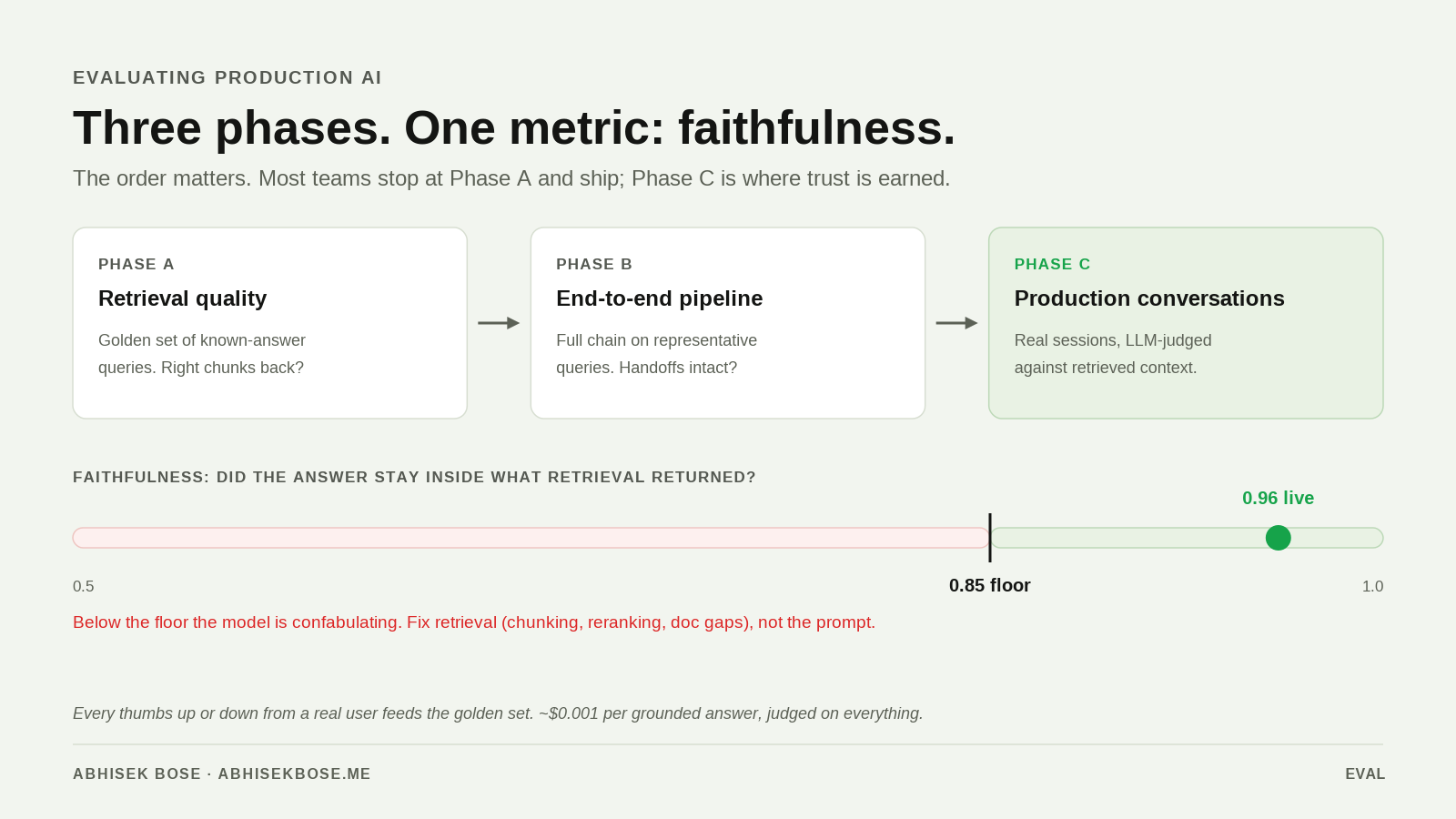
I run evals in three phases, and the order matters:
Phase A — retrieval quality on a golden set. Before anything touches generation, measure whether the right chunks come back for known-answer queries. This isolates the retrieval layer: if recall is bad here, no amount of prompt engineering downstream will save you.
Phase B — end-to-end pipeline on representative queries. Now run the full chain — query expansion, retrieval, reranking, generation, citation — on queries that look like what users actually ask. This catches integration failures: retrieval works, generation works, but the handoff between them drops the table that held the answer.
Phase C — real production conversations, scored by an LLM judge. This is the only phase that catches the bugs that matter. Real users don't ask representative queries. They ask half-formed questions, follow-ups that depend on context, and things your documentation doesn't cover. An LLM judge scores every production answer against what the model actually retrieved — not against an idealized reference answer.
Most teams stop at Phase A and ship. Phase C is where trust is actually earned or lost.
Why faithfulness, not accuracy
The metric I trust most is faithfulness: did the model's answer stay grounded in the retrieved context, or did it hallucinate past the evidence?
Accuracy asks "was the answer right?" — which sounds better but hides the failure mode that destroys user trust. An answer can be accidentally right while inventing its reasoning, and it can be wrong for the honest reason that your documentation doesn't contain the answer. Those two failures need completely different fixes.
Faithfulness separates them. In RAGOS, a faithfulness score below 0.85 means the model is confabulating — answering past what the retrieval returned. And here's the operational insight that took a while to internalize: no amount of prompt tuning fixes a retrieval problem. When faithfulness drops, the instinct is to rewrite the system prompt. The actual fix is almost always in the retrieval layer — chunking, reranking, or a documentation gap.
Measure retrieval and generation separately. Fix the right layer.
What this costs, measured
Eval rigor sounds expensive. In production it isn't:
- 0.96 faithfulness sustained across 875+ handled tickets
- ~$0.001 per grounded answer — the LLM judge scoring is cheap enough to run on everything, not a sample
- Every 👍/👎 from a real user feeds back into the eval set, so the golden set grows from production reality instead of my imagination
The doc-gap loop closes the system: when retrieval fails because the documentation genuinely doesn't contain an answer, that gap is logged and lands in a weekly digest. The eval system doesn't just score the AI — it drives the documentation roadmap.
The habit, not the framework
The framework is three phases and one metric. The habit is harder: evals come before features. Every new capability ships with its eval first, the same way test-driven development writes the test first. If you can't describe what "good" looks like well enough to score it, you're not ready to build it — you're ready to do more discovery.
That's the discipline that makes AI products reliable in production. Not better prompts. Better measurement.
This framework runs live in RAGOS and drives spec-drift detection in Ultipad. More on how I make AI product decisions on the home page.