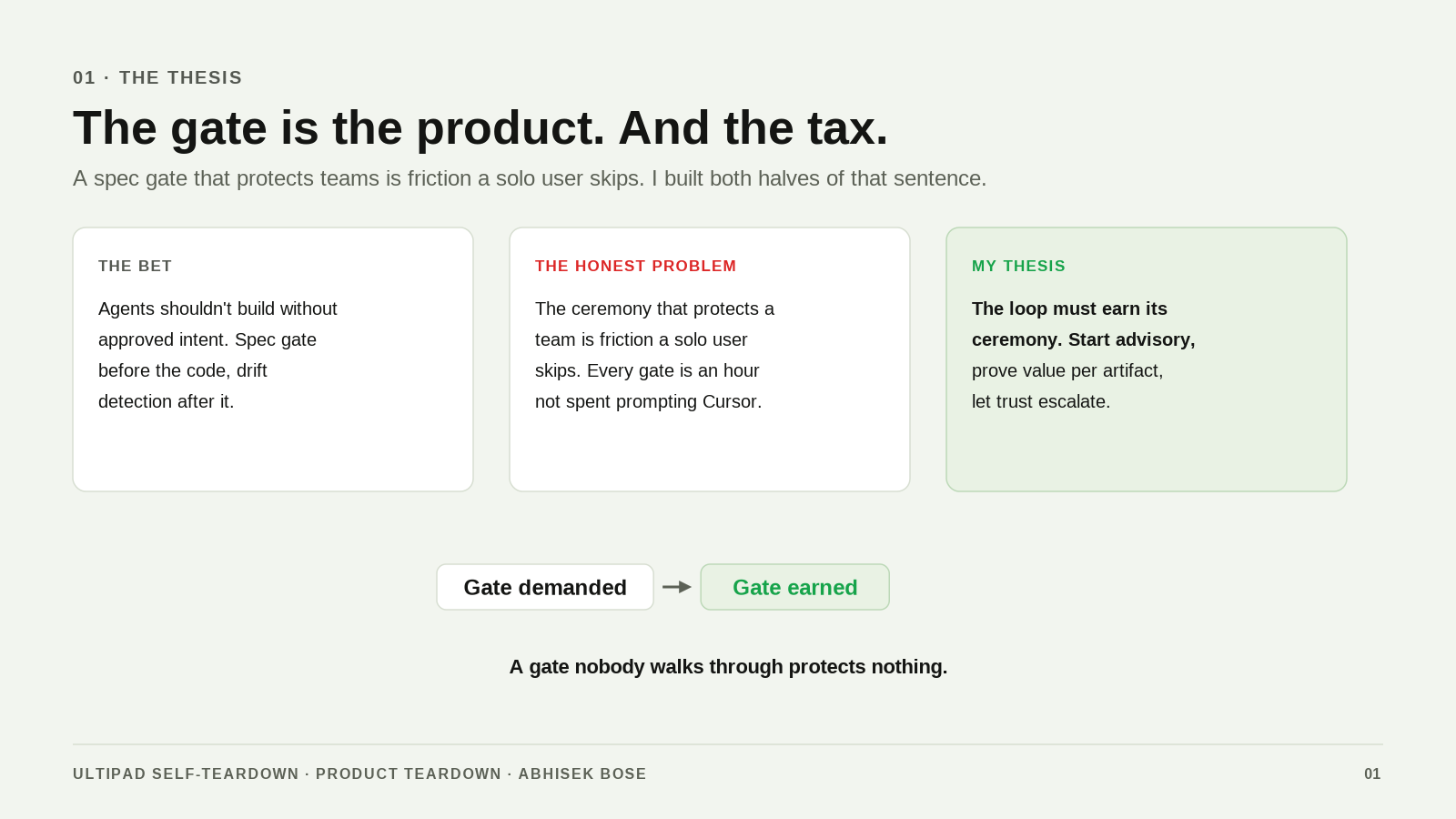
Ultipad (self-teardown)
12 min read
Does my own product survive the trust framework I judge everyone else by?
Ultipad: tearing down my own product with my own framework
Self-CritiqueADLCSpec-Drift DetectionAdoption Strategy
Read the teardown →
Product judgment, applied
Real AI products, analyzed the way I analyze my own: core loop, monetization incentives, evaluation architecture, and the redesign. Written from operating production AI systems, not from reading launch posts. Each teardown ends where it should — at the product where I work on the same problem.
Three kinds of claims: observed (documented behavior, public pricing) · inferred (my product analysis) · illustrative (modeled economics, marked inline as such).
Ultipad (self-teardown)
12 min read
Does my own product survive the trust framework I judge everyone else by?
The gate is the product and the adoption tax. A first-person teardown of Ultipad's cold-start problem, the bypass risk where adoption failure looks exactly like success, and the value-first inversion the roadmap needs. The conflicts of interest are total — which is exactly why the kill criteria are real.
Read the teardown →
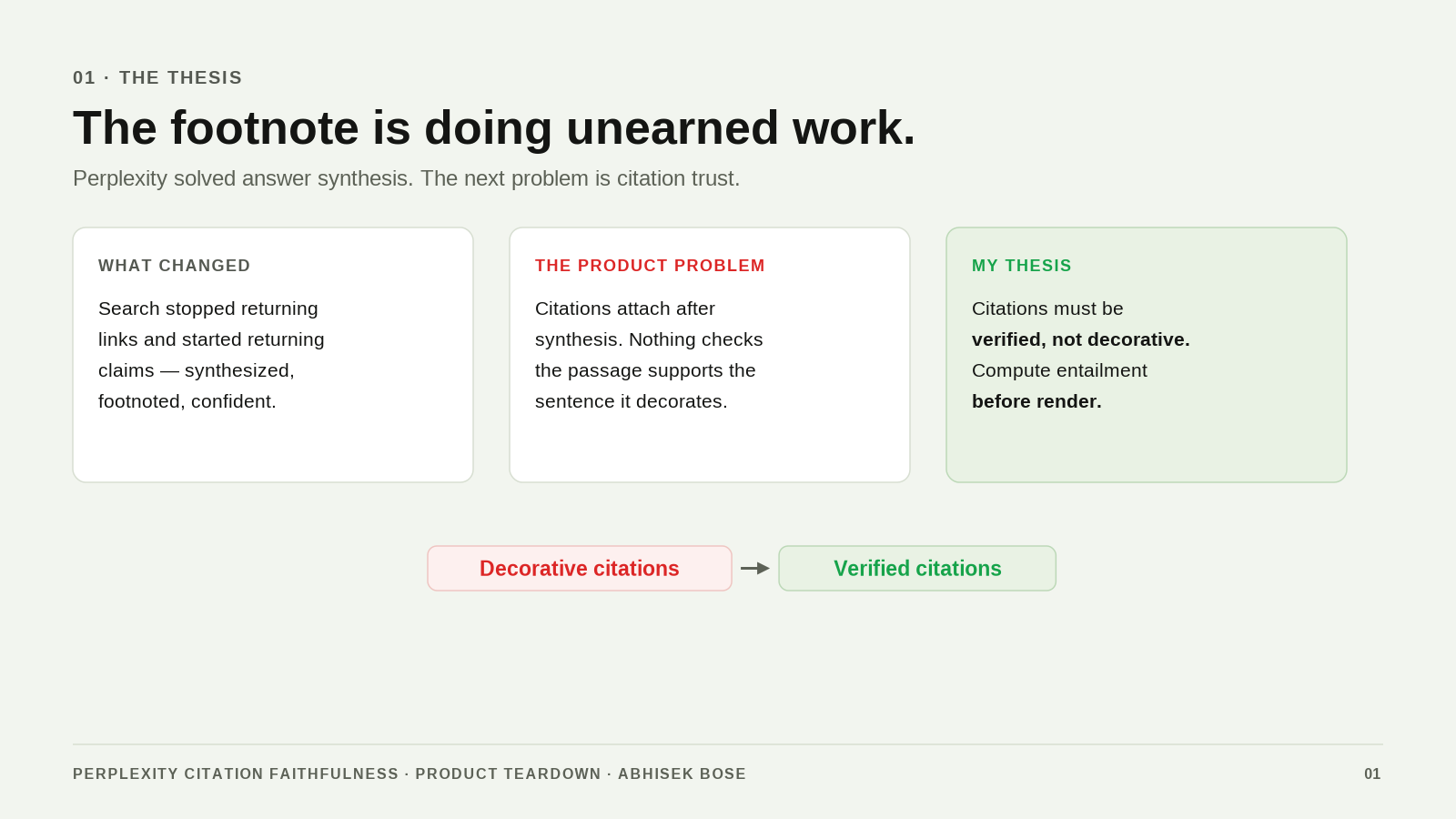
Perplexity AI
12 min read
Can a citation actually prove the claim it accompanies?
A citation next to a sentence and a citation that entails the sentence are different artifacts. Perplexity ships the first and gets credit for the second. Why faithfulness must move from unmeasured aesthetic to render gate — from someone who runs a production RAG pipeline.
Read the teardown →
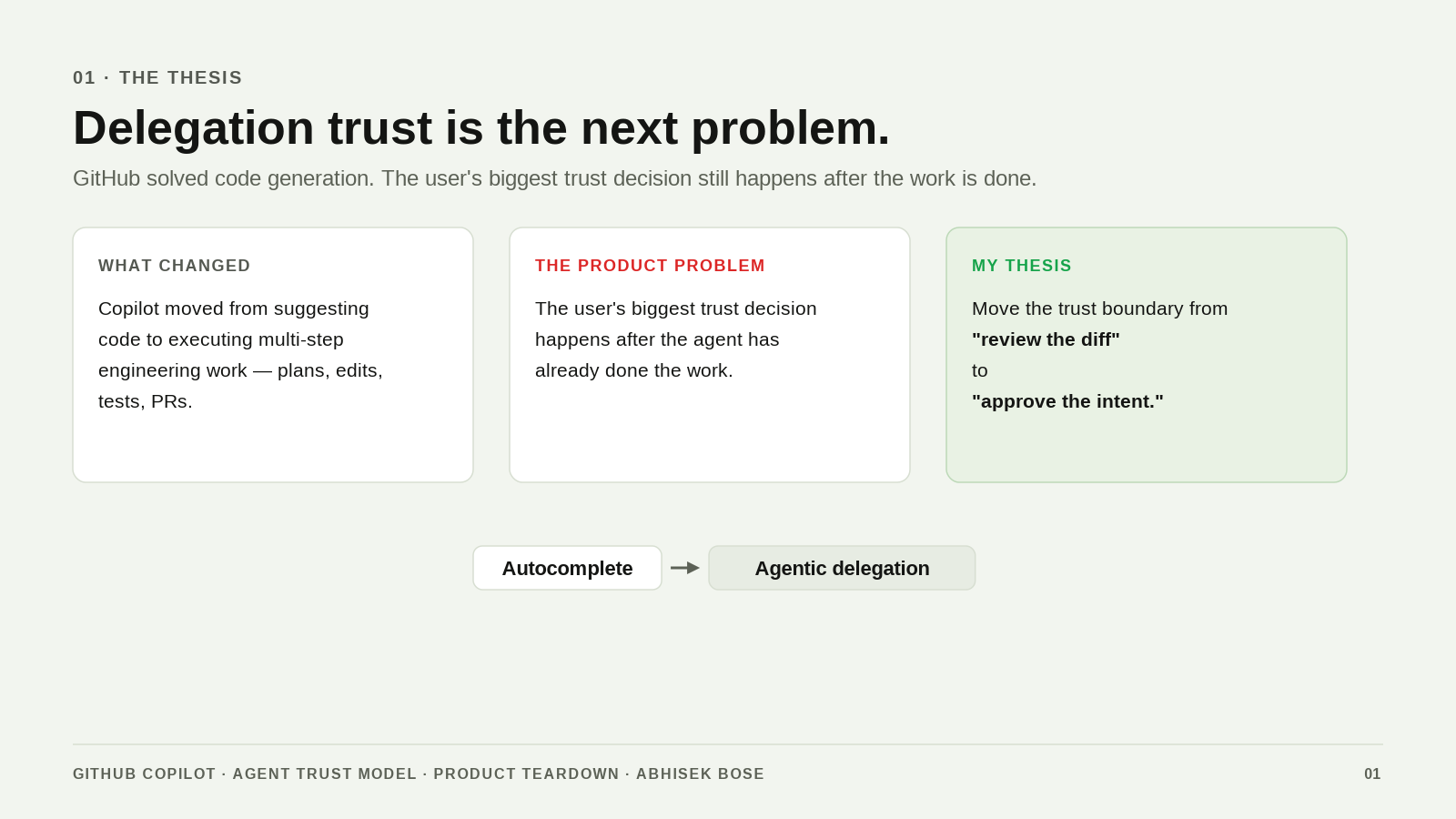
GitHub Copilot
12 min read
How do you know an agent built what you intended?
A 15-section teardown: product evolution, personas, JTBD, trust map, a concrete spec-divergence scenario — then the designed artifacts: an agent task spec, drift-detection interaction, measurement system, and the A/B experiment to validate it all. Approve intent, not archaeology.
Read the teardown →
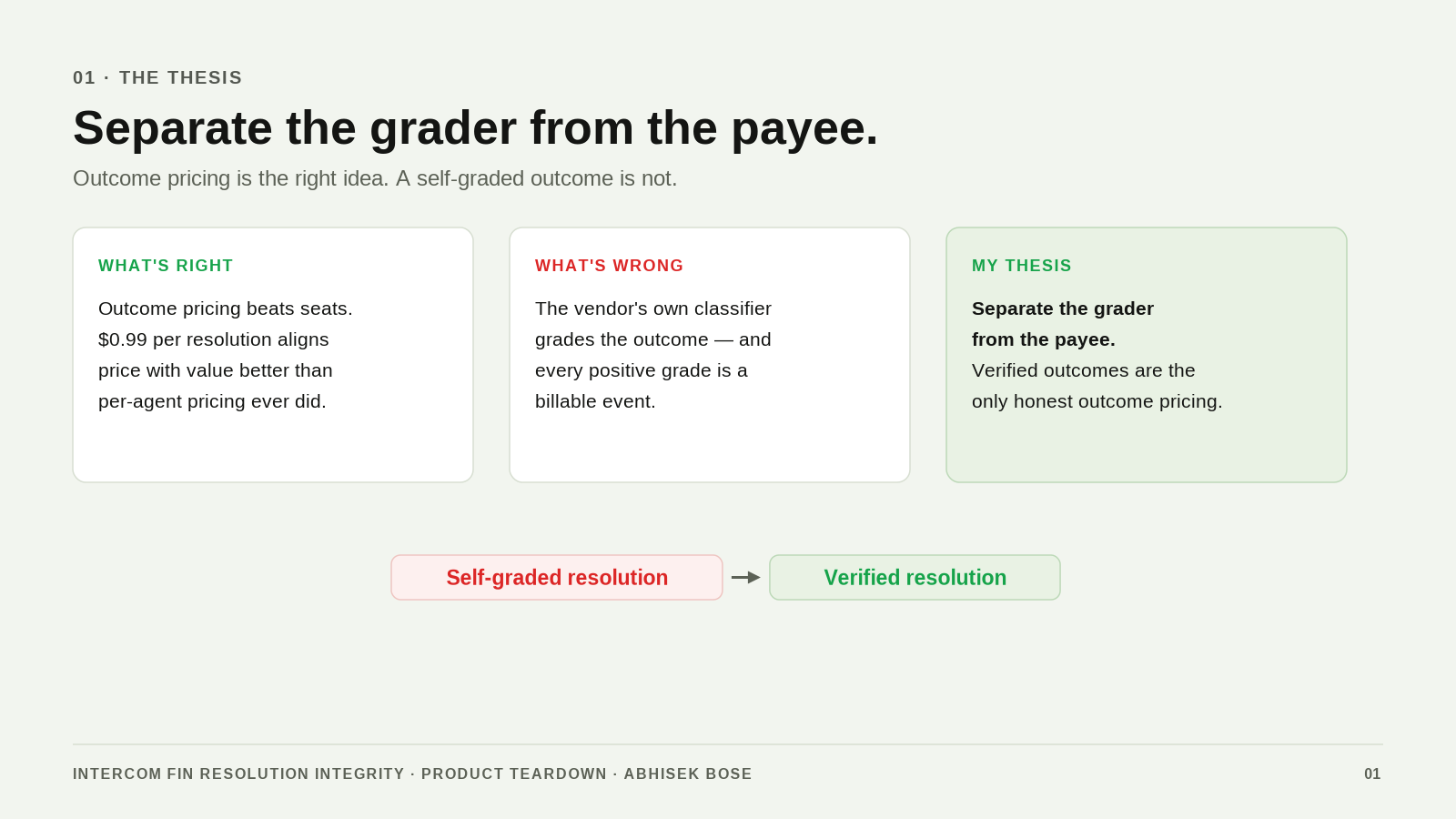
Intercom Fin
12 min read
Who should grade an AI outcome when that outcome determines the bill?
Resolution-based pricing is the right idea with the wrong measurement architecture: the billable event and the quality signal are the same metric, computed by the party getting paid. What a customer-auditable eval layer looks like — from someone who operates an AI support desk.
Read the teardown →
Cursor
12 min read
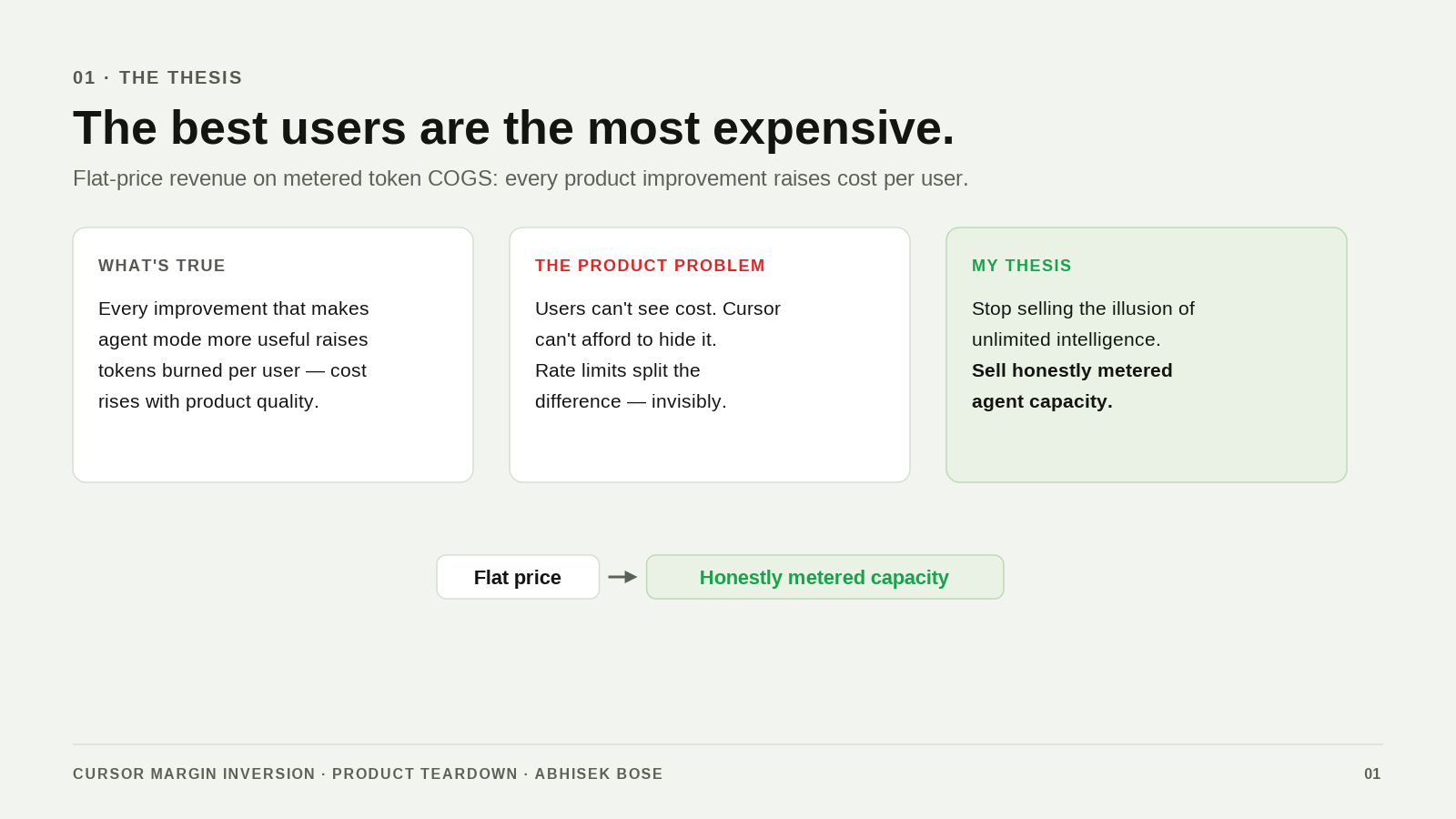
What happens when your best users are also your most expensive users?
Flat-price subscriptions on metered frontier-model token costs invert SaaS economics: the users who love the product most destroy gross margin. The 2025 rate-limit backlash was the symptom. The fix is honestly metered agent capacity — budgets, receipts, cost-aware routing.
Read the teardown →
Devin (Cognition)
12 min read
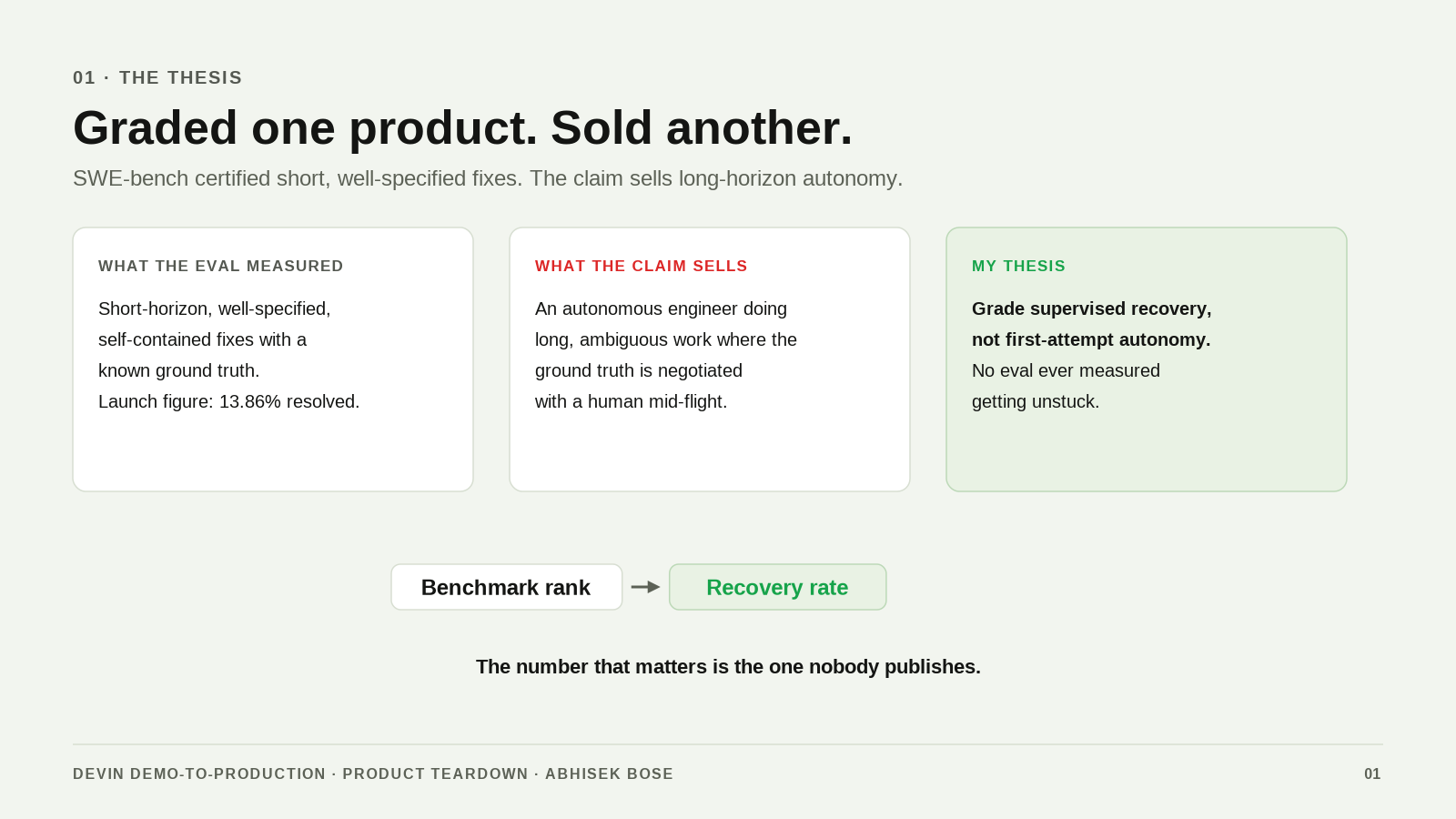
What does a benchmark prove about a product that ships into ambiguity?
SWE-bench grades short, well-specified fixes; "autonomous software engineer" describes long, ambiguous work. Cognition graded the first product and shipped the second. Production competence is failure recovery, not first-attempt success — and no benchmark awards points for asking.
Read the teardown →
Salesforce Agentforce
12 min read
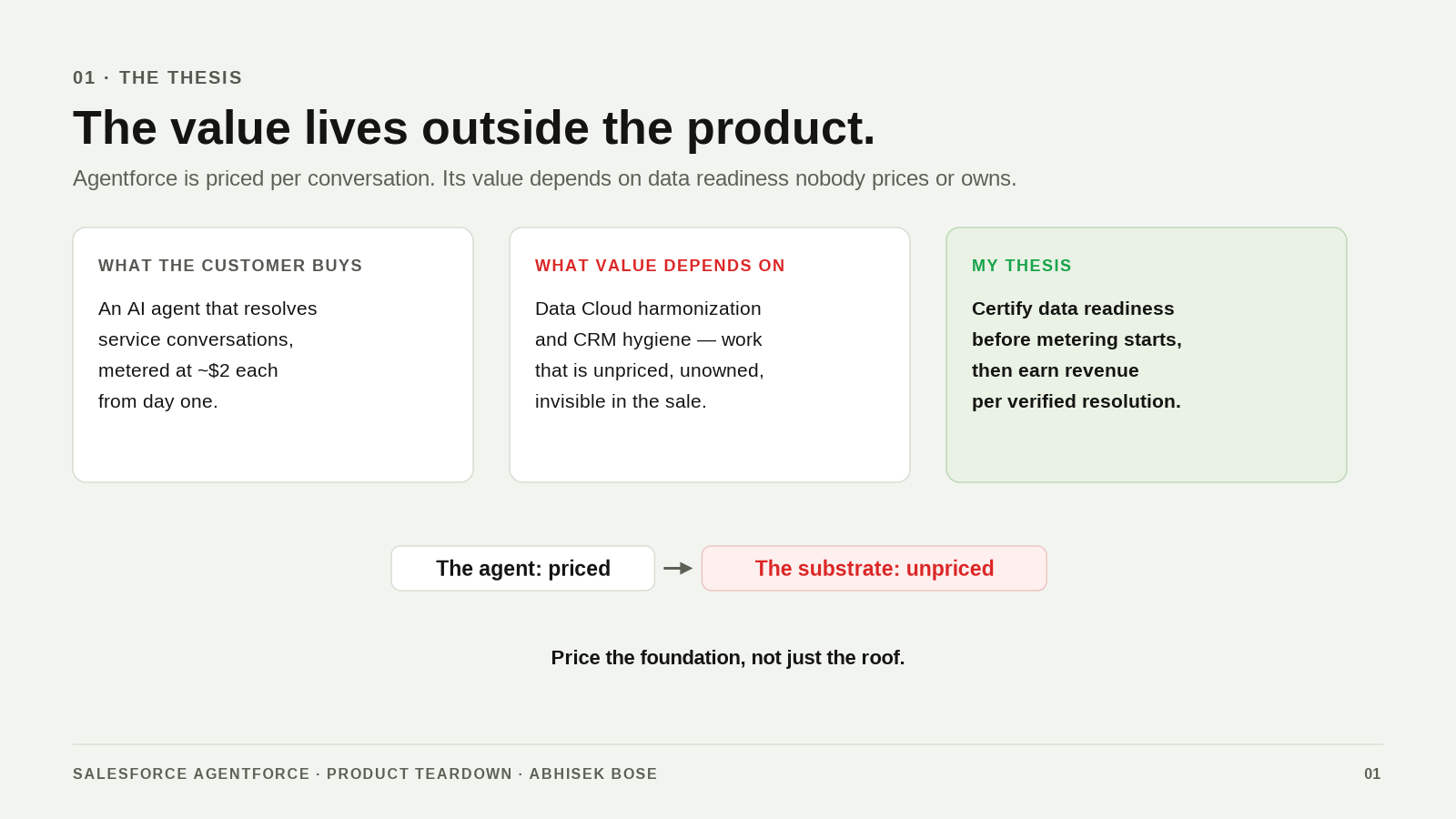
What is an agent worth when nobody owns the data it depends on?
Agent value depends on Data Cloud harmonization and CRM hygiene that nobody prices or owns, while $2-per-conversation metering starts on day one and agents cannibalize the Service Cloud seats Salesforce also sells. Guardrails check permissions, not correctness — governance theater, not alignment.
Read the teardown →
Zapier AI
12 min read
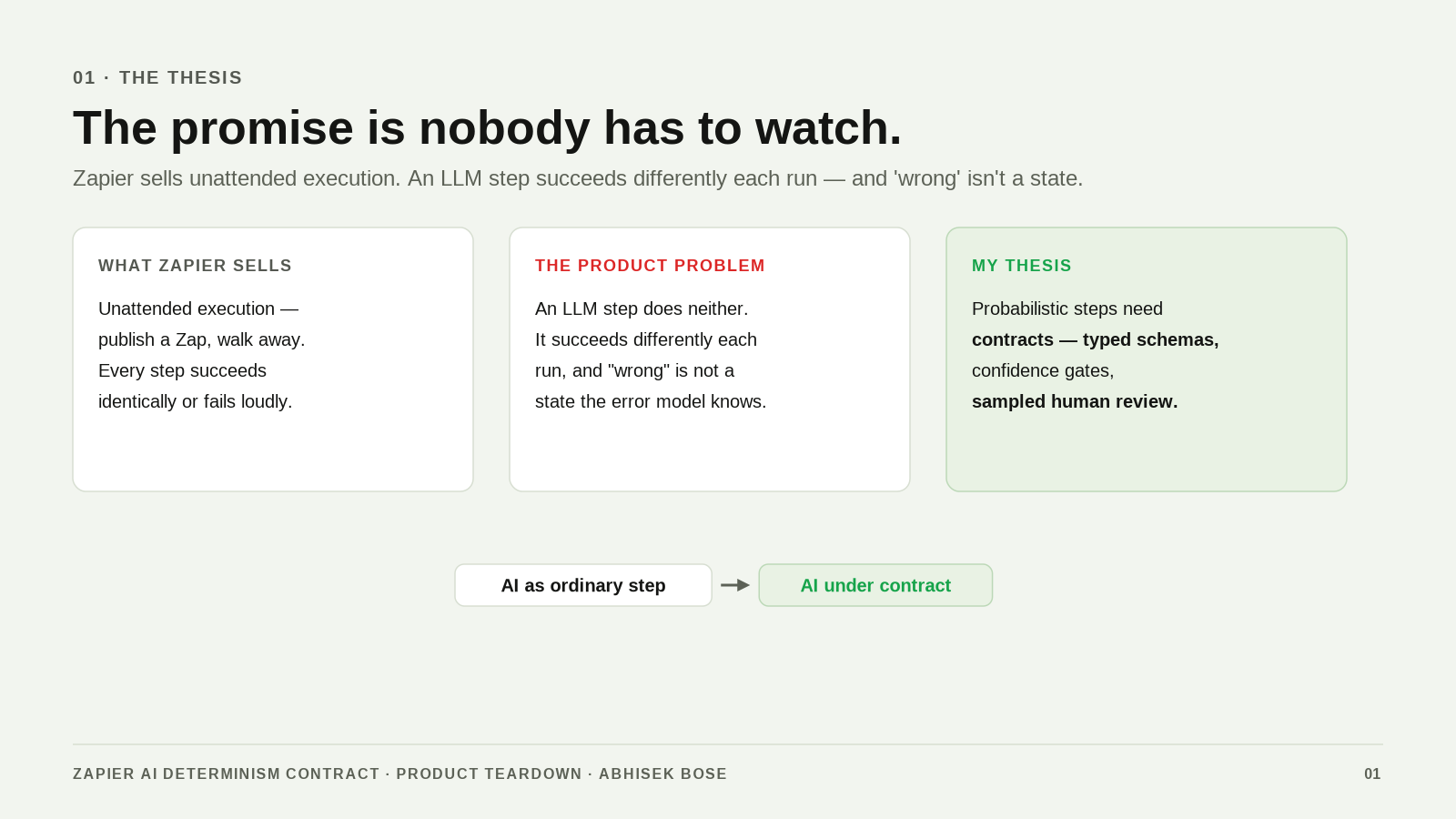
Where do probabilistic components belong in a product that promises determinism?
Automation's contract is unattended execution — every step succeeds identically or fails loudly. An LLM step does neither: it succeeds differently each run, and the error model has no vocabulary for "ran fine, output was wrong." Probabilistic steps need contracts: schemas, confidence gates, sampled review.
Read the teardown →
Grammarly
12 min read
What does a writing company own when writing itself is generated?
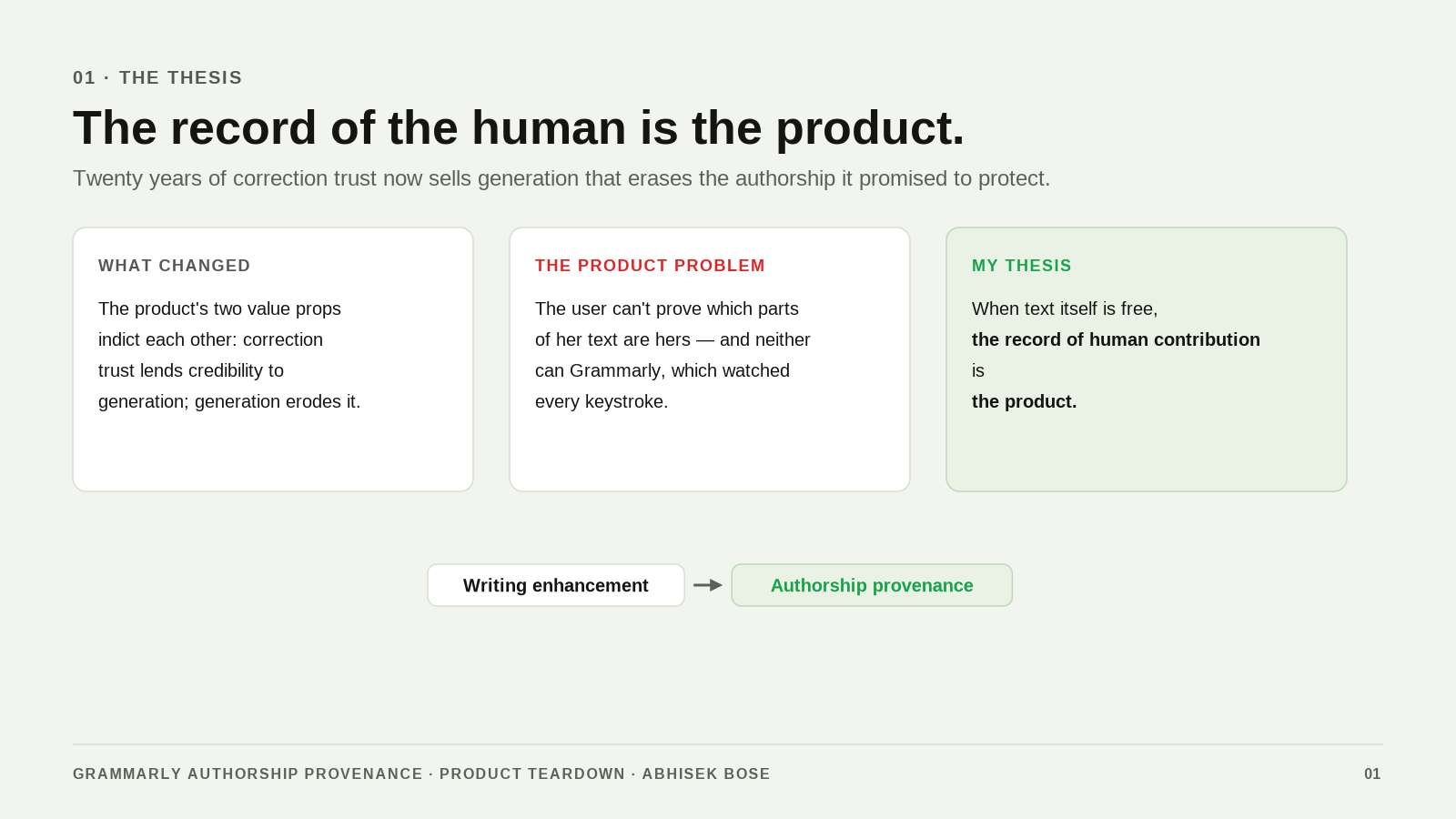
Twenty years of trust said "still your voice, made correct." Generative AI says "we write it for you" — and the schools that seeded the brand now run detectors against its output. The defensible asset is provenance, and Grammarly shipped it as a buried checkbox called Authorship.
Read the teardown →