Claude broke the ADLC spec-driven development in UltiPad. Then our own AI decision layer — co-powered by Jev AI (TypeSafe) — caught it.
We built a guard inside UltiPad that checks every AI-generated commit against the approved product spec.
- 89% aligned → pass.
- 25% aligned → drift flagged.
Before code review. Not after.
And the twist? The guard was built by the same AI-native workflow it now governs. AI building the system that keeps AI on-spec.
A typed decision model, not a chatbot
Under the hood, we're using Jev AI (TypeSafe) — not as a chatbot, but as a typed decision model. It returns a probability, not a paragraph. That makes it fast and cheap enough to evaluate every commit. Running a full LLM in this loop would be too slow and expensive.
We already knew how much AI-generated code we were shipping per idea. Now we can measure something more important: did the AI actually build what we asked for?
Still early. Still beta. But watching an agent catch its own drift in real time is a pretty interesting moment.
The real problem
The interesting problem isn't "AI writes code." We already know that. The problem is AI can write a lot of code that is technically correct but strategically wrong. A PR can pass tests. The code can look clean. The build can succeed. And the agent can still have drifted away from the original product intent.
That's the gap we're experimenting with in UltiPad:
Spec → AI Agent → Commit → Intent Check → Feedback
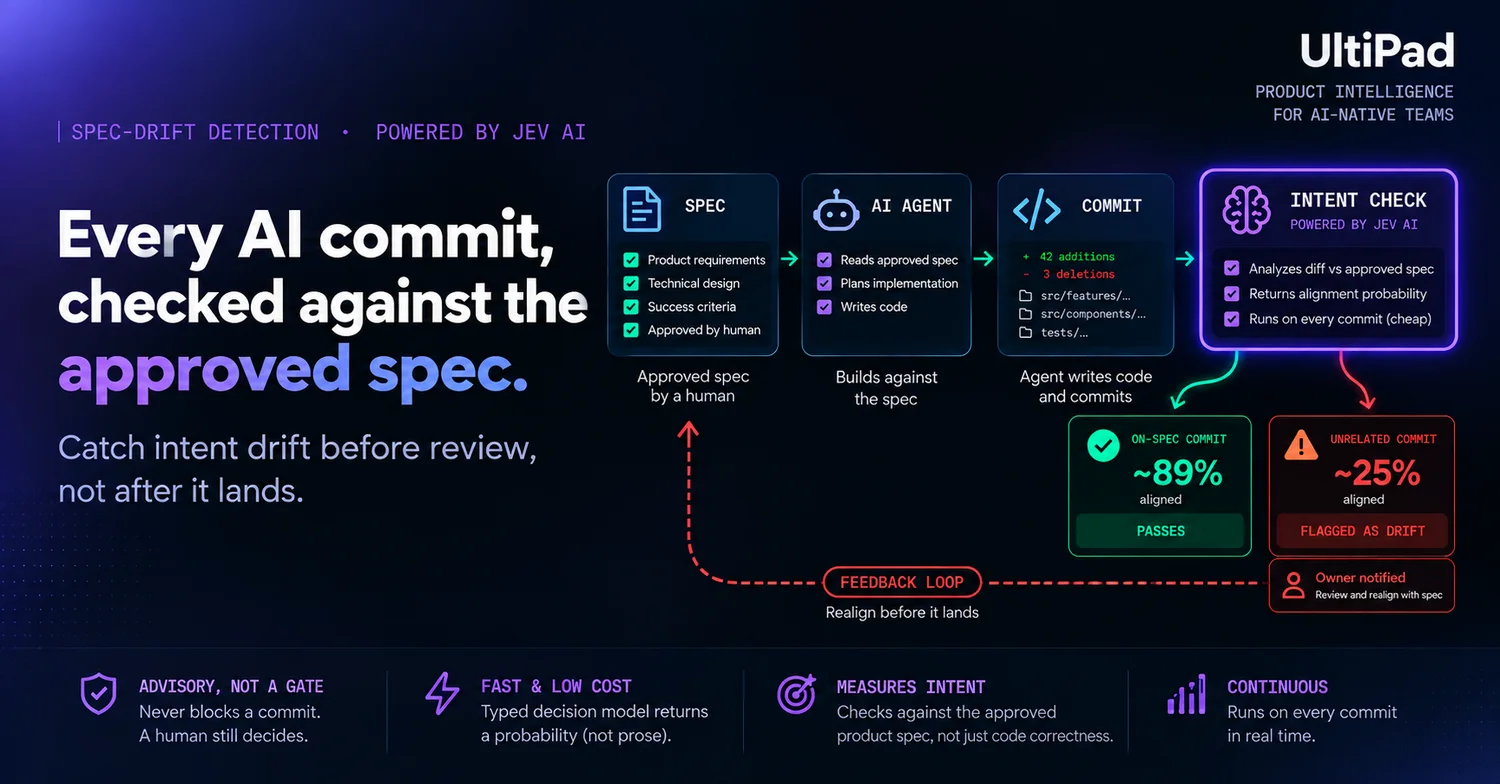
The goal isn't to replace code review. It's to catch product-intent drift before the review queue. Early beta, so we're still learning where probability-based intent checking works — and where it doesn't.
Originally published on LinkedIn. See spec-drift detection in the Ultipad case study.