Scenario: Tear down Zapier AI — AI steps, Copilot, and Zapier Agents inside the automation platform — and design the contract that probabilistic steps need before they're allowed to run unattended.
01 · The thesis
Zapier's contract with the user is unattended execution: publish a Zap, walk away, and every run either succeeds identically or fails loudly.
What changed: LLM steps entered the pipeline. An LLM step does neither of those things. It succeeds differently each run, and the platform's error model has no vocabulary for "ran fine, output was wrong."
The product problem: Zapier bolted a probabilistic component onto a deterministic runtime without giving it a contract — so failures are invisible by design, not by accident.
My thesis: probabilistic steps need contracts — typed output schemas, confidence gates, and sampled human review — before they earn the right to run alone.
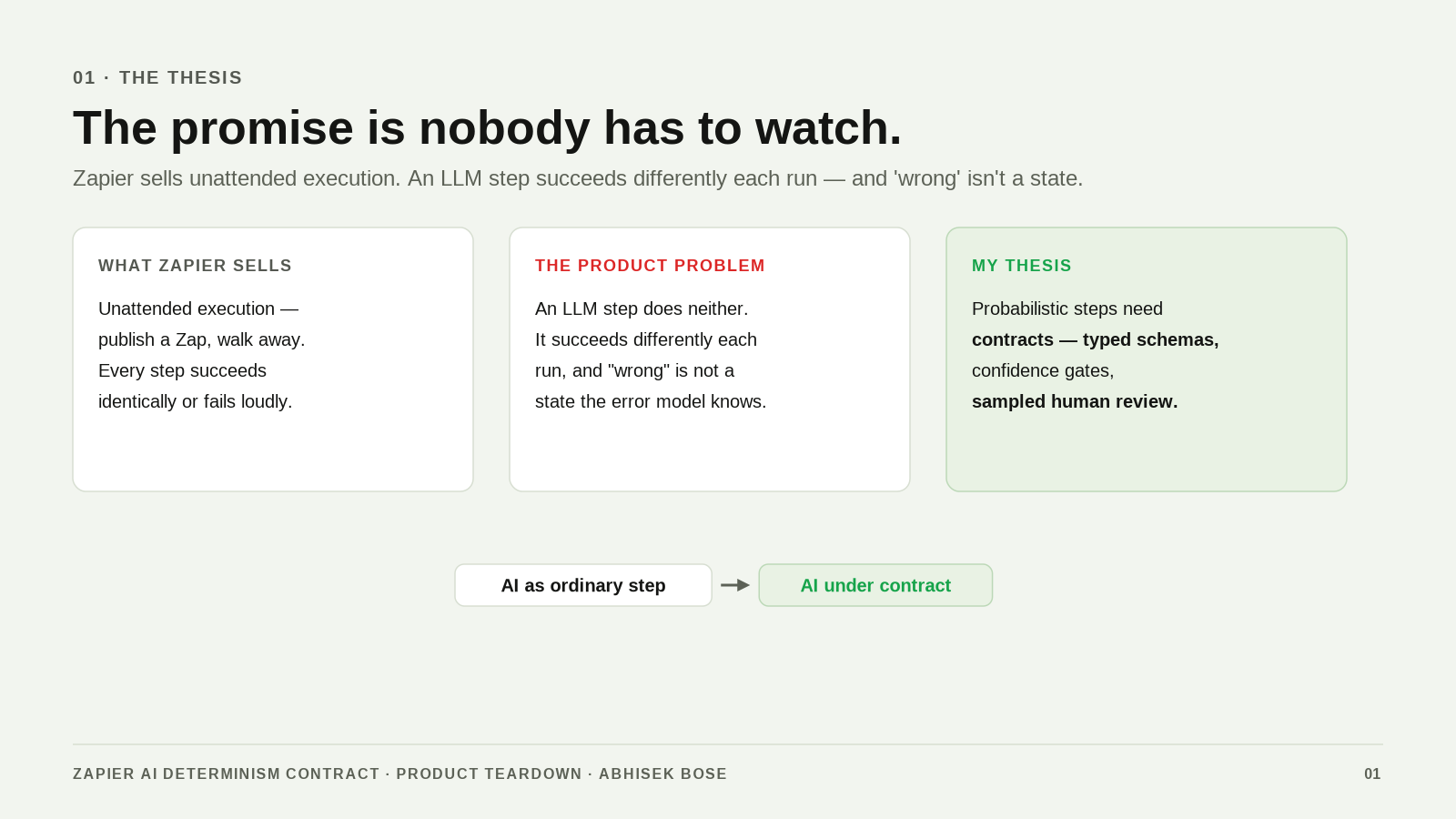
One screen: the promise, the component that breaks it, and the contract that fixes it.
02 · Product evolution
Zapier's own history is the argument. Each era expanded what the system does — and quietly degraded what the system can guarantee:
| Era | User does | System guarantees | Error model |
|---|---|---|---|
| Single-step Zaps | Wires trigger to action | Same input, same output | Crash or succeed |
| Multi-step + Paths | Designs branching logic | Deterministic routing | Crash or succeed |
| AI by Zapier steps | Writes a freeform prompt | Something is emitted | Crash or succeed — wrong isn't a state |
| Copilot authoring | Describes the Zap | Human reviews before publish | Caught at build time |
| Zapier Agents | Delegates goals | Autonomous multi-action runs | Crash or succeed, multiplied |
The guarantees column collapsed at row three and nobody updated the error model. Copilot is the exception — its AI runs upstream of publish, where a human still checks.
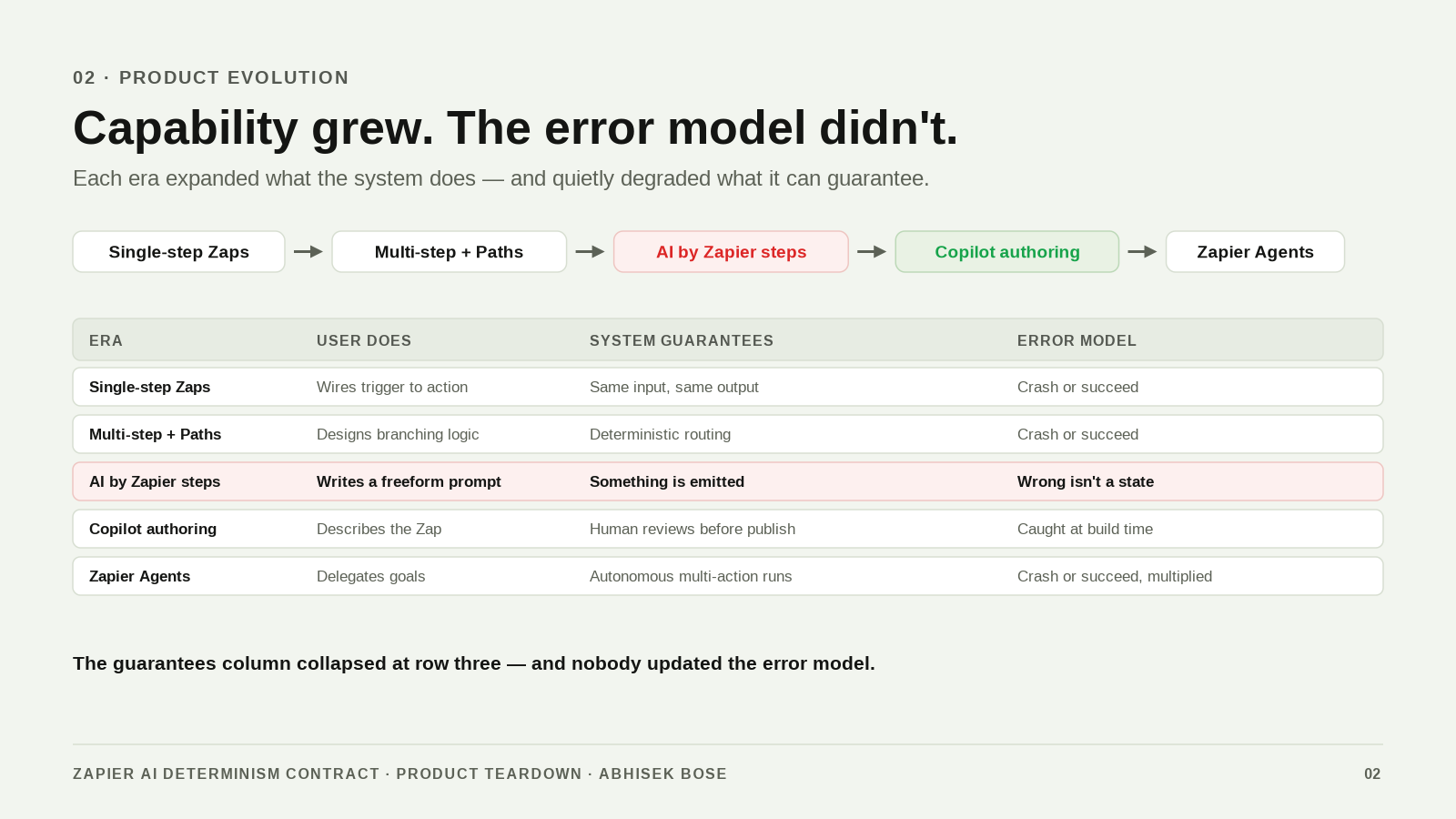
Capability grew five eras. The error model never left era one.
03 · Who actually has this problem
Not "Zapier users." Three personas, three very different abilities to validate an AI step's output:
- Technical ops engineer — job: automate internal tooling across services he owns. Validation capability: high — he can bolt webhook checks and validation scripts onto anything. He's annoyed, not exposed.
- Non-technical RevOps manager — job: own the lead-routing Zap end to end. Validation capability: none — she cannot write a validation script and will not read run logs daily. She's the exposed one.
- Agency bulk-builder — job: ship dozens of client Zaps a month. Validation capability: low per Zap — validation doesn't scale across a portfolio, and a silent failure lands in a client's CRM.
The pattern: the less able the owner is to validate output, the more the platform's silence costs. Zapier's current model serves the persona who needs help least and quietly exposes the two who pay for volume.
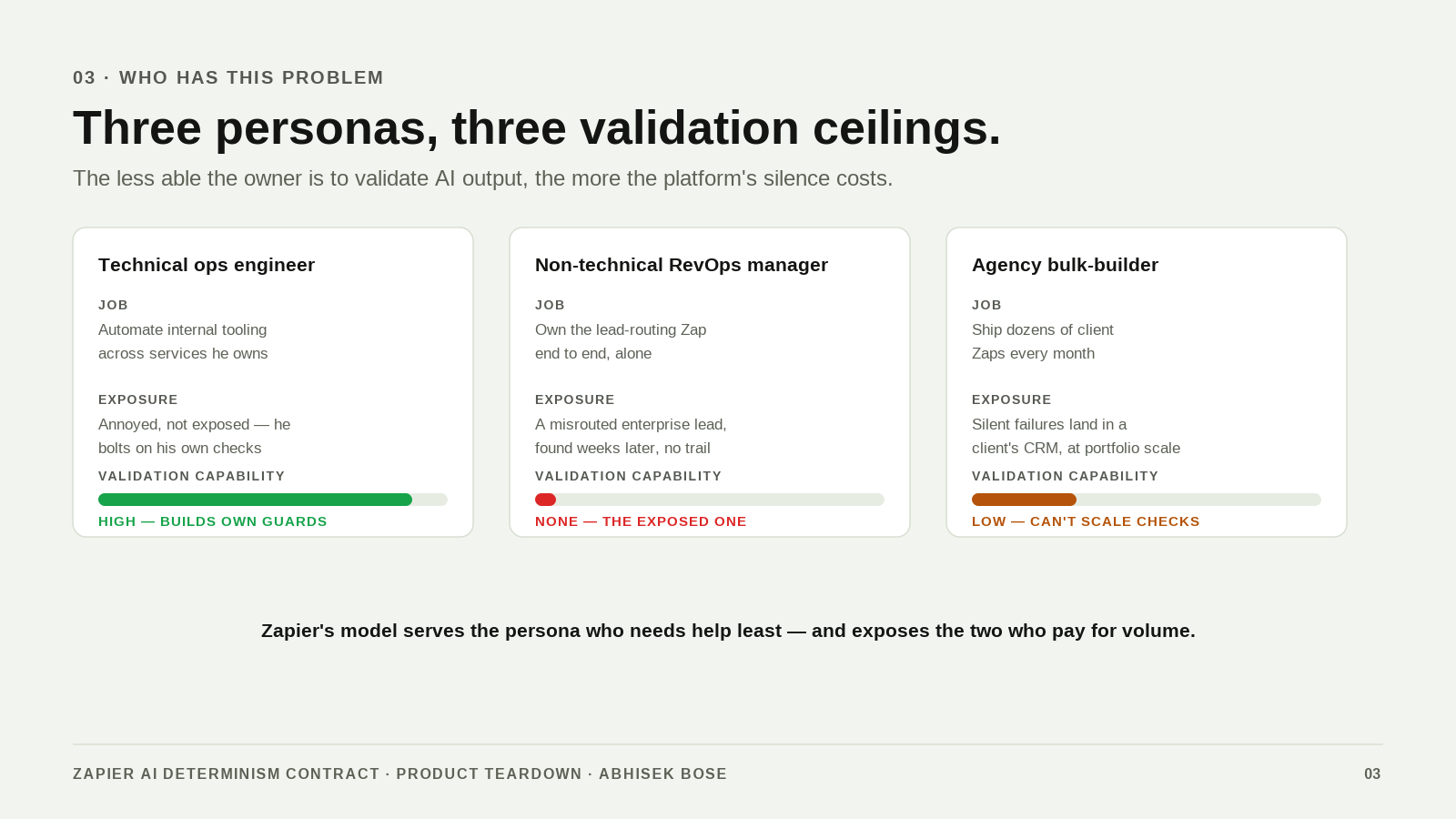
Exposure is inversely proportional to validation capability — and the platform validates nothing for you.
04 · Jobs to be done
Functional JTBD: when data moves between my tools, I want the handoff automated so nobody re-keys anything.
Emotional JTBD: I want to stop checking. The entire payoff of automation is attention freed.
Trust JTBD: I need to know the AI step's output was right when nobody was watching.
The third one is the missing job. Zapier ships the functional job brilliantly, sells the emotional job as its core promise — and the trust job has no product surface at all. Worse: the emotional job (stop checking) actively removes the only safety net the trust job relies on (someone checking).
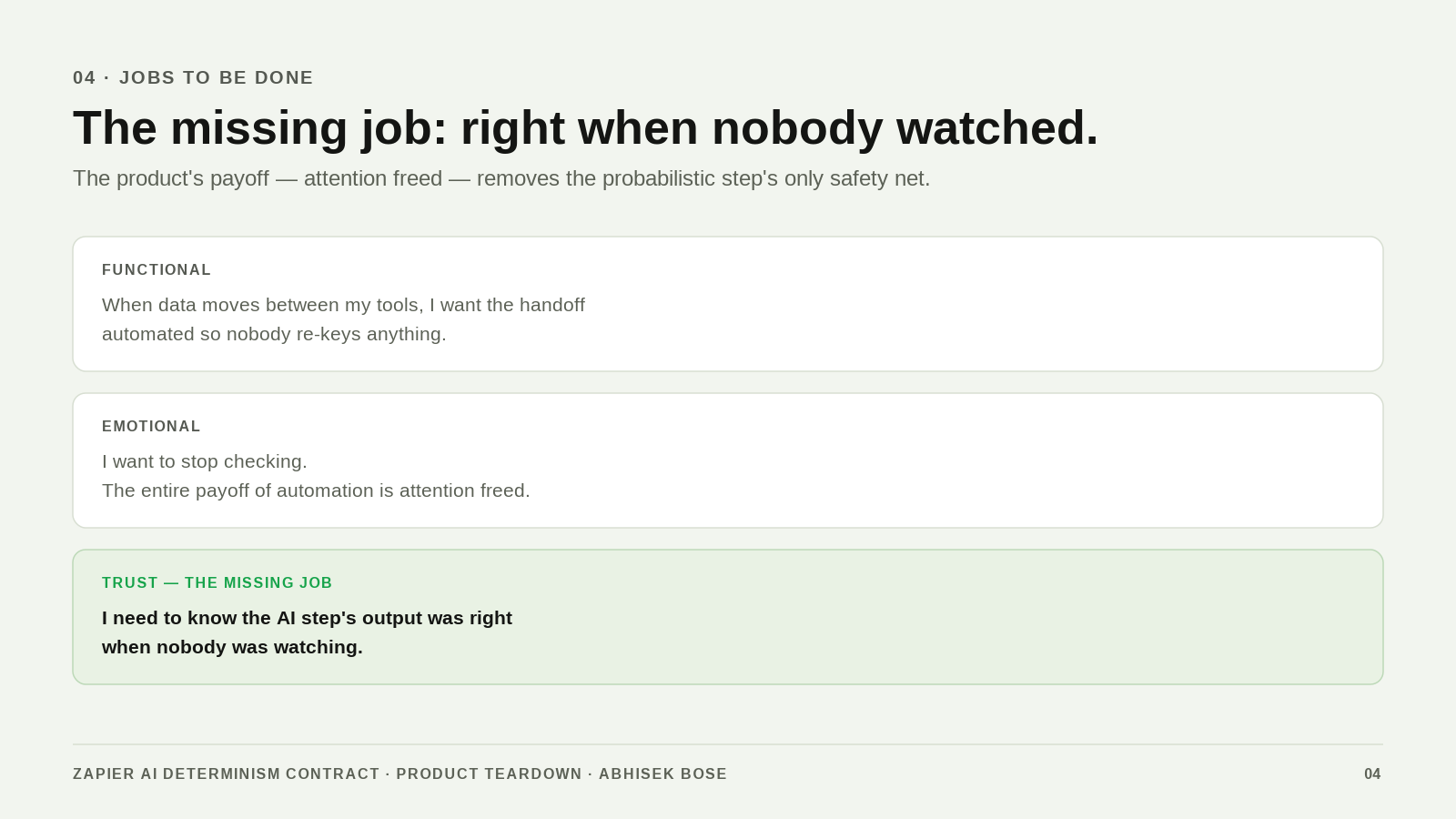
The product's payoff — attention freed — is exactly what removes the probabilistic step's safety net.
05 · How the product actually works
A published Zap is real unattended infrastructure. The trigger fires, steps execute in order with no human present, the AI step emits free text that downstream steps consume as if it were structured data, the CRM write lands, and run history records Success — because every step returned without erroring.
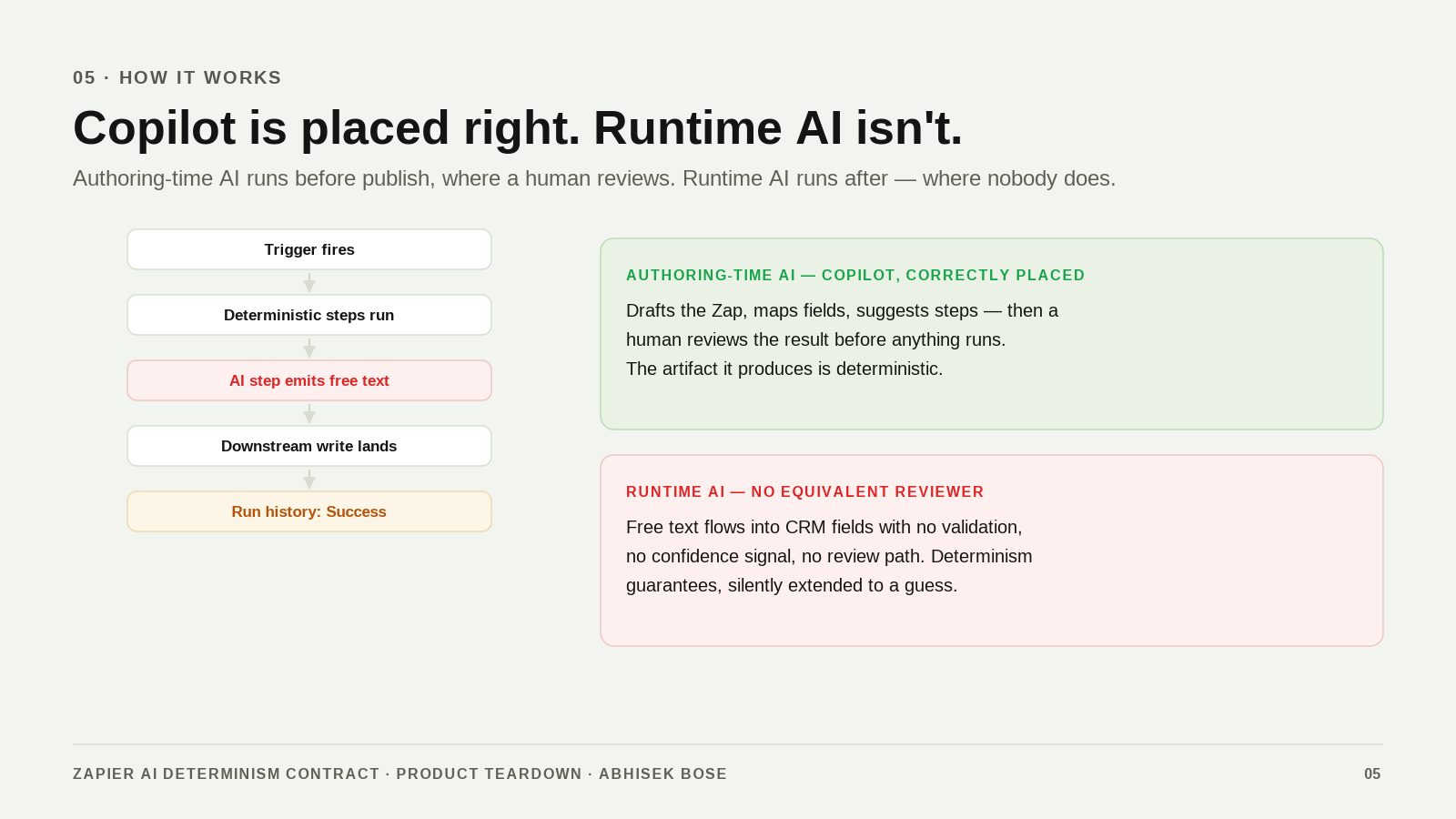
Copilot's AI runs before publish, where a human reviews. Runtime AI runs after — where nobody does.
Notice the placement asymmetry. Copilot at authoring time is correctly placed: it drafts the Zap, a human reviews the result, and the artifact it produces is deterministic. Runtime AI has no equivalent reviewer — the platform extends its determinism guarantees to a component that cannot honor them.
06 · Where trust actually lives
Map the trust decisions across one unattended run and the problem becomes visible:
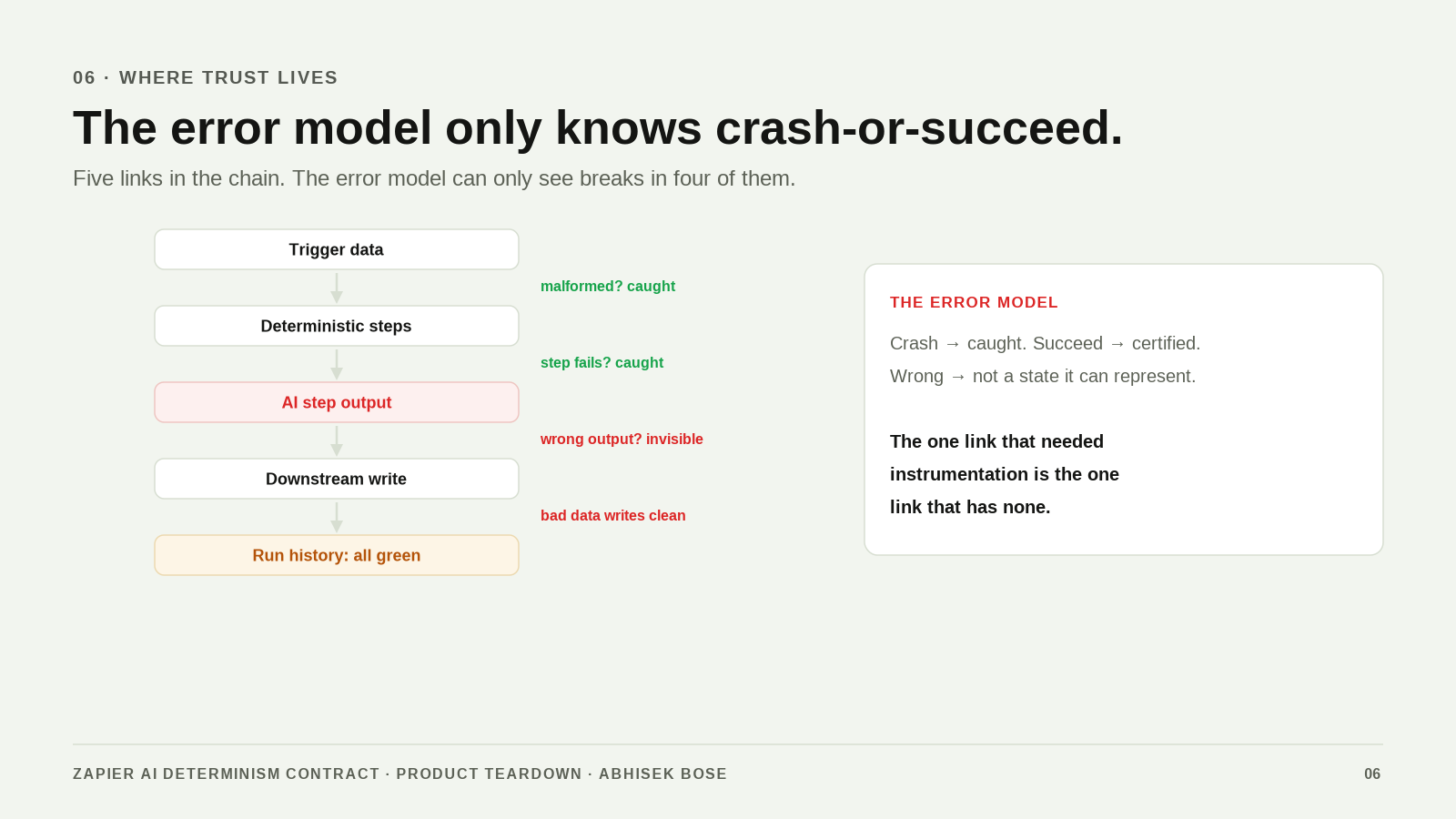
Five links in the chain. The error model can only see breaks in four of them.
Trigger data can be malformed — caught, the step errors. A deterministic step can fail — caught, the run halts. The AI step's output can be wrong — not caught, because wrong is not a state the error model knows. The downstream write succeeds with bad data, and run history certifies the whole run. The one link that needed instrumentation is the one link that has none.
07 · The real product gap — a concrete scenario
A RevOps manager runs a lead-routing Zap: form fill → AI step classifies the lead by segment → CRM write → rep assignment.
An enterprise lead comes in. The AI step tags it "SMB." The CRM write succeeds — the field got a valid-looking string. The lead routes to the SMB queue. No rep calls, because the SMB queue is triaged weekly. Run history shows every run green for three weeks, because every run was green — by the only definition the platform knows.
The failure surfaces as "why did nobody follow up on the enterprise lead," with no trail back to the AI step that caused it. A five-figure pipeline loss (illustrative estimate), billed as a successful task.
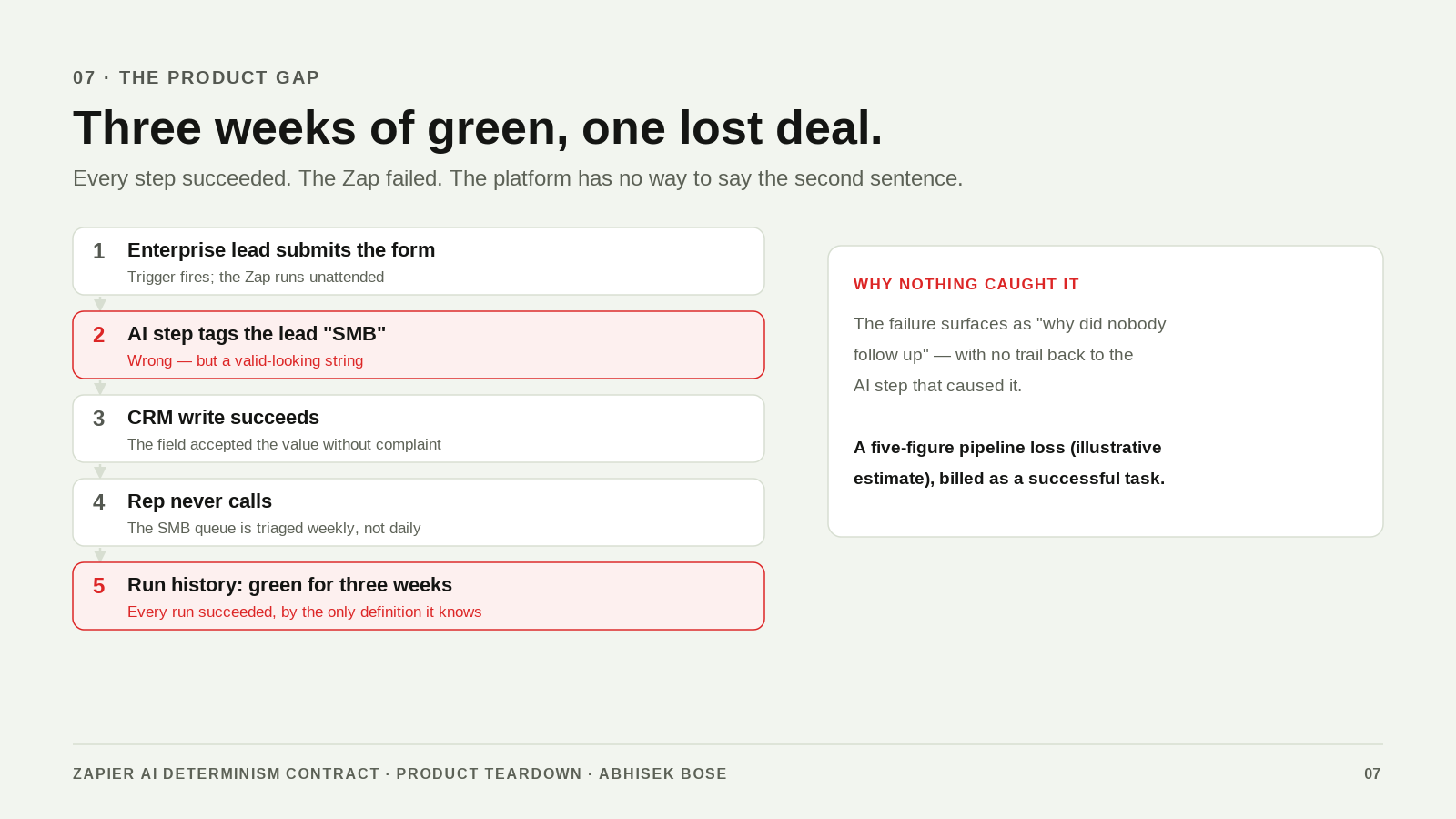
Every step succeeded. The Zap failed. The platform has no way to say the second sentence.
08 · Current vs proposed
Current: AI steps are ordinary steps. Same editor, same success semantics, same monitoring, no output contract. Free text flows into CRM fields at full speed.
Proposed: AI steps become a distinct step class with mandatory contracts — typed output schema validated on every run, confidence exposed as a routable value, a required fallback path for schema violations, and sampled human review in run history. Copilot stays frictionless; runtime AI pays a small setup tax for the right to run unattended.
An automation that fails loudly is an inconvenience. An automation that fails quietly is a liability with a monthly invoice.
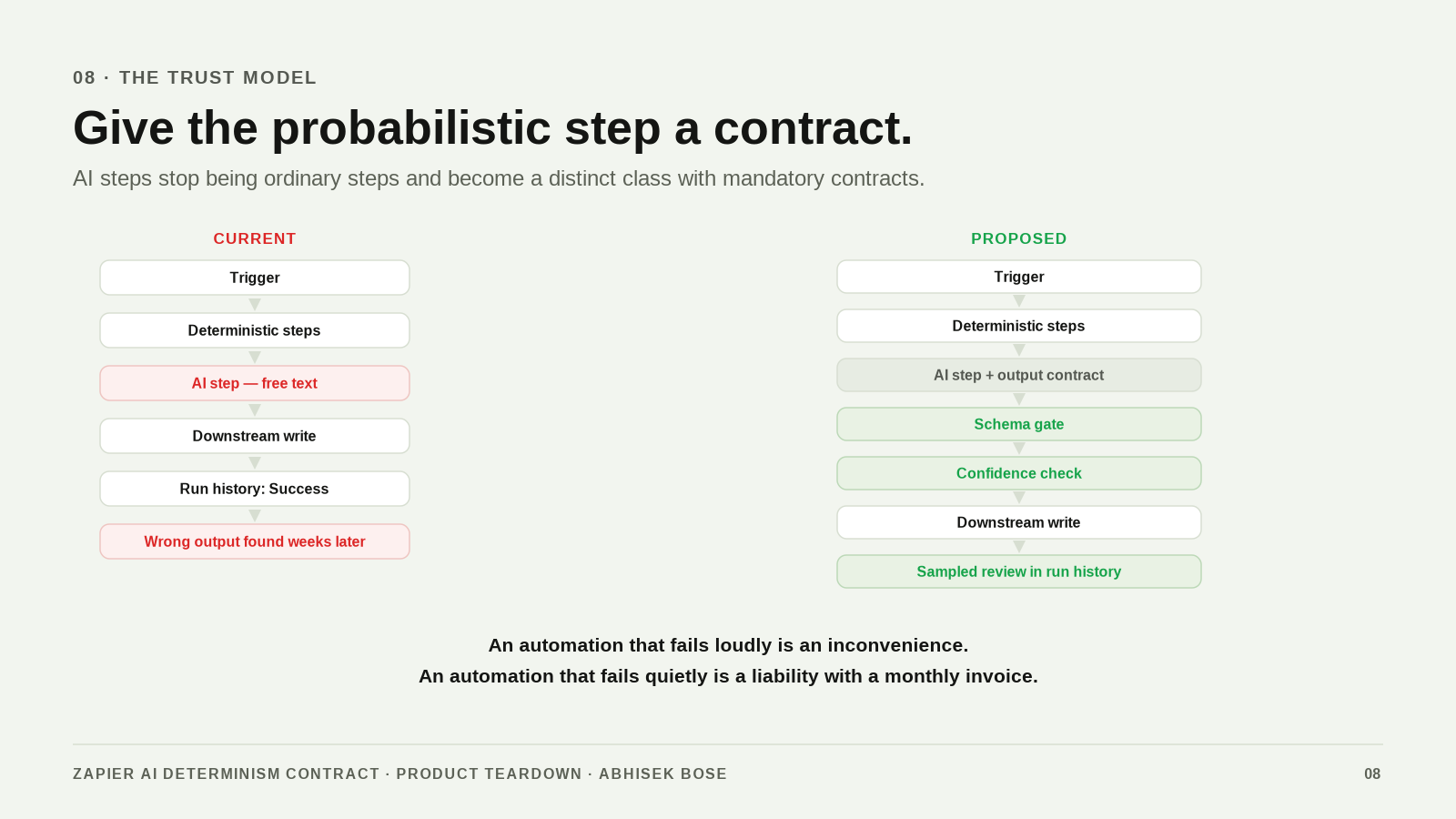
The boundary between deterministic pipeline and model output becomes an enforced interface, not an honor system.
09 · The artifact: the output contract
"Add validation" is hand-waving unless you design the object. This is the AI step's config panel with a contract attached — one screen, three decisions, all mandatory before publish:
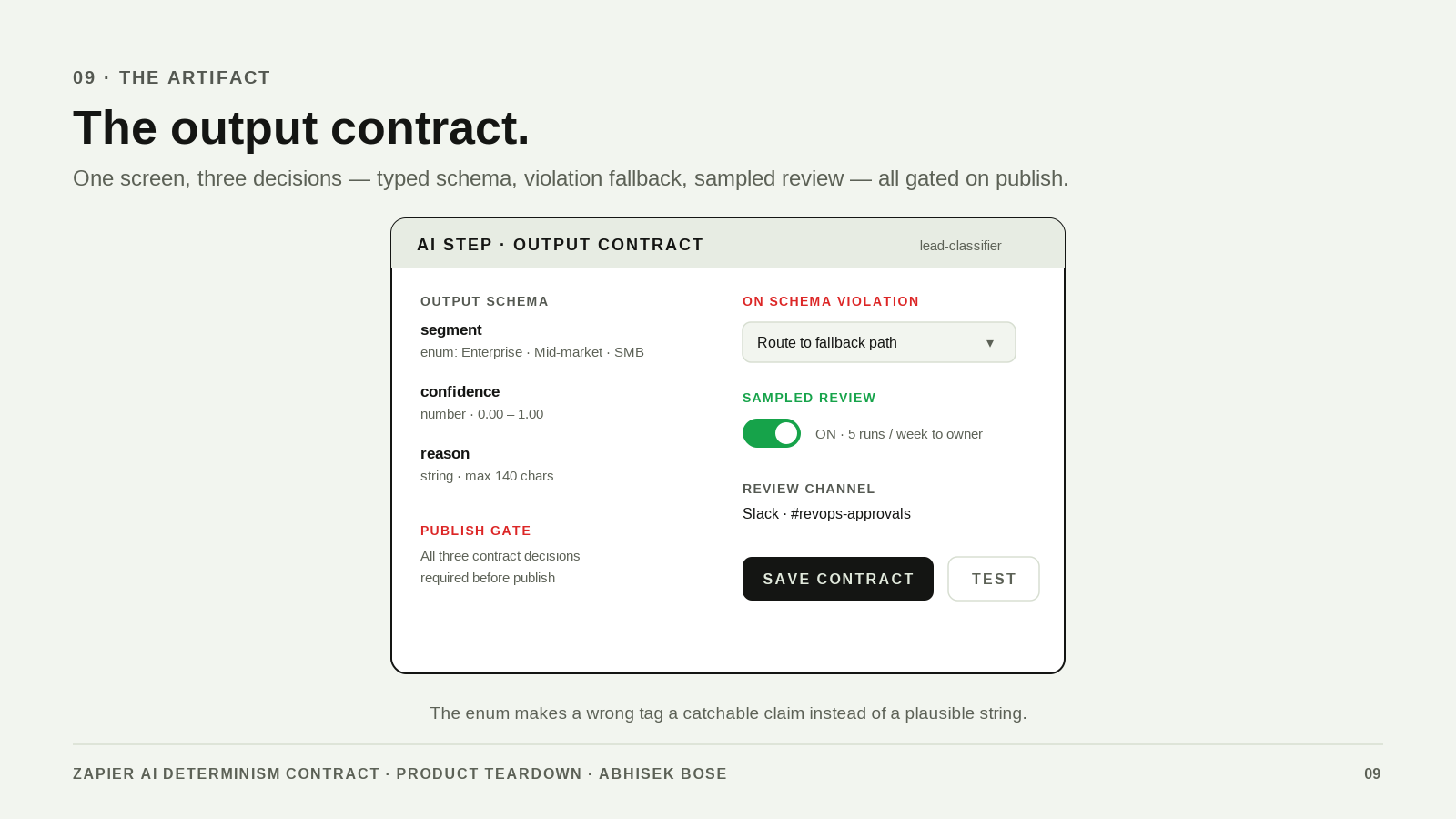
The contract object: typed schema, violation fallback, sampled review. Publish is gated on all three.
Every field earns its place: the enum makes "SMB" for an enterprise lead a catchable claim instead of a plausible string, the confidence field turns model uncertainty into a routable value, the fallback selector decides where violations go instead of letting them crash or pass, and the sampled-review toggle keeps a human in the loop at a cost the owner controls. I run this exact split in Unify V6: a deterministic LangGraph pipeline owns the known path, DeepAgents own the open-ended one, and they operate in separate workspaces — the probabilistic side never writes where the deterministic side's guarantees apply. The pattern is buildable today; what's missing at Zapier is the product decision to make it mandatory.
10 · Confidence routing — the interaction
The contract isn't documentation, it's a runtime gate. When the AI step's confidence lands below threshold, the output doesn't write downstream — it routes to an approval queue:
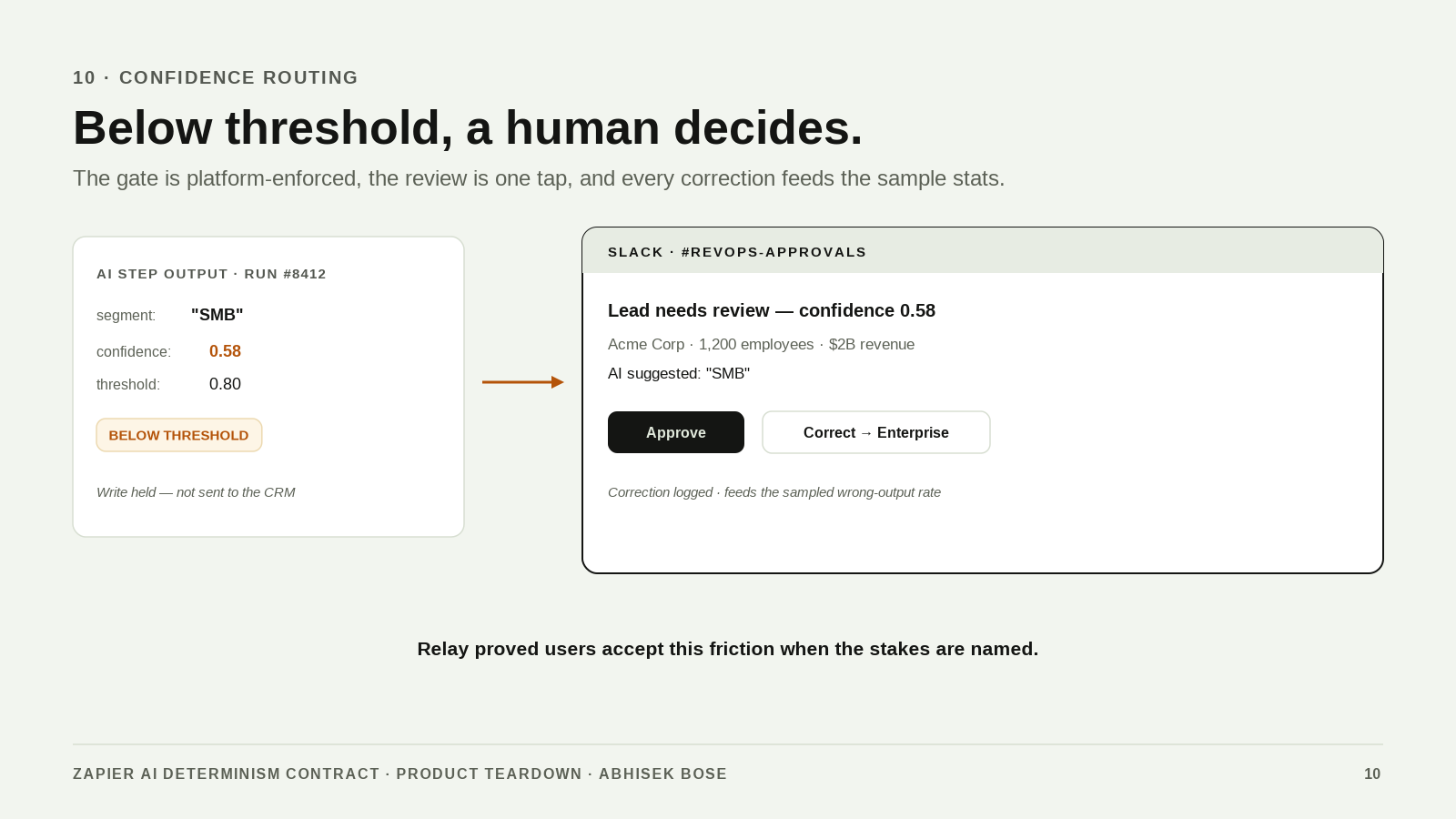
Below threshold, the run pauses in Slack — one tap to approve, one tap to correct, and the correction feeds the stats.
Three properties matter: the gate is platform-enforced (not a prompt instruction the model can ignore), the review is one tap (Relay proved users accept this friction when the stakes are named), and every correction is logged — the wrong-output rate stops being invisible and becomes a trend line on the Zap's health view.
11 · Category view: automation trust models
Comparing Zapier vs Make vs n8n feature-by-feature misses the point. Compare the trust model each pattern ships for AI in the pipeline:
| Product pattern | Trust model |
|---|---|
| Deterministic-only (classic Zapier, Make) | Tested once, trusted forever — and it holds |
| AI steps as ordinary steps (Zapier today) | Deterministic guarantees silently extended to a probabilistic component |
| Human-in-loop-first (Relay) | A human approves every AI output — safe, but caps the scale |
| Contracted probabilistic steps | Schema-gated, confidence-routed, sampled — trusted because it's checked |
Relay made the right diagnosis and the expensive prescription: humans everywhere. Nobody has shipped the middle — AI that runs alone because it operates under a contract. That's the open position, and Zapier owns everything needed to take it: the steps, the Paths primitive, and the run history surface.
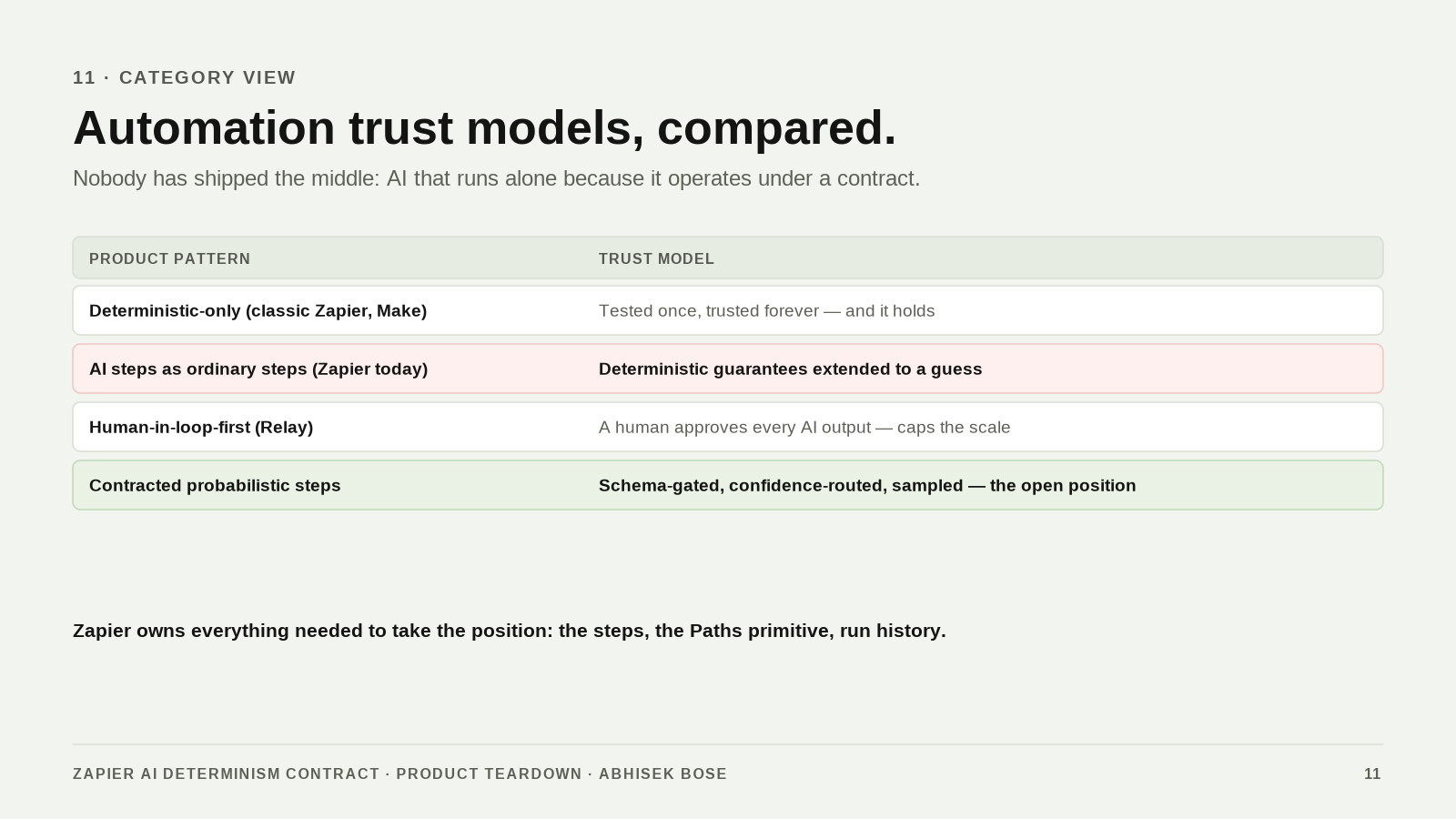
The open position in the category: unattended AI that earned it.
12 · Metrics that prove the thesis
Not engagement. A measurement system where each metric tests one link in the contract:
- Wrong-output rate on sampled runs — the silent-failure detector; measures the gap between "completed" and "correct" the platform currently cannot see at all.
- Schema-violation catch rate — how many bad outputs the contract stops before a downstream write; proves the validation layer is load-bearing, not decorative.
- % of revenue-critical AI Zaps with a review path — adoption of the safety pattern by the persona who needs it most; low uptake means the default path is still the unsafe one.
- Time-to-detection of degradation — days between a quality regression (model drift, prompt rot) and the owner learning about it; the current baseline is effectively infinite.
- AI-step 90-day retention — do builders keep AI steps in production Zaps after the honeymoon; churn here is the truth-teller on whether trust was earned or assumed.
- Silent-failure incidents reported — the metric that should go up before it goes down: rising reports mean the product finally sees what was always happening.
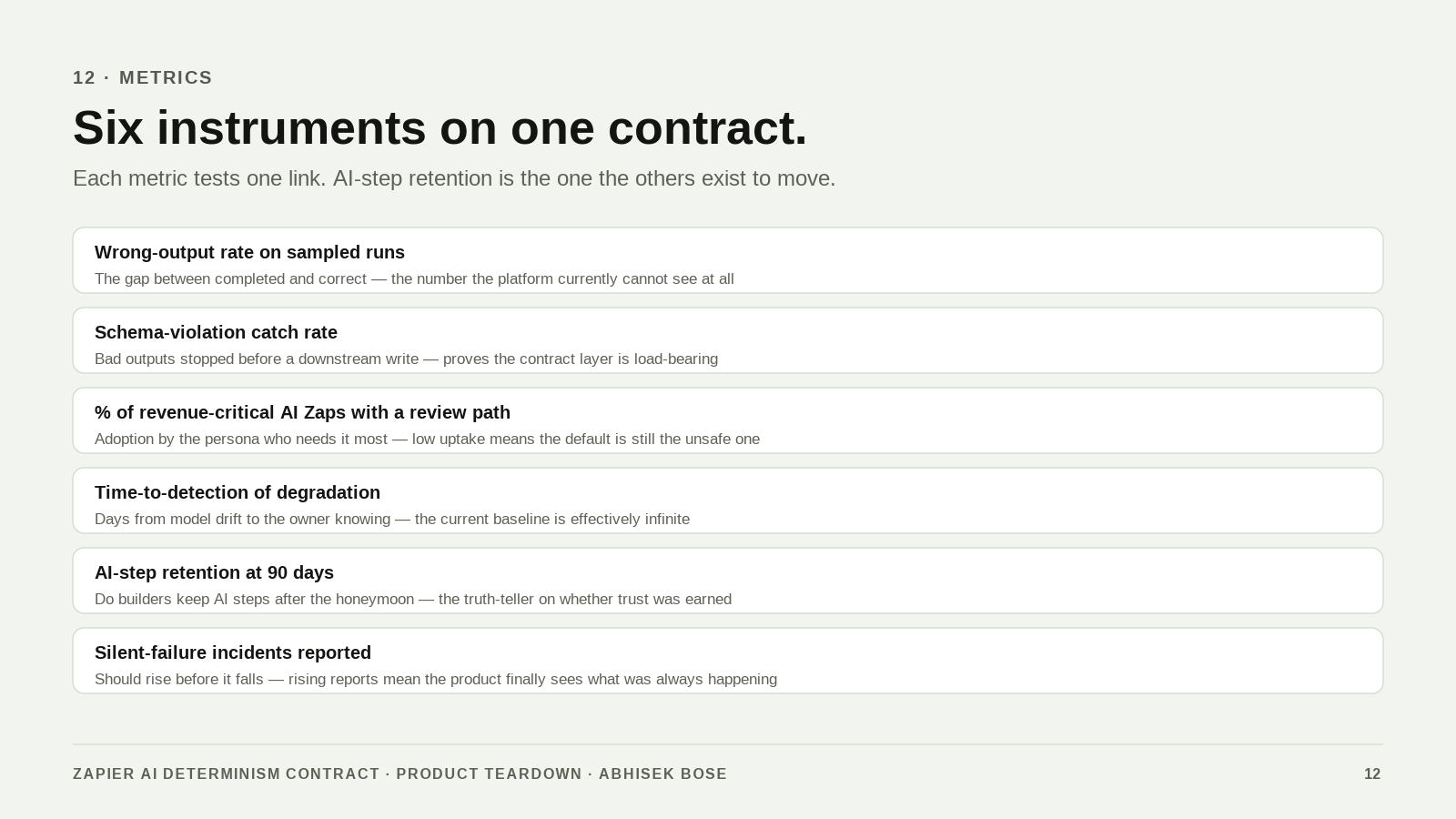
Six instruments on one contract — retention is the metric the others exist to move.
13 · The experiment
Don't build it on conviction. Run the test:
Control: current AI steps — freeform output, no contract. Treatment: mandatory schema + confidence routing on newly published revenue-critical Zaps.
Hypothesis: contracts raise AI-step 90-day retention and cut wrong-output incidents, because trust that's checked survives longer than trust that's assumed.
Primary metric: AI-step retention at 90 days. Secondary: wrong-output rate on sampled runs, schema-violation catches, review-queue response time, incidents reported. Guardrail: Zap publish completion rate must not crater — if the contract gate kills publishes, it's a tax, not a product.
Kill criterion: if wrong-output rates on real traffic are genuinely negligible, the contract layer is over-engineering and authoring-time AI is the whole story.
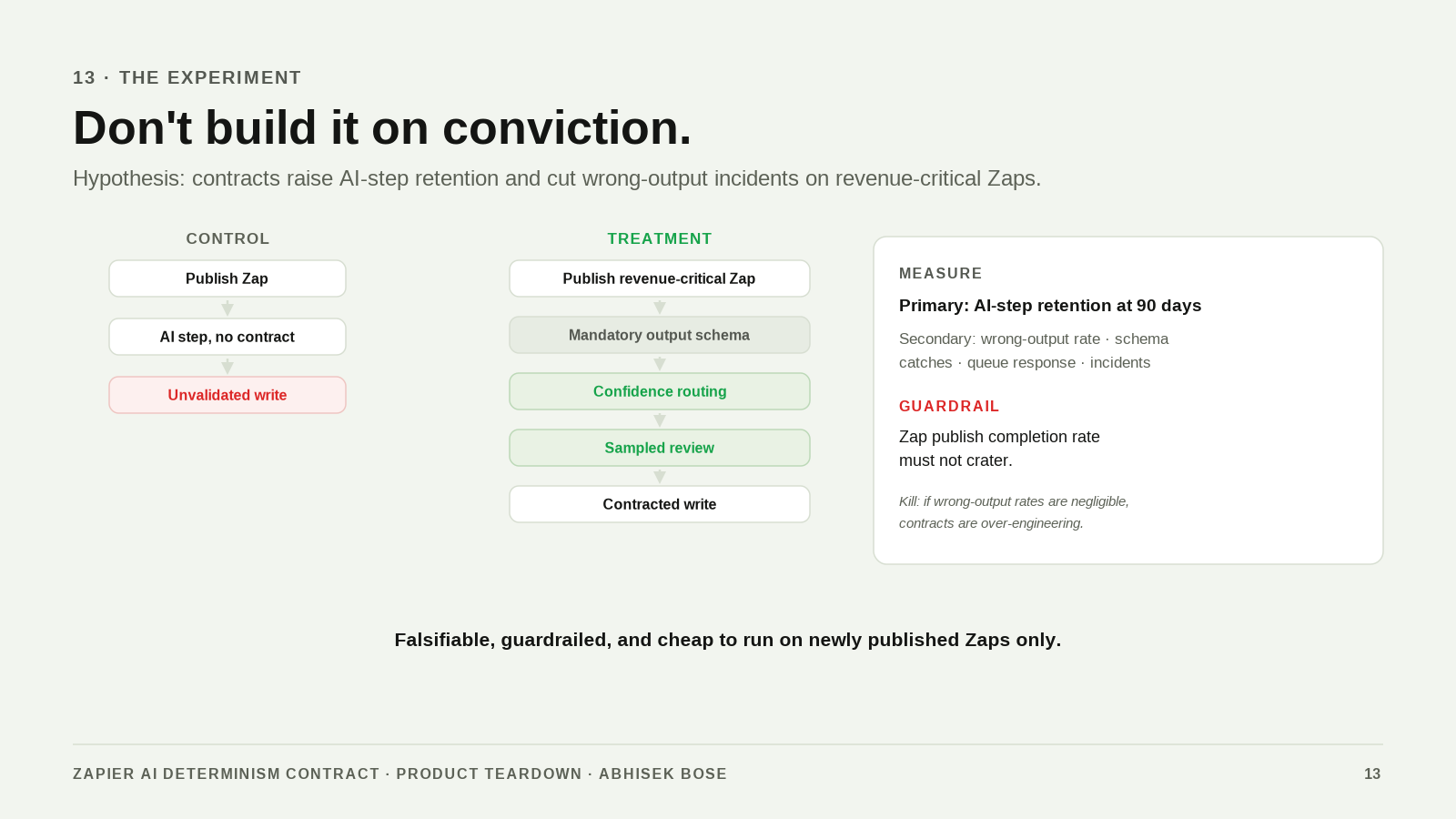
Falsifiable, guardrailed, and cheap to run on newly published Zaps only.
14 · What I'd build first
| Feature | Impact | Effort | Priority |
|---|---|---|---|
| Typed output schemas on AI steps | High | Medium | P0 |
| Schema-violation fallback path | High | Low | P0 |
| Confidence as a routable value in Paths | High | Medium | P1 |
| Sampled review in run history | High | Medium | P1 |
| Per-Zap AI health score + drift alerts | Medium | High | P2 |
| Contract system extended to Zapier Agents | Medium | High | P2 |
The P0 pair ships the thesis: a contract worth enforcing and somewhere for violations to go. Existing AI steps get grandfathered with a visible "unvalidated" badge — loud honesty beats silent breakage. Confidence routing is P1 because it needs the schema's confidence field to exist first — sequencing, not importance.
15 · Final thesis
Zapier's moat was never integrations. It was the promise that a published Zap needs no babysitter — and AI steps without contracts quietly revoke that promise.
The fix is not smarter models. It's honest boundaries: keep AI frictionless where humans review it, and make it earn its way into the parts that run alone.
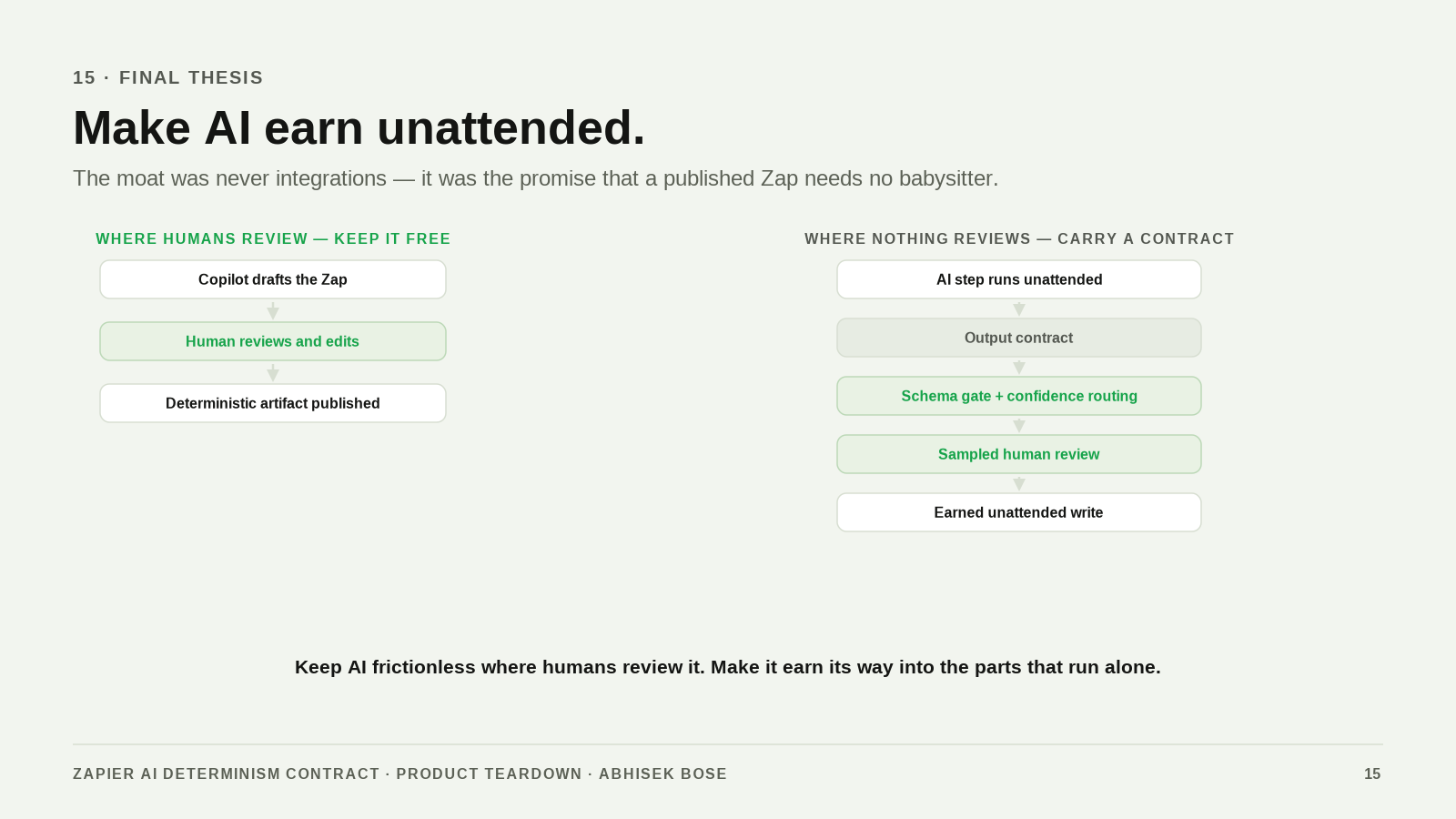
Where a human reviews, AI stays free. Where nothing reviews, AI carries a contract.
Sources
Observed claims in this teardown draw on:
- AI by Zapier: model-based pricing — official docs: AI steps consume tasks, priced by model tier
- Zapier pricing changes 2025–2026: tasks, AI, overflow — task-based billing mechanics: what consumes a task and what doesn't
- Zapier Agents: pricing, limits, and alternatives — the separate Agents product and its activity-based meter
Everything else is inferred product analysis or marked (illustrative estimate) inline.