Scenario: Tear down Salesforce Agentforce — the enterprise AI agent platform priced at roughly $2 per conversation — and design the readiness gate its pricing model pretends isn't needed.
01 · The thesis
Agentforce's interesting failure isn't agent quality. It's that the agent's value function lives outside the product.
What the customer buys: an AI agent that resolves service conversations on their CRM.
What the value actually depends on: Data Cloud harmonization and CRM hygiene — deduplicated contacts, current knowledge articles, connected objects. That work is unpriced, unowned, and invisible in the sales motion.
My thesis: certify data readiness before a single conversation meters, then earn revenue per verified resolution. Price the foundation, not just the roof.
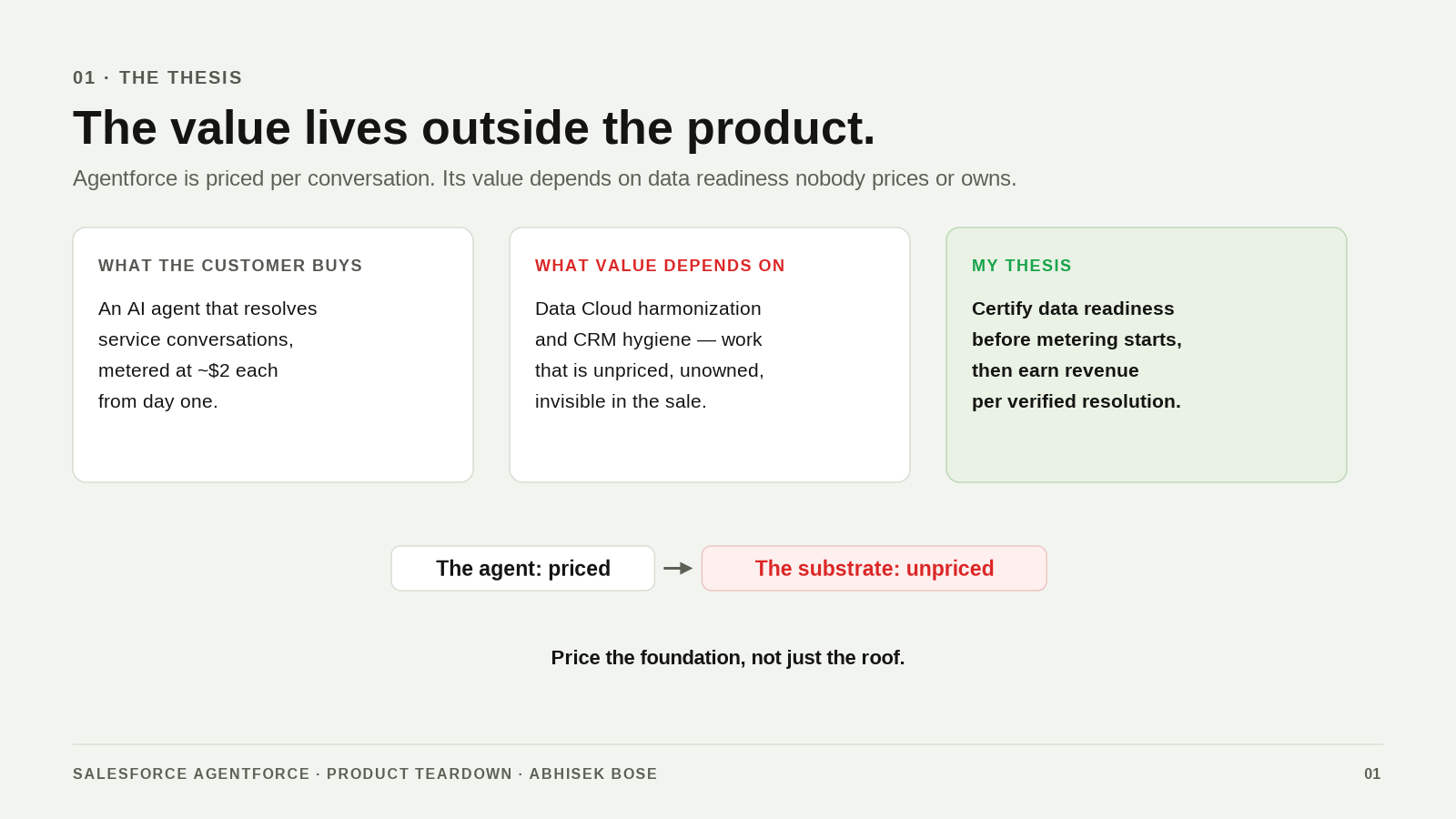
One screen: the billable event and the value-determining work live on opposite sides of the contract.
02 · Product evolution
Salesforce's own AI history is the argument. Each era changed what the buyer buys — and quietly changed what the value depends on, without ever changing who owns that dependency:
| Era | Buyer buys | Value depends on | Who owns the dependency |
|---|---|---|---|
| Einstein Bots | Scripted deflection | Dialog tree quality | Vendor + admin |
| Einstein GPT | Generative replies | Prompt + CRM context | Nobody, quietly |
| Agentforce | Autonomous agents, ~$2/conversation | Data Cloud + CRM hygiene | Nobody, expensively |
| Help Agent | Per-resolution outcomes | The same substrate | Still nobody |
The pricing evolved from seats toward outcomes. The dependency never acquired an owner. Help Agent's per-resolution pricing shows Salesforce knows where this ends — it just hasn't priced the input side yet.
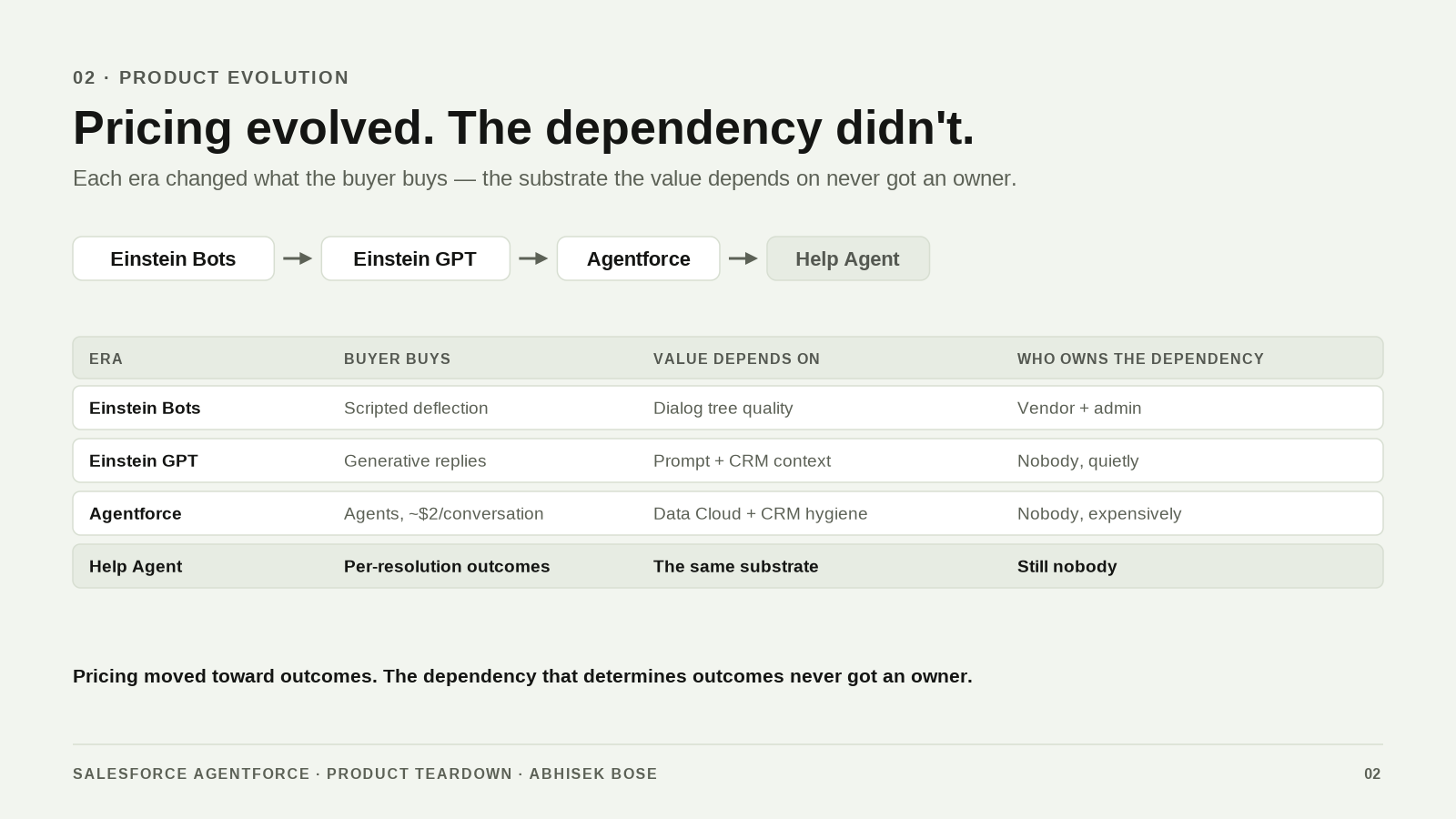
Pricing moved toward outcomes. The dependency that determines outcomes never got an owner.
03 · Who actually has this problem
Not "enterprises." Three personas, three very different data-readiness starting points:
- VP of Customer Service, clean-CRM B2C — roughly 800 agents across three BPO contracts (illustrative estimate). A prior CDP project forced deduplication, so her substrate is genuinely usable. Readiness threshold: already met. She can succeed today.
- Mid-market Salesforce admin — one admin, part-time, wearing six hats. Knowledge base is half-current, contacts are mostly clean. Readiness threshold: reachable with a scoped cleanup nobody has scoped.
- Fragmented-CRM enterprise — three org merges, three duplicate contact records per customer (illustrative estimate), stale articles everywhere. Readiness threshold: quarters away. This buyer will churn after the pilot exposes the data.
The pattern: the sales motion targets all three identically, and the pricing meters all three identically from day one. Only one of them bought a product that can work.
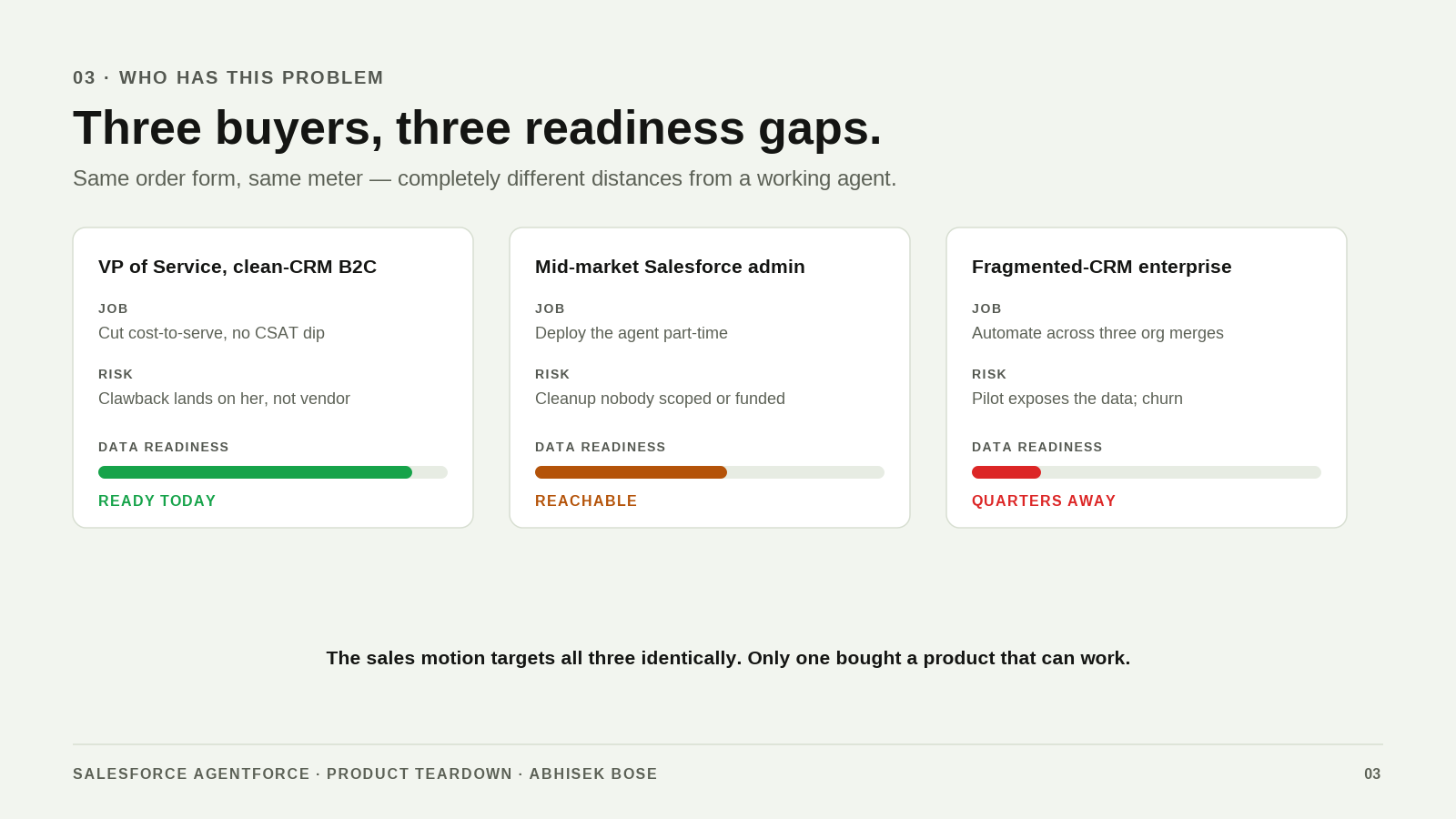
Same order form, same $2 meter, three completely different distances from a working agent.
04 · Jobs to be done
Functional JTBD: when ticket volume grows faster than headcount, I want an agent to cut my cost-to-serve without a CSAT dip.
Emotional JTBD: I have committed a deflection number to the CFO. I need to defend that number in the QBR without flinching.
Trust JTBD: I need to know the agent is answering from clean, current data before it talks to my customers — because when it hallucinates refund policy, the clawback conversation lands on me, not on Salesforce.
The third job is the foundation, and it's the unowned one. Agentforce ships the functional job, gestures at the emotional job with dashboards, and has no product surface at all for the trust job.
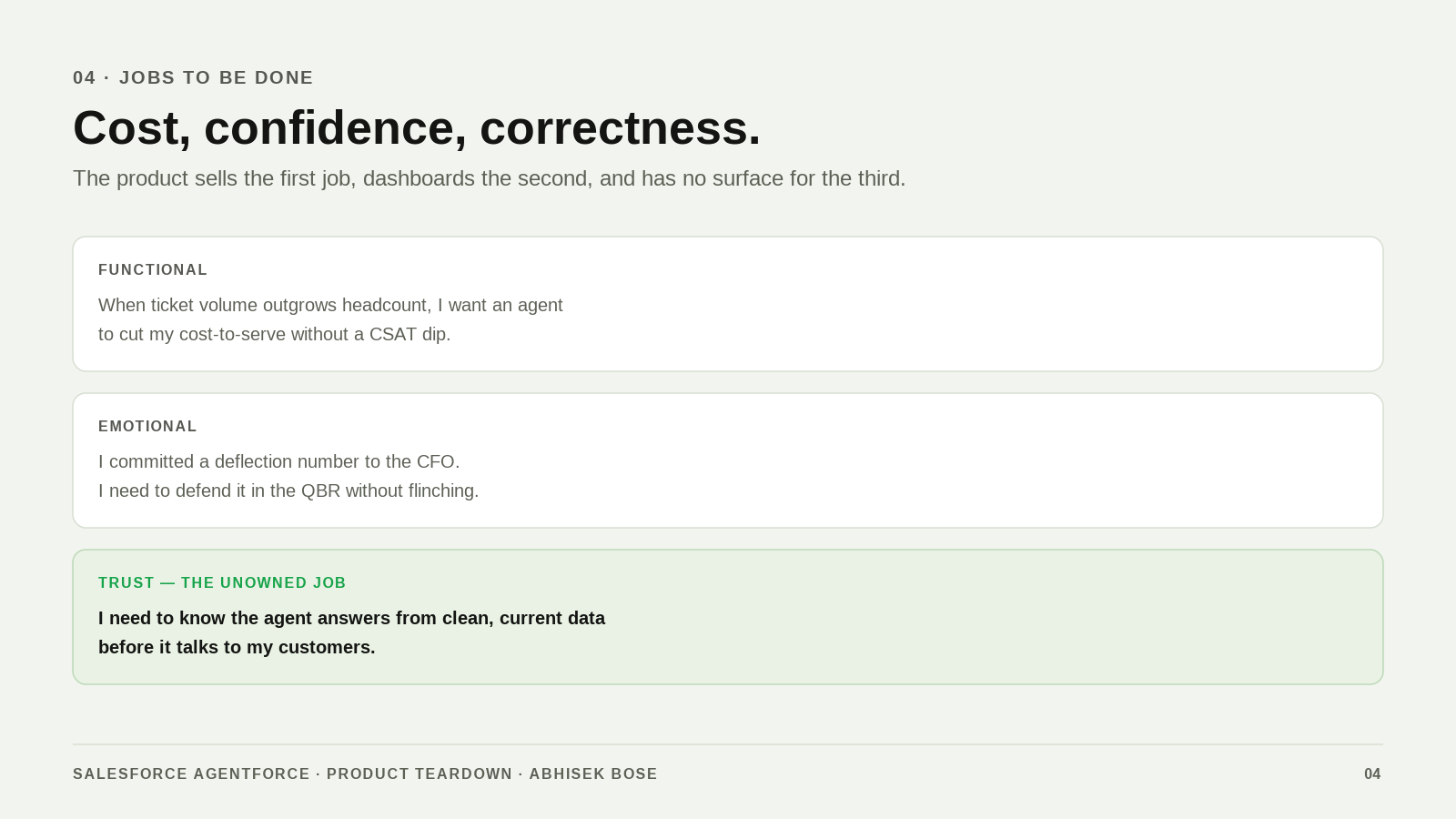
Cost, confidence, and correctness — and the product only sells the first one.
05 · How the product actually works
Agentforce is real enterprise infrastructure, not a chatbot skin. An admin configures topics, instructions, and guardrails in Agent Builder; the agent grounds its answers through Data Cloud on CRM records and knowledge articles; actions reuse existing Flows and Apex, so the agent inherits years of hardened business logic; then it deploys to chat and voice channels — and every conversation meters at roughly $2.
That action model is genuinely good design. Admins configure agents in a tool they already know, and business logic isn't reinvented in prompts. That's a real moat.
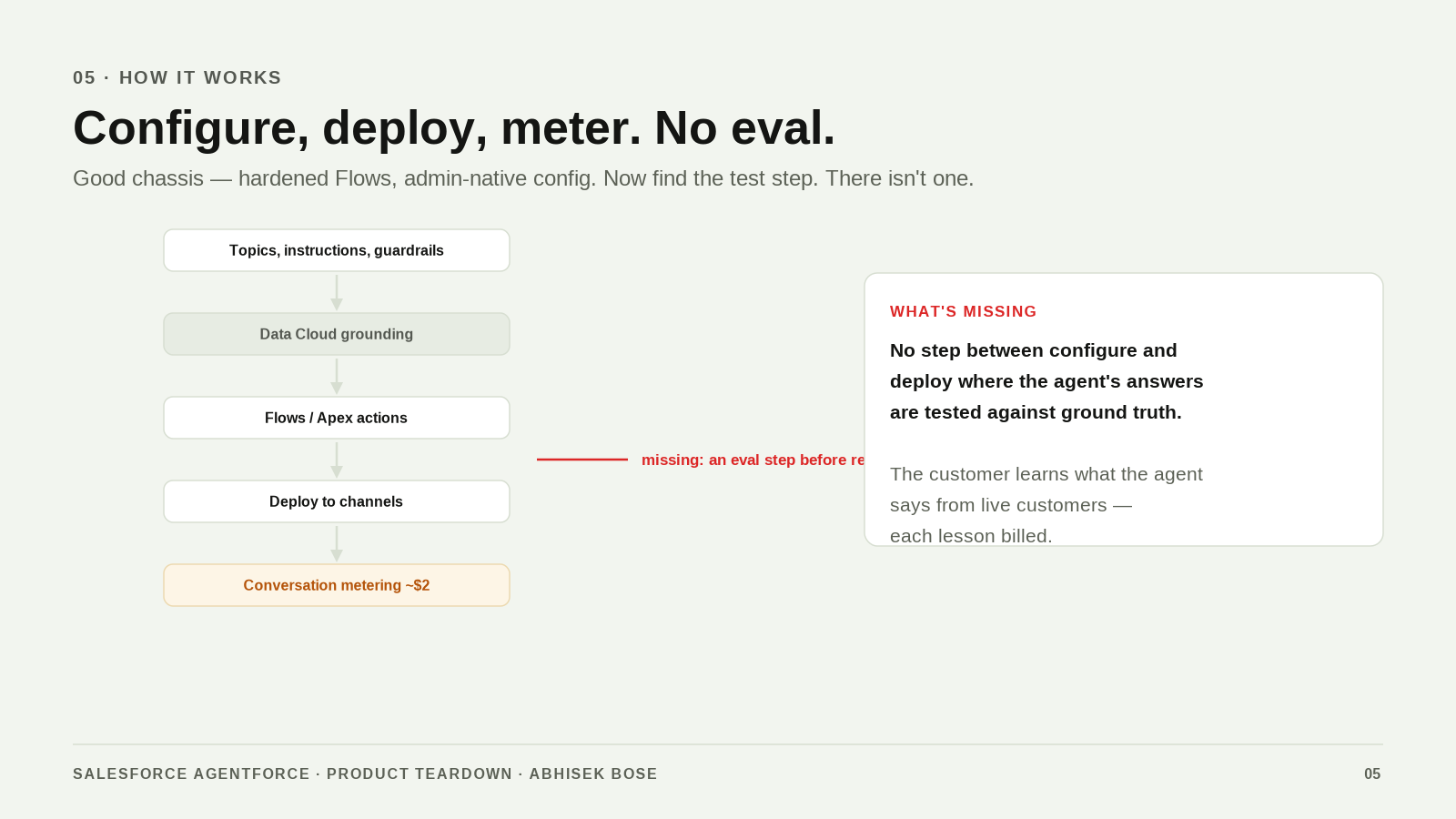
Good chassis. Now find the eval step between "configure" and "deploy to real customers." There isn't one.
Notice what's absent from this pipeline: any step between configuration and deployment where the agent's answers are tested against ground truth. The customer ships an agent whose guardrails define what it may touch, then learns what it actually says from live customers — each lesson billed. Salesforce also counts its own billable events, the same self-graded metering pattern the Intercom Fin teardown covers as a category disease, so I'll leave it at one line here.
06 · Where trust actually lives
Map the trust chain across one agent-handled conversation and the problem becomes visible:
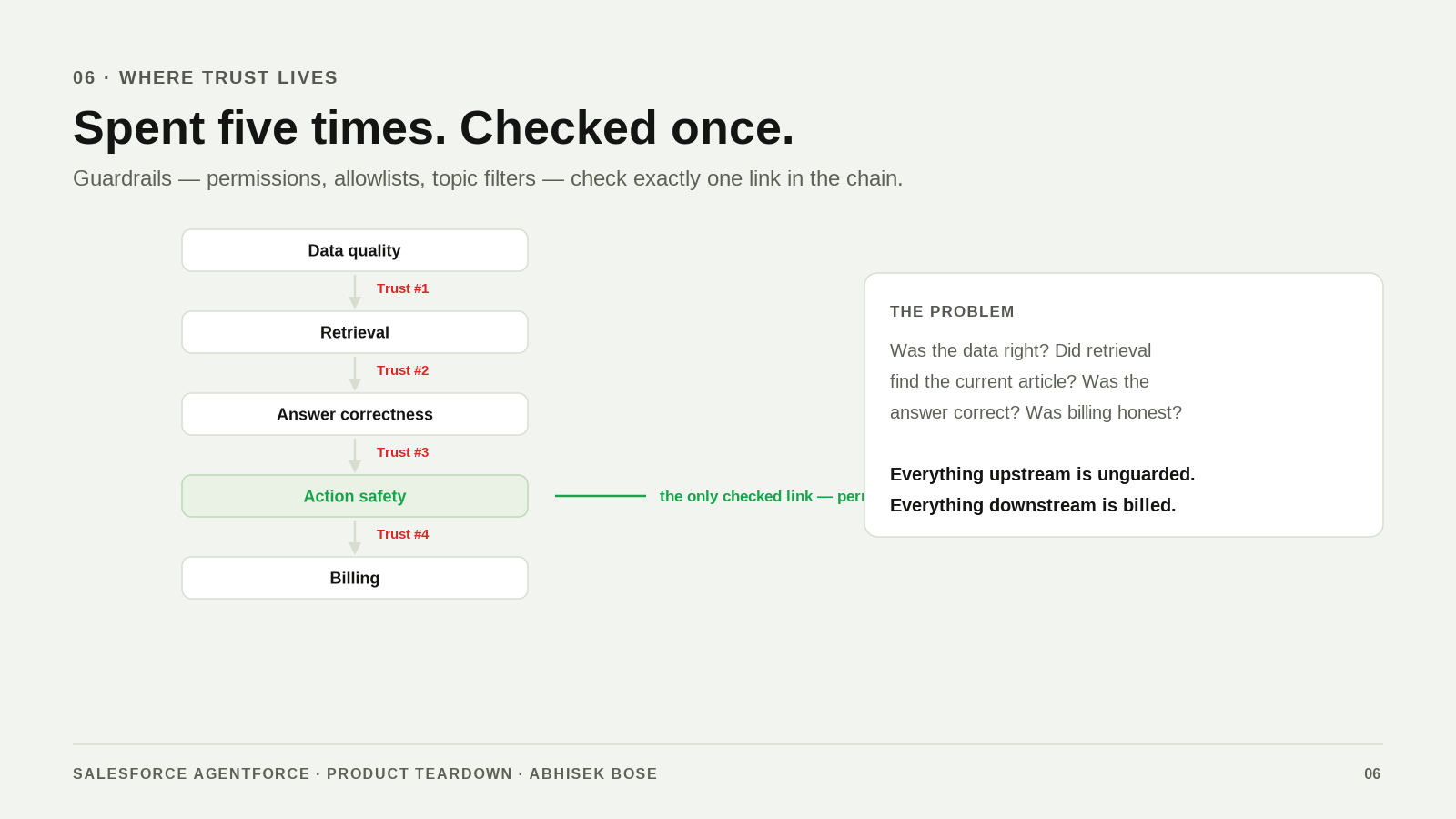
Five links in the chain. Guardrails check one — and it's not the one that answers customers.
Trust is spent five times per conversation: was the underlying data right, did retrieval find the current article, was the answer correct, was the action safe, was the billing honest. Guardrails — object permissions, action allowlists, off-topic filters — check exactly one link: action safety. That's access control. Access control cannot answer the only question the VP of Service has, which is whether the agent is right. Everything upstream of step four is unguarded, and everything downstream is billed.
07 · The real product gap — a concrete scenario
A subscription company updates its refund policy from 30 days to 14. The Salesforce knowledge article doesn't get updated — knowledge maintenance is nobody's KPI.
The agent, perfectly configured, retrieves the stale article and quotes the old 30-day policy to 400 customers over a weekend (illustrative estimate).
Count the failures: zero guardrails violated. The agent touched only permitted objects, invoked only allowlisted actions, stayed on topic. Every one of those 400 conversations metered at ~$2. The company now owes refunds under a policy it retired, the VP is explaining a clawback to the CFO, and the product's trust model registered nothing — because the trust model checks permissions, and permissions were perfect.
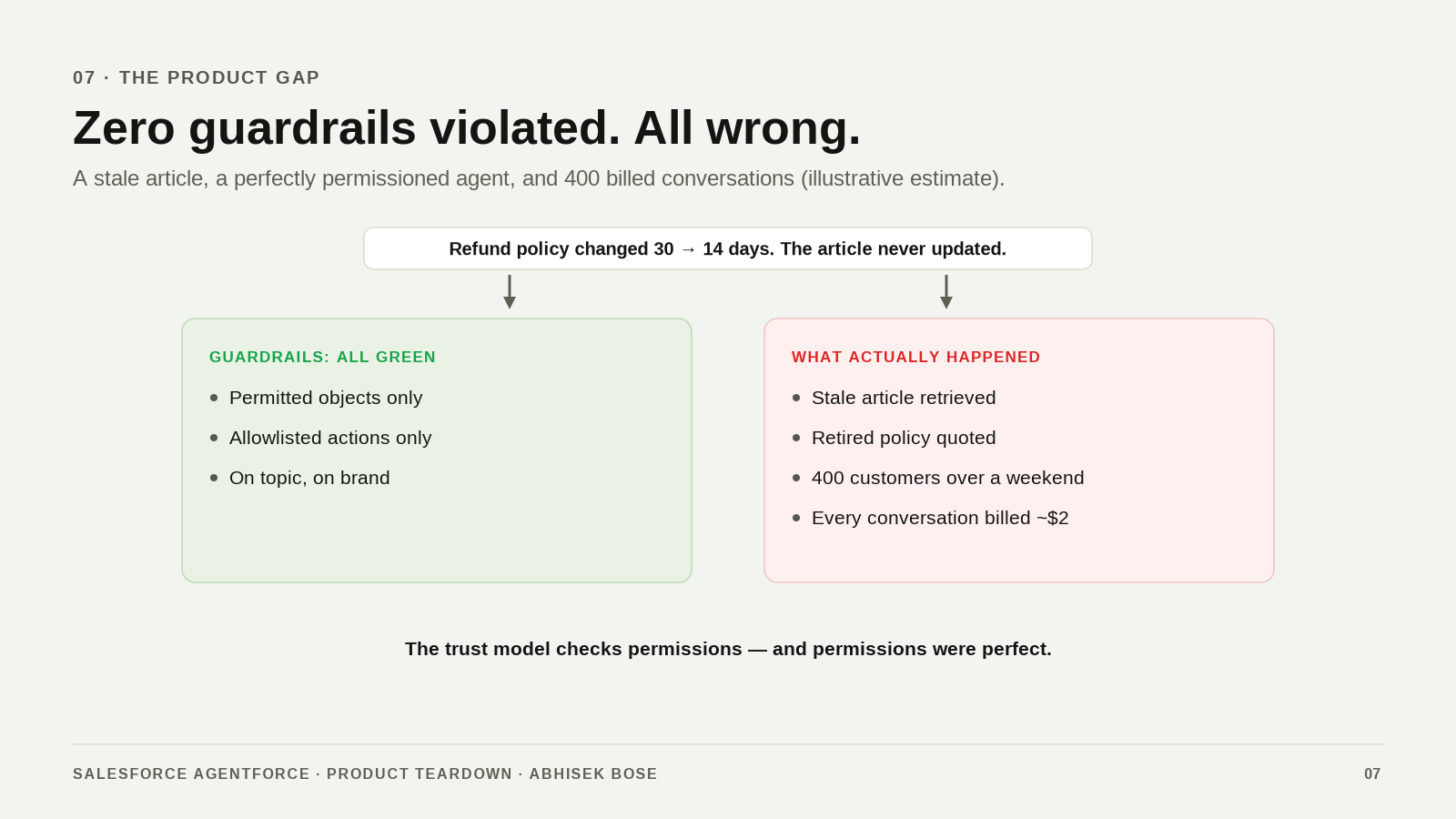
Every guardrail green. Every conversation billed. Every answer wrong.
08 · Current vs proposed
Current: sign the order form → discover the data dependency → configure and deploy → discover quality failures on live traffic at $2 per discovery → whack-a-mole tuning against production.
Proposed: scan and score data readiness → remediate with a named owner → certify above threshold → eval against golden conversations → deploy → meter per verified resolution.
Salesforce sells the agent by the conversation and the data problem by the shrug.
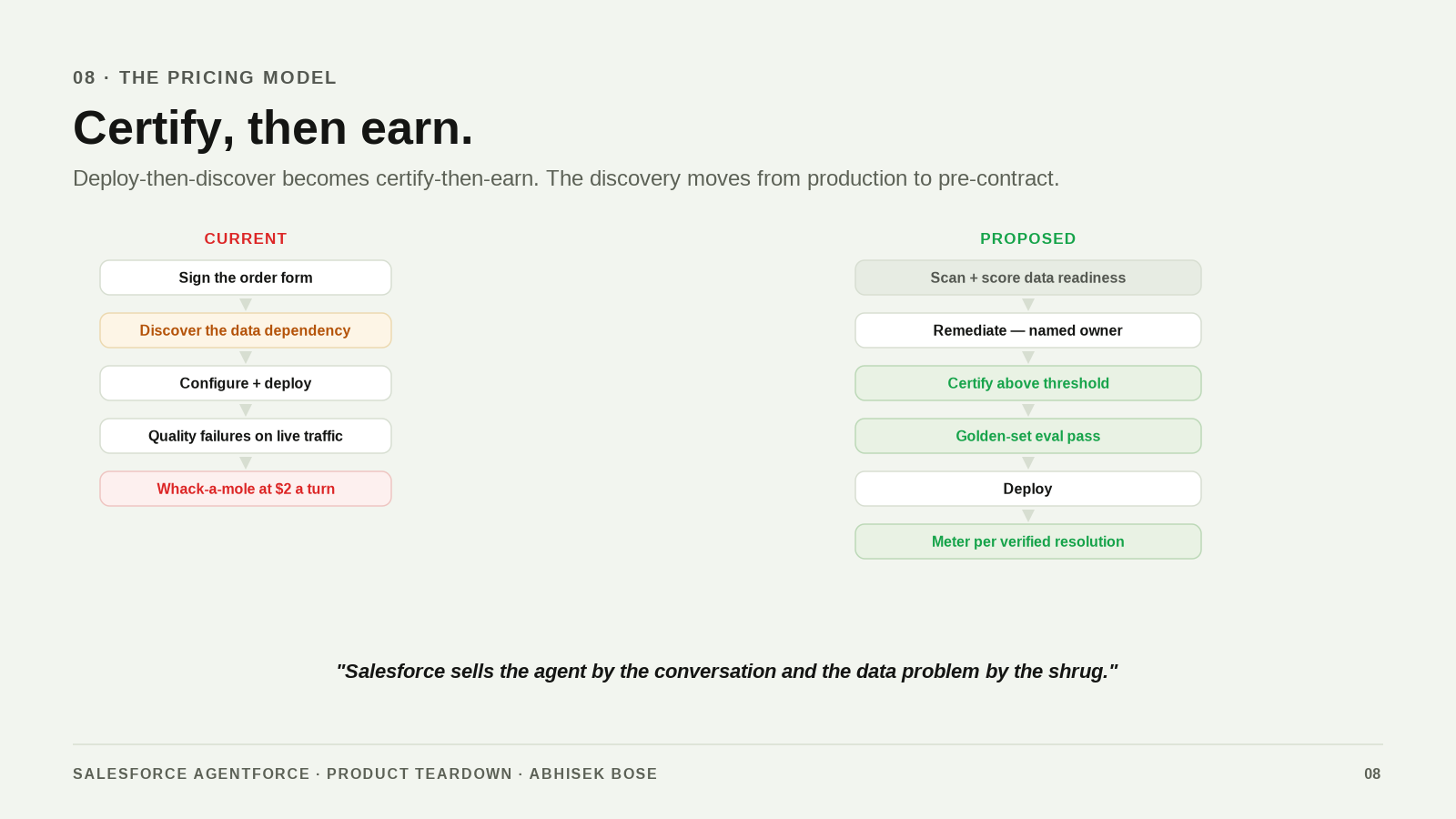
Deploy-then-discover becomes certify-then-earn. The discovery moves from production to pre-contract.
09 · The artifact: a data readiness score
"Fix your data first" is hand-waving unless you design the object. This is the actual artifact — an automated scan, a scored report, a named owner, and a metering gate:
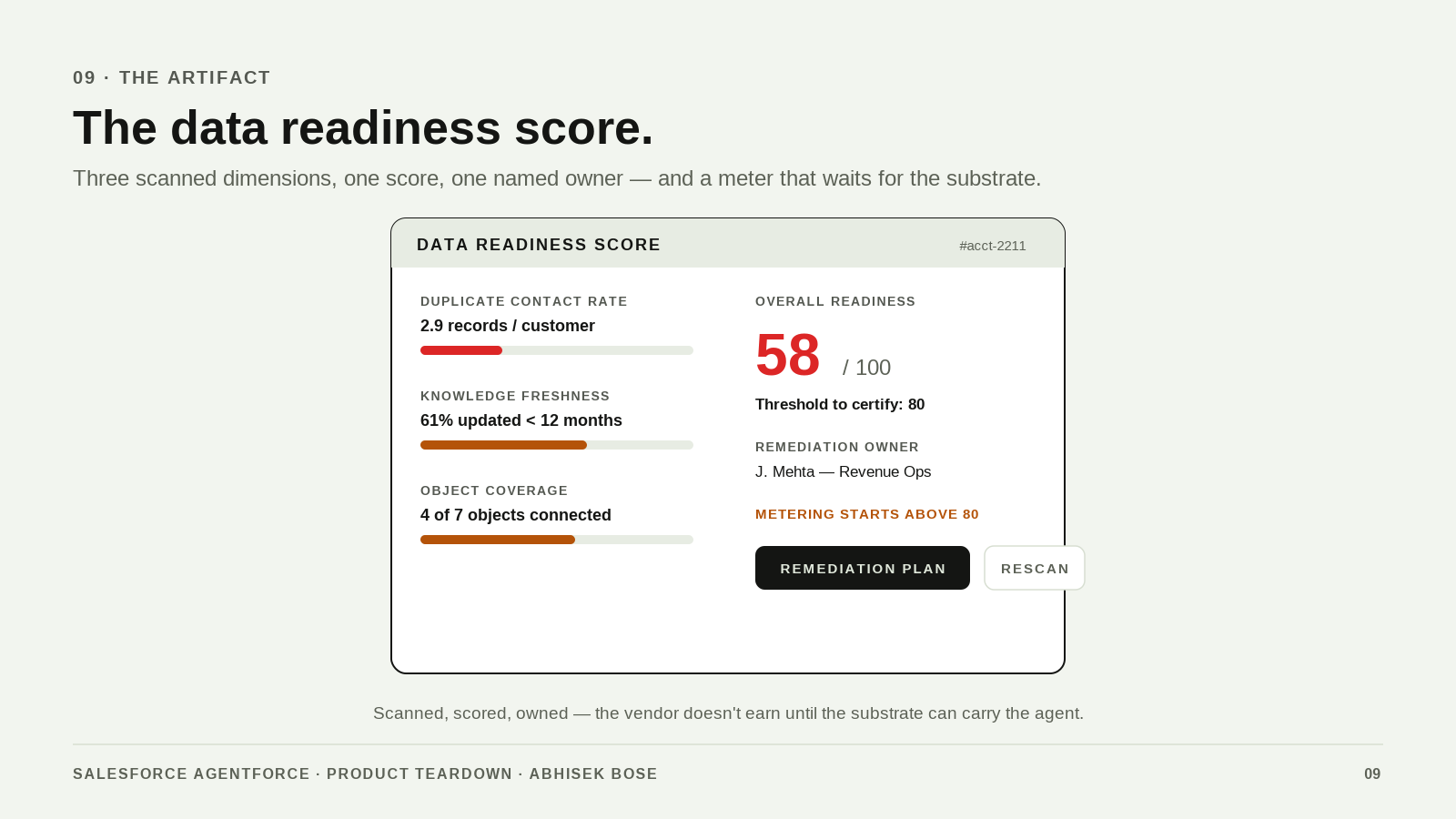
The readiness object: three scanned dimensions, one score, one named owner, and a meter that waits.
Every field earns its place: duplicate rate predicts wrong-customer answers, knowledge freshness predicts the Section 07 scenario, object coverage predicts "I don't have access to that" dead ends. The named remediation owner converts an unowned dependency into an accountable project. And the line that changes the vendor relationship: conversation metering starts above 80. Salesforce doesn't earn until the substrate can carry the agent — which finally puts the vendor on the customer's side of the data problem.
10 · The interaction: an eval regression gate
The readiness score gets you to a trustworthy launch. The eval gate keeps you there. Every change to a topic, instruction, or knowledge source triggers a golden-set run — the agent's answers replayed against a certified set of the customer's own historical conversations — and a regression blocks the deploy:
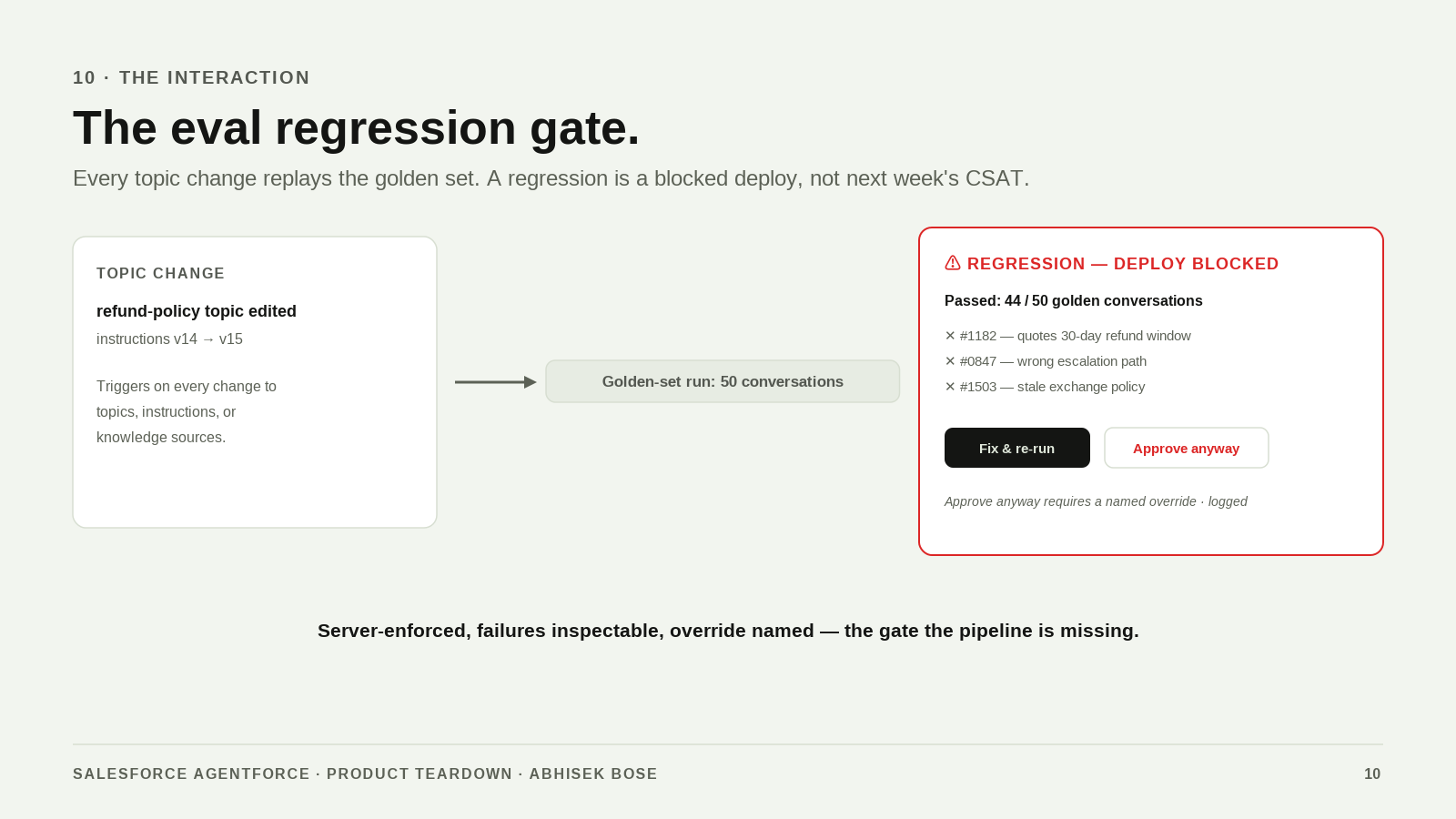
A regression is a blocked deploy with the failing conversations listed — not a surprise in next week's CSAT.
Three properties matter: the gate is server-enforced (not an instruction the agent can talk past), the failures are inspectable (the admin reads the exact conversations that regressed, not a score), and the override is named (approve-anyway exists, because sometimes the golden set is stale — but a human puts their name on it). I build this pattern in DeepAgent for funnels, where every mutating action passes a server-enforced approval gate and every thumbs-up and thumbs-down feeds the eval set — the gate and the golden set improve each other.
11 · Category view: trust models, not feature lists
Comparing Agentforce vs Copilot Studio vs Sierra feature-by-feature misses the point. Compare the trust model each pricing pattern ships:
| Pricing pattern | Who carries the readiness risk |
|---|---|
| Seat-bundled copilots (Microsoft) | Customer — risk hidden inside the bundle |
| Per-conversation agents (Agentforce today) | Customer — and the vendor bills the failures |
| Outcome-priced agents (Sierra, Help Agent) | Shared — vendor eats bad outcomes, blind to inputs |
| Readiness-certified + resolution-verified | Priced, owned, and gated — the open position |
Outcome pricing is the honest half of the answer: the vendor stops billing failure. But it still leaves the vendor blind to why accounts fail. Nobody in the category certifies the input side. Salesforce is best positioned to take the open position — it already owns the CRM (the substrate) and the agent (the consumer of it), and connects them with a shrug.
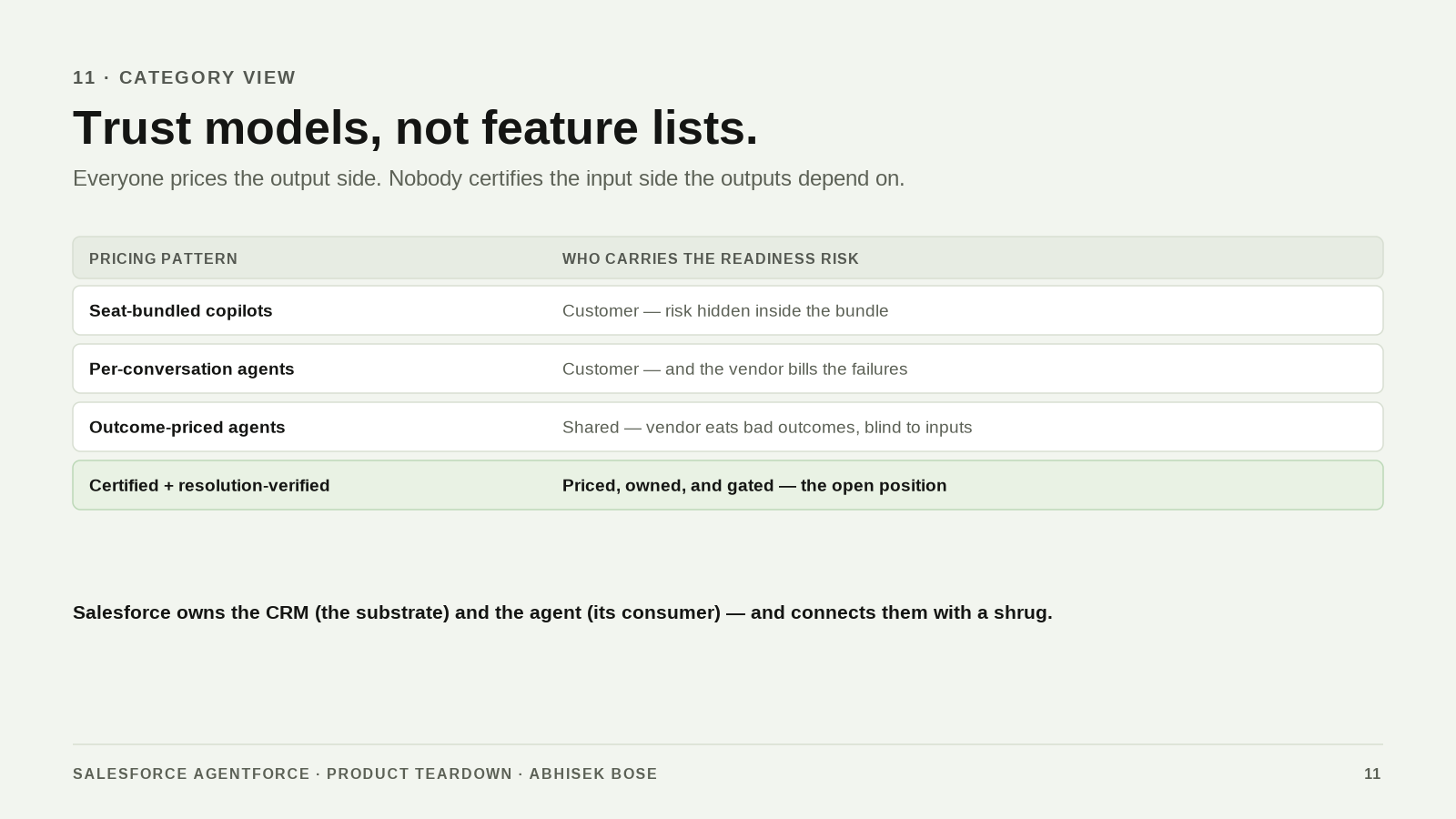
Everyone prices the output side. The open position prices both sides of the dependency.
12 · Metrics that prove the thesis
Not conversation volume. A measurement system where each metric tests one link in the certify-then-earn loop:
- Readiness score at go-live — was the deployment set up to succeed or to churn, before a single conversation billed.
- Verified resolution rate — no reopen, no escalation within the window. The honest replacement for deflection.
- Eval regression pass rate per change — is governance alignment or theater; a team shipping without green evals is flying blind.
- Reopen / multi-contact rate on agent-handled cases — are conversation counts masking failure loops the current pricing quietly monetizes.
- Time-to-trusted-deployment — signature to certified production. The number the readiness gate exists to compress.
- Net account revenue, seats plus agents, at renewal — did the seat-cannibalization war get resolved or just deferred to the renewal negotiation.
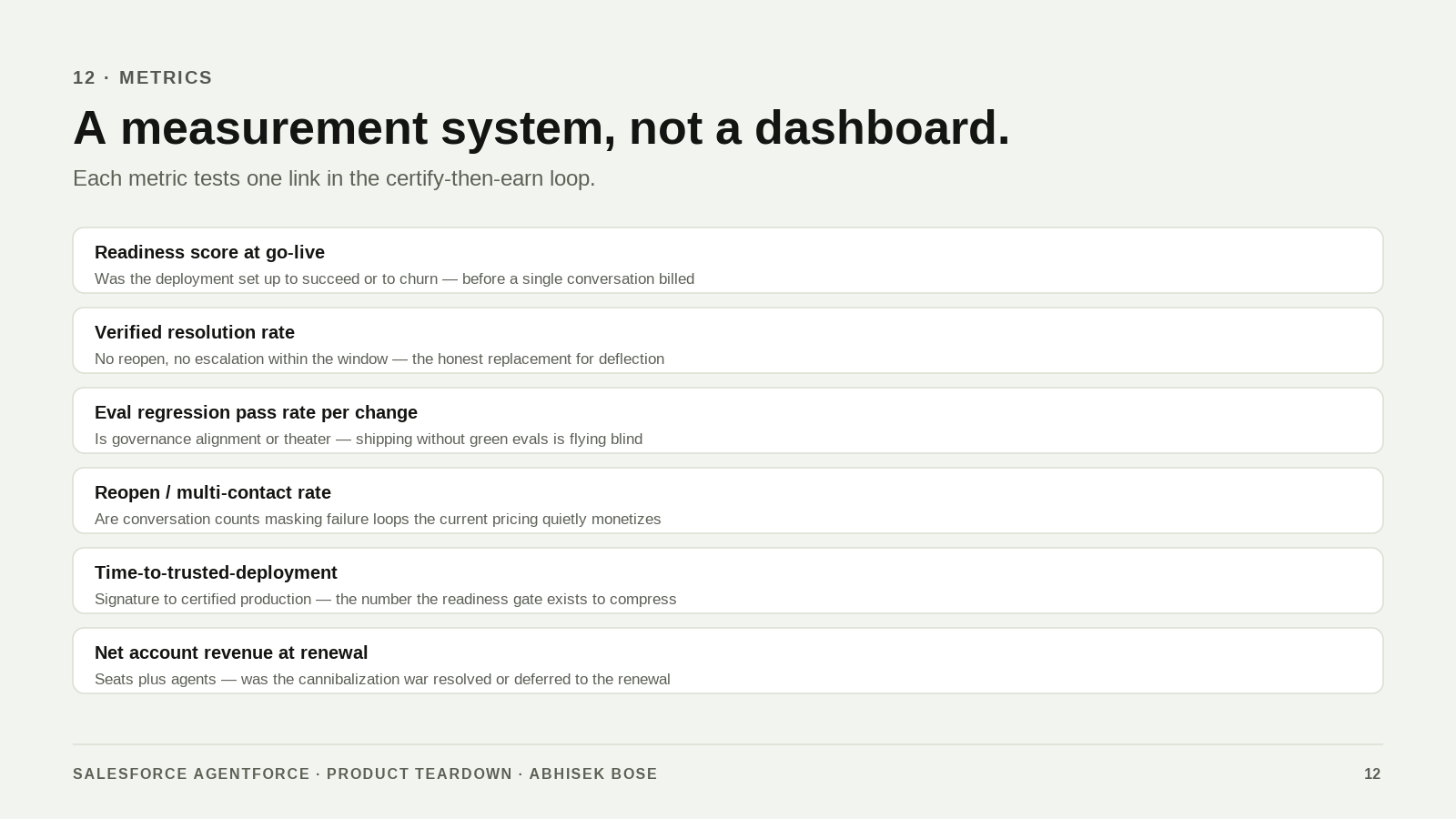
Six instruments on one loop — net revenue at renewal is the metric the others exist to move.
13 · The experiment
Don't restructure pricing on conviction. Run the test:
Control: standard onboarding — sign, configure, deploy, meter from day one. Treatment: readiness-gated cohort — scan, remediate to threshold, eval harness on, metering starts at certification.
Hypothesis: gated accounts reach production faster and churn less, despite delayed metering — because the weeks "lost" to the gate are cheaper than the quarters lost to whack-a-mole tuning on live traffic.
Primary metric: time-to-trusted-deployment and 12-month retention. Secondary: verified resolution rate, reopen rate, expansion revenue. Guardrail: sales cycle length must not blow out — if the readiness gate becomes a reason deals die, the gate belongs post-signature, not pre-.
Kill criterion: if gated accounts stall anyway and the stalls trace to change management — agents fighting the rollout, leadership losing nerve — rather than data, then the readiness gate solves the wrong bottleneck and the investment belongs in adoption tooling.
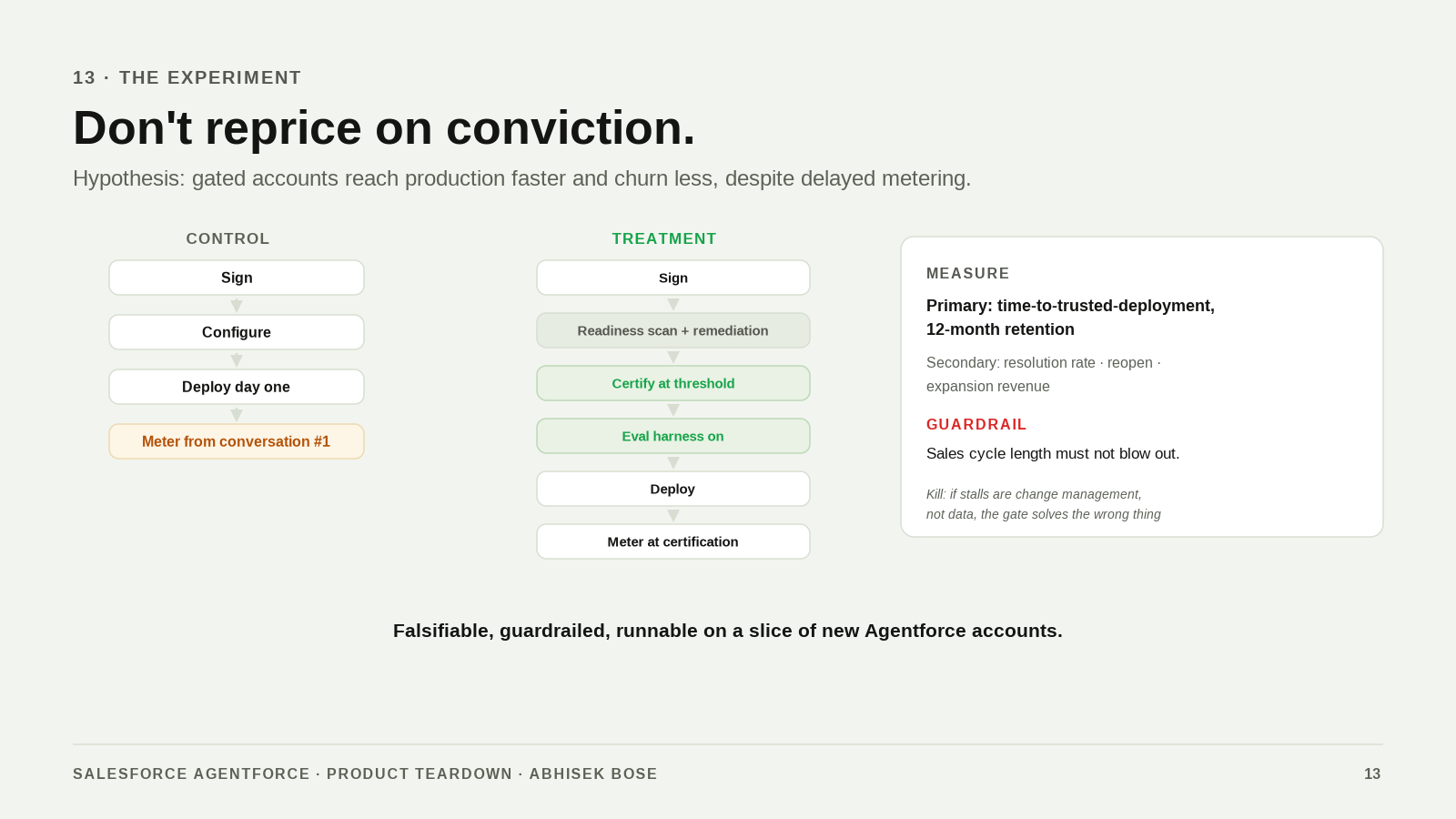
Falsifiable, guardrailed, and runnable on a slice of new Agentforce accounts.
14 · What I'd build first
| Feature | Impact | Effort | Priority |
|---|---|---|---|
| Readiness scanner + score | High | Medium | P0 |
| Metering gate at threshold | High | Low | P0 |
| Golden-set eval harness | High | High | P1 |
| Deploy-blocking regression gate | High | Medium | P1 |
| Verified-resolution metering | High | High | P2 |
| Customer-auditable event log | Medium | Medium | P2 |
The P0 pair ships the thesis: a score worth trusting and a meter that respects it. The eval harness is P1 because it needs certified accounts to be meaningful — sequencing, not importance. Resolution metering is P2 only because repricing an enterprise SKU is a fiscal-year project, not a sprint.
15 · Final thesis
Enterprise agents won't win by getting smarter alone. They'll win when someone prices the thing their intelligence depends on.
The product opportunity isn't a better agent. It's owning the dependency: price the readiness, warrant the correctness. Certify the substrate before the meter starts, gate every change behind evals, and bill for resolutions you can defend in an audit. Whoever does that owns the category — whether or not it's Salesforce.
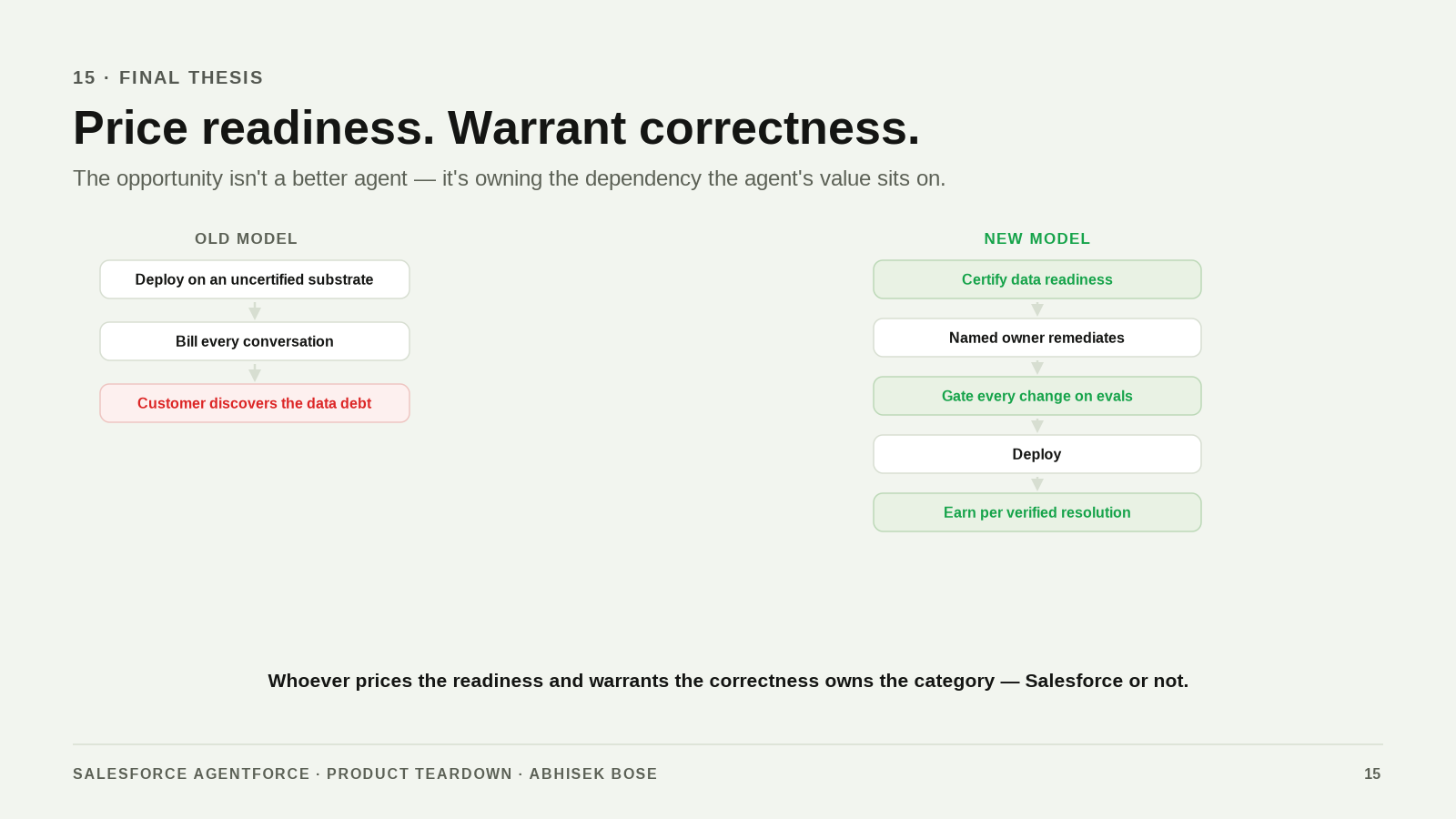
Old model: meter the easiest thing to count. New model: warrant the only thing the customer values.
Sources
Observed claims in this teardown draw on:
- Salesforce pricing per AI conversation — Benioff's ~$2-per-conversation announcement and "very high margin opportunity" framing
- Complete guide to Agentforce pricing options — the conversation / consumption / licensing pricing evolution
- Salesforce takes a run at outcome-based Help Agent pricing — the later shift toward per-resolution pricing
Everything else is inferred product analysis or marked (illustrative estimate) inline.