Scenario: Tear down Perplexity — the answer engine — and design the citation faithfulness layer that verified answers actually require.
01 · The thesis
Perplexity solved answer synthesis. The next problem is citation trust.
What changed: search stopped returning links and started returning claims. The answer arrives pre-synthesized, footnoted, and confident.
The product problem: citations are attached after synthesis, and nothing in the pipeline checks that the cited passage supports the sentence it decorates. A citation next to a sentence and a citation that entails the sentence are different artifacts. Perplexity ships the first and gets credit for the second.
My thesis: citations must be verified, not decorative. Compute entailment before render, or the footnote is theater.
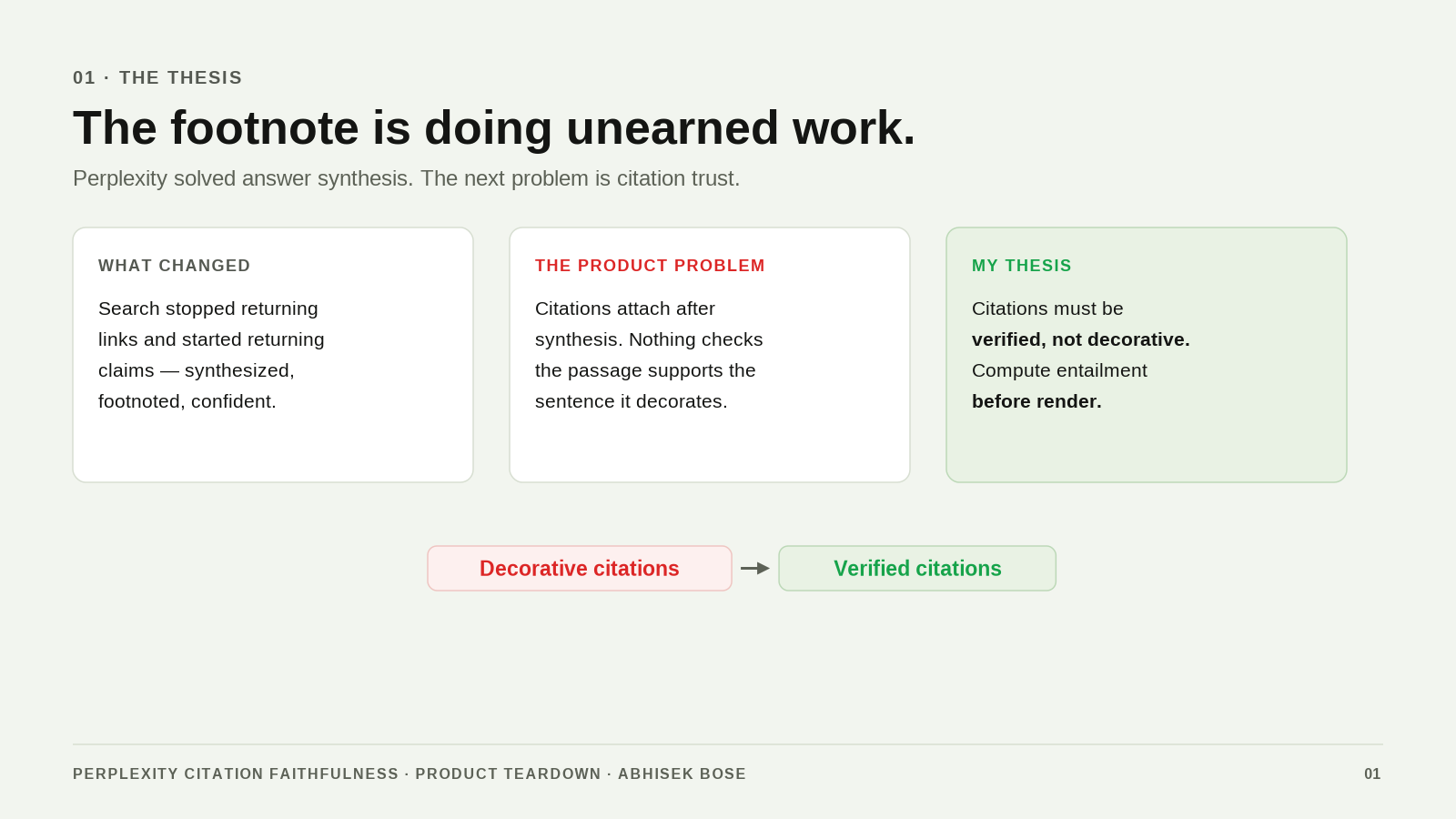
One screen: the shift from links to claims, and where verification has to move.
02 · Product evolution
Perplexity's own trajectory is the argument. Each step changed the user's job — and quietly changed what one unit of trust has to cover:
| Era | User does | AI does | Trust unit |
|---|---|---|---|
| Ten blue links | Reads and judges | Ranks pages | A ranking |
| Answer engine | Asks and accepts | Synthesizes and cites | A footnote |
| Ads and commerce | Decides and buys | Recommends inside the answer | The answer itself |
The trust unit grew from a ranking to the answer itself. The trust mechanism — a footnote the user is expected not to click — never changed. Sponsored questions and commerce now monetize the exact surface the footnote is supposed to keep neutral, and publisher revenue share gives the ranking function a stakeholder. That gap is this teardown.
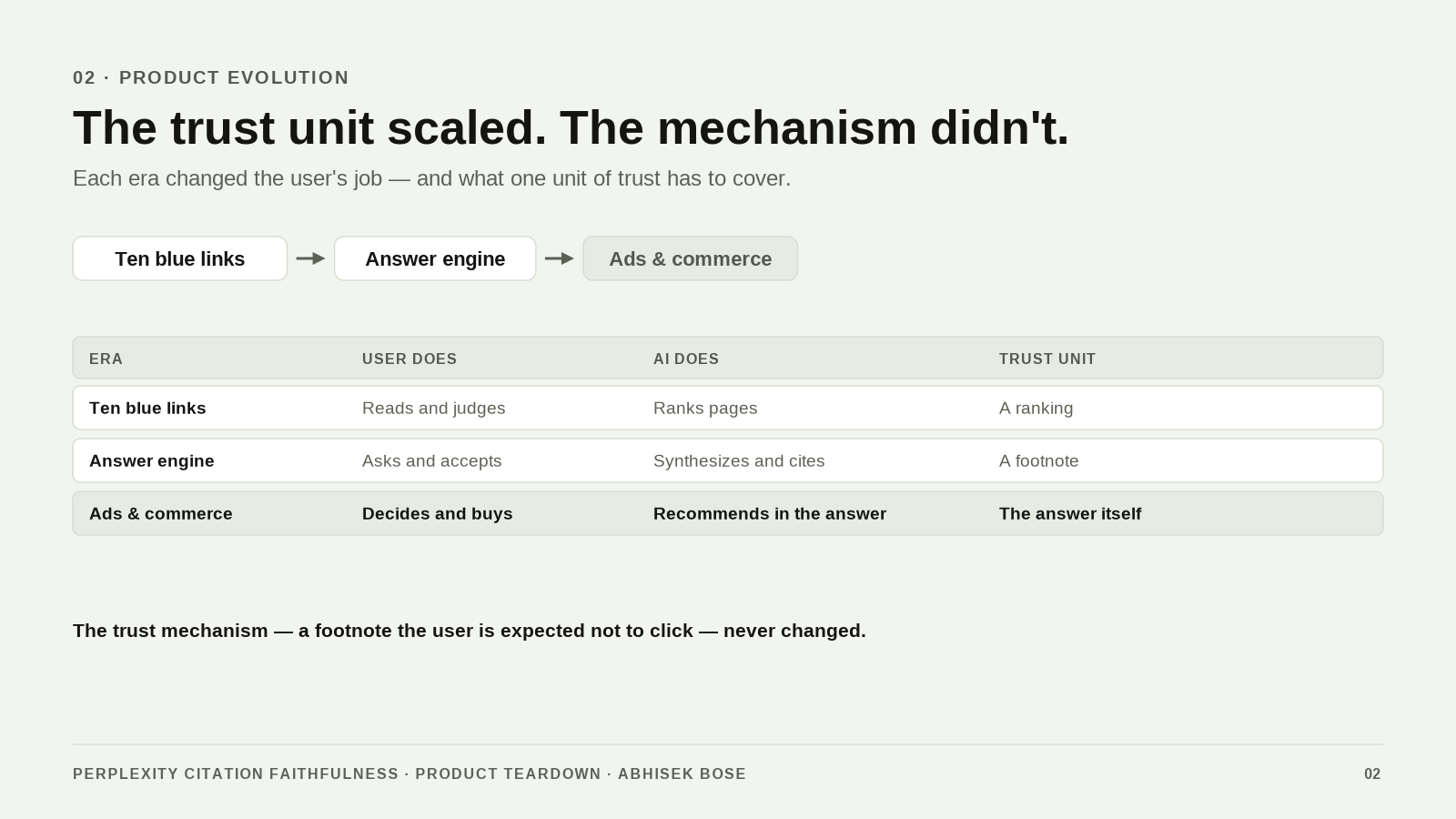
The trust unit scaled; the trust mechanism didn't.
03 · Who actually has this problem
Not "searchers." Three personas, three very different trust thresholds:
- Casual searcher — job: settle a question fast. Risk: a wrong trivia answer costs nothing. Trust threshold: low.
- Deadline professional — job: get a defensible answer without reading ten tabs. Risk: repeats an unsupported claim in a meeting or a memo with his name on it. Trust threshold: high.
- Compliance-bound analyst — job: a source trail for every claim that reaches an internal document. Risk: one number the cited filing doesn't contain is a compliance incident, not an inconvenience. Trust threshold: extreme.
The pattern: the more expensive a wrong answer, the more valuable a verified citation becomes. Perplexity's current design optimizes for the persona who never clicks the footnote and quietly taxes the two who pay for seats.
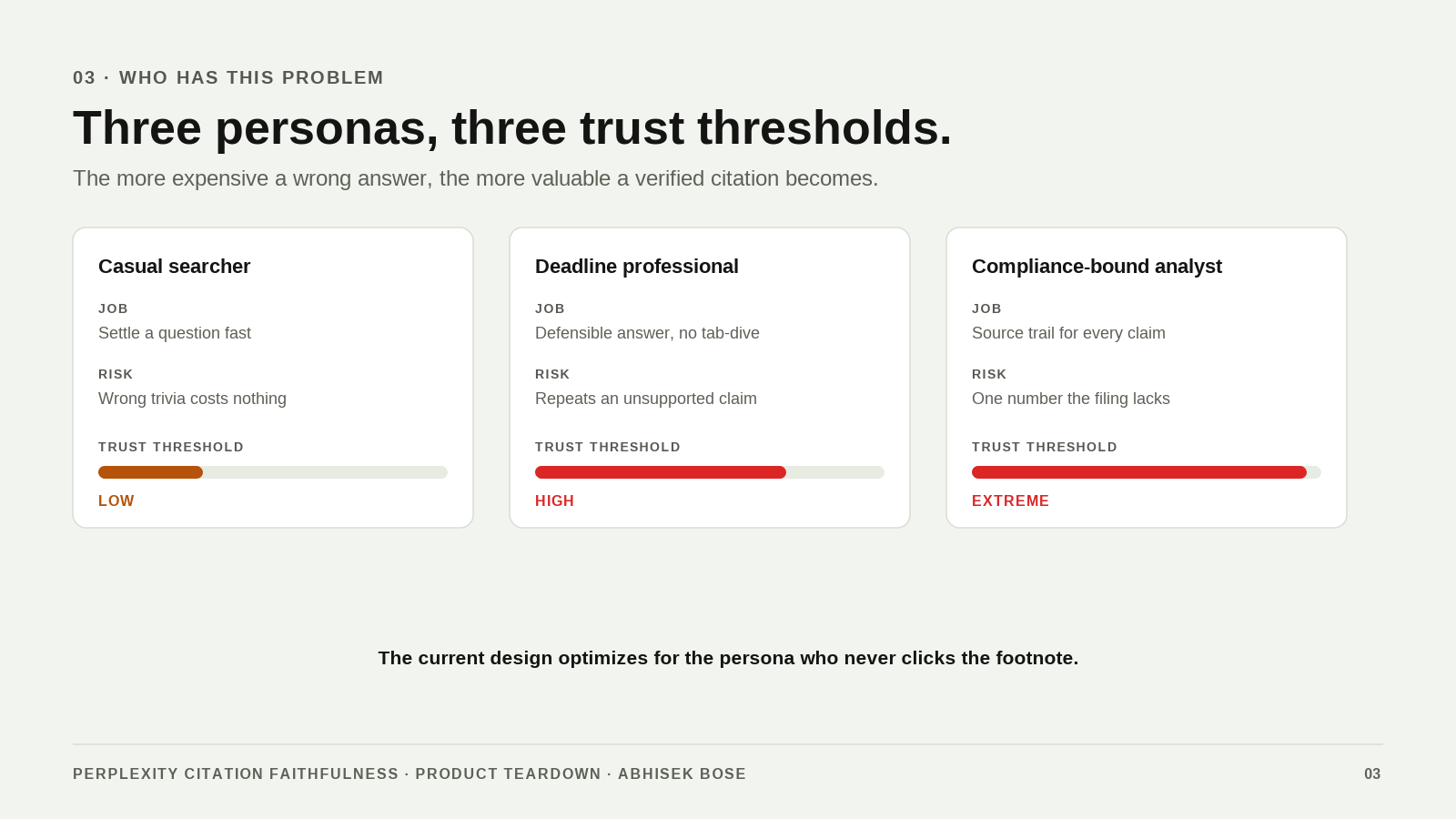
Trust threshold rises with consequence — and so does the value of verified support.
04 · Jobs to be done
Functional JTBD: when I have a question, I want a direct answer fast, without assembling it myself from ten tabs.
Emotional JTBD: I want to feel informed — the sensation of having done the reading without doing the reading.
Trust JTBD: I need to know that the source actually supports the claim before I repeat it.
The third job is the foundation. Perplexity ships the functional job brilliantly, sells the emotional job with footnotes as set dressing, and has no product surface at all for the trust job. The footnote does UX work the pipeline never did.
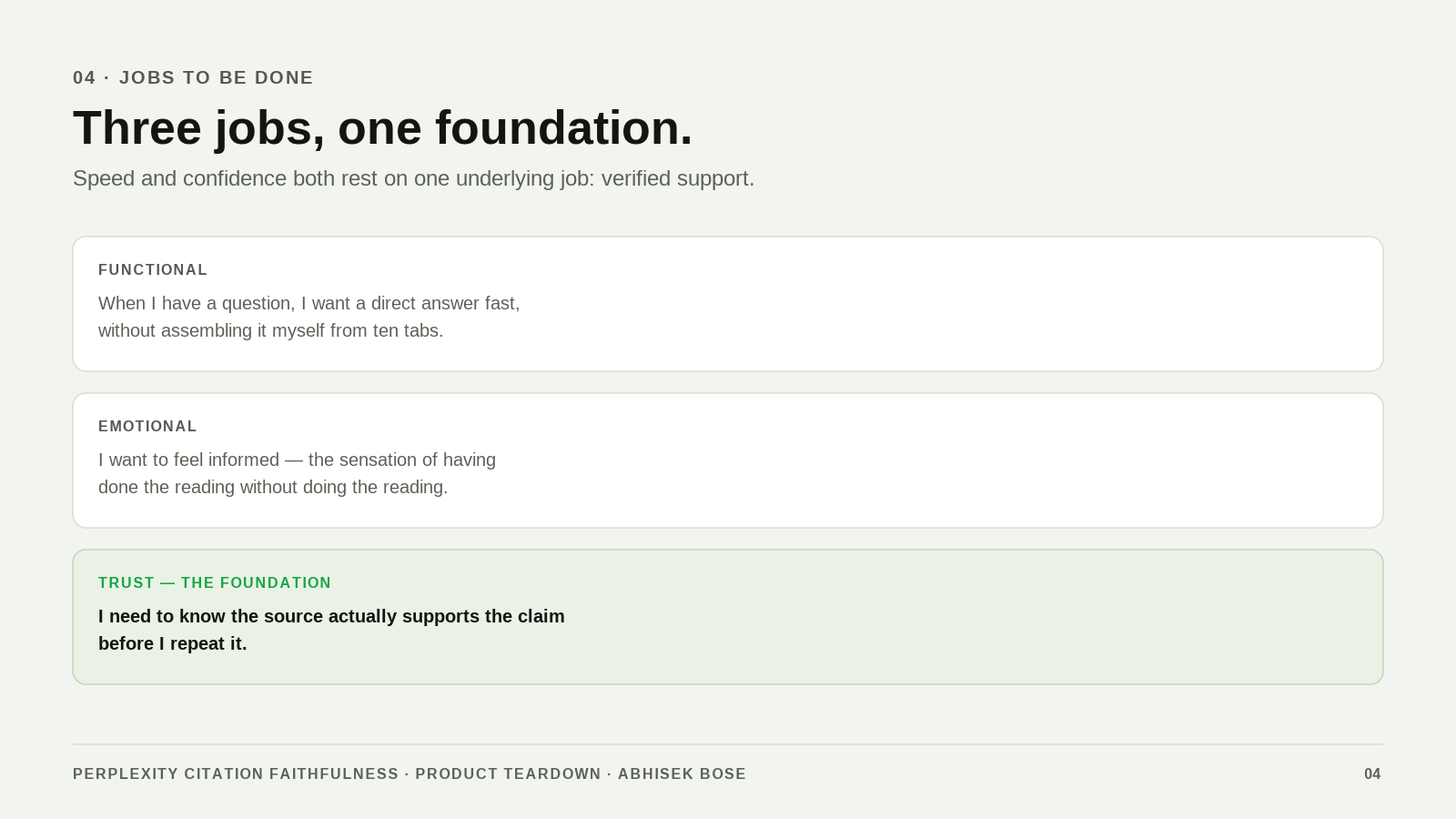
Speed and confidence both rest on one underlying job: verified support.
05 · How the product actually works
The pipeline is real infrastructure. A query fans out to web retrieval; a reranker selects passages into the generator's context; the model synthesizes an answer; citation markers attach to sentences based on which sources were in context; the answer renders with uniform typographic confidence.
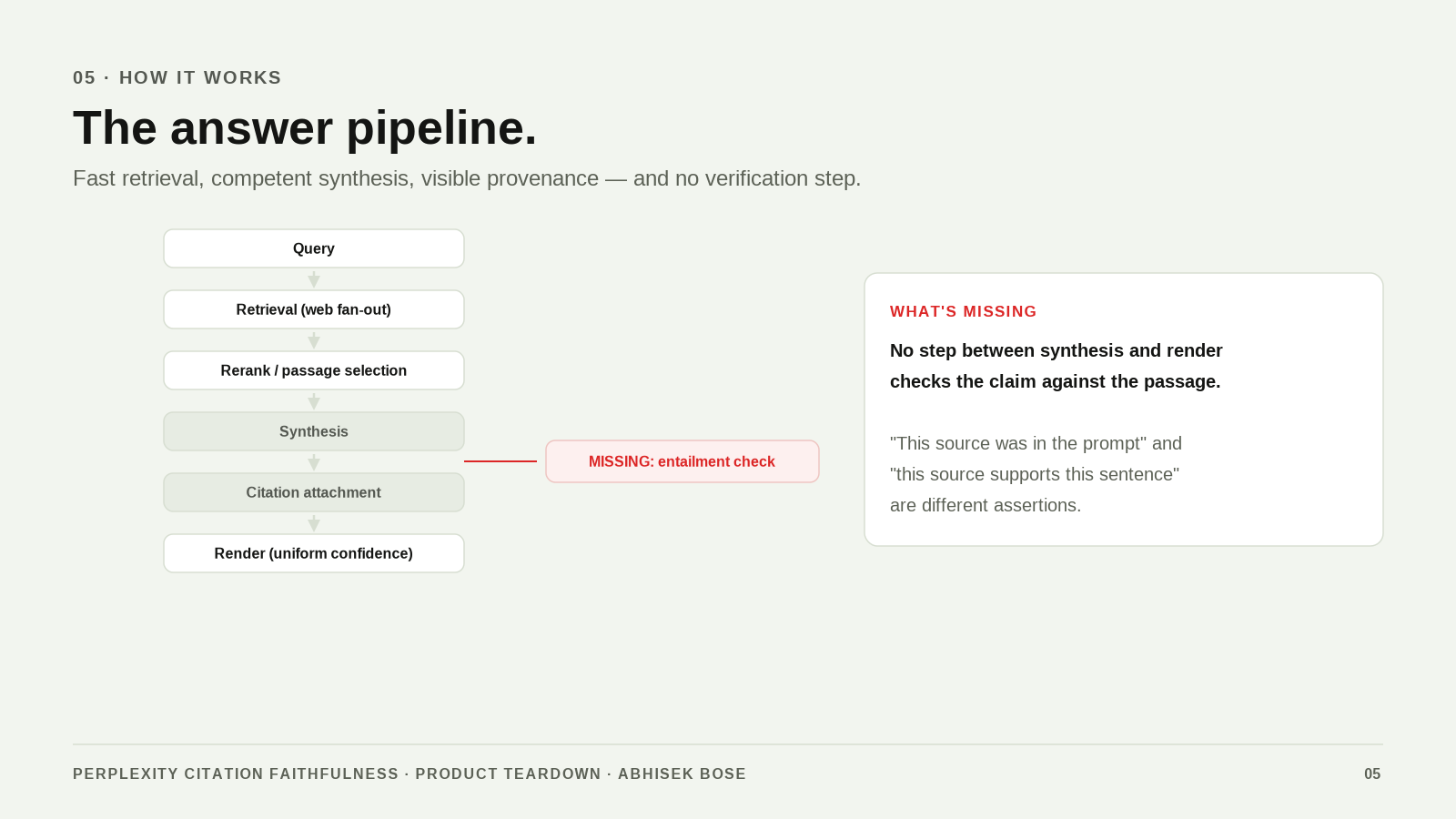
Good chassis: fast retrieval, competent synthesis, visible provenance. The verification step is what's missing.
Notice what's absent: any step between synthesis and render that checks whether the specific claim is entailed by the specific passage. "This source was in the prompt" and "this source supports this sentence" are different assertions. The pipeline ships the first as a proxy for the second, and those routinely diverge — synthesis across sources is where interpolation happens.
06 · Where trust actually lives
Map the trust decisions across one answered query and the problem becomes visible:
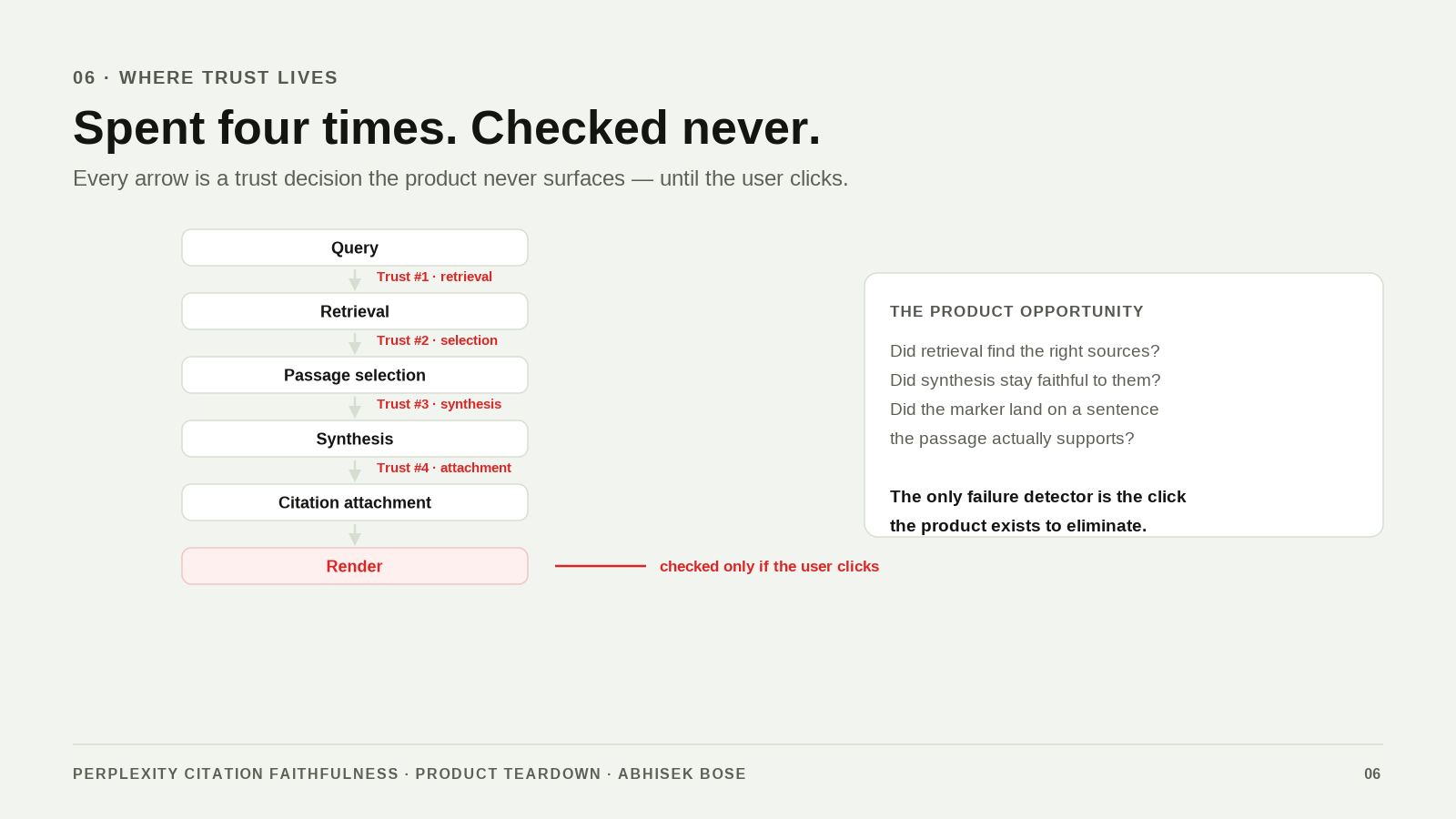
Four places trust is spent. Zero places it's checked — until the user clicks.
Trust is spent four times per answer — did retrieval find the right sources, did the reranker select the right passages, did synthesis stay faithful to them, did the marker land on the sentence it supports. The product surfaces exactly zero checkpoints. The only failure detector in the whole system is the user clicking the footnote, which is precisely the action the value proposition exists to eliminate.
07 · The real product gap — a concrete scenario
An analyst asks: "What margin guidance did the company give for next year?"
The cited 10-K says: gross margin guidance of 42–44%, withdrawn in the third quarter (illustrative estimate).
The answer asserts: "The company guided to 44% gross margins for next year." Footnote attached. Clean, confident, wrong.
The retrieval was correct — the 10-K is the right document. The citation is honest provenance. But the claim interpolates past the withdrawal, and the footnote lends it false authority. The analyst's memo now carries a number the filing doesn't support, with a receipt that says it does. The problem was never a missing source. It's unfaithful synthesis wearing a verified costume, and no amount of source quality fixes it.
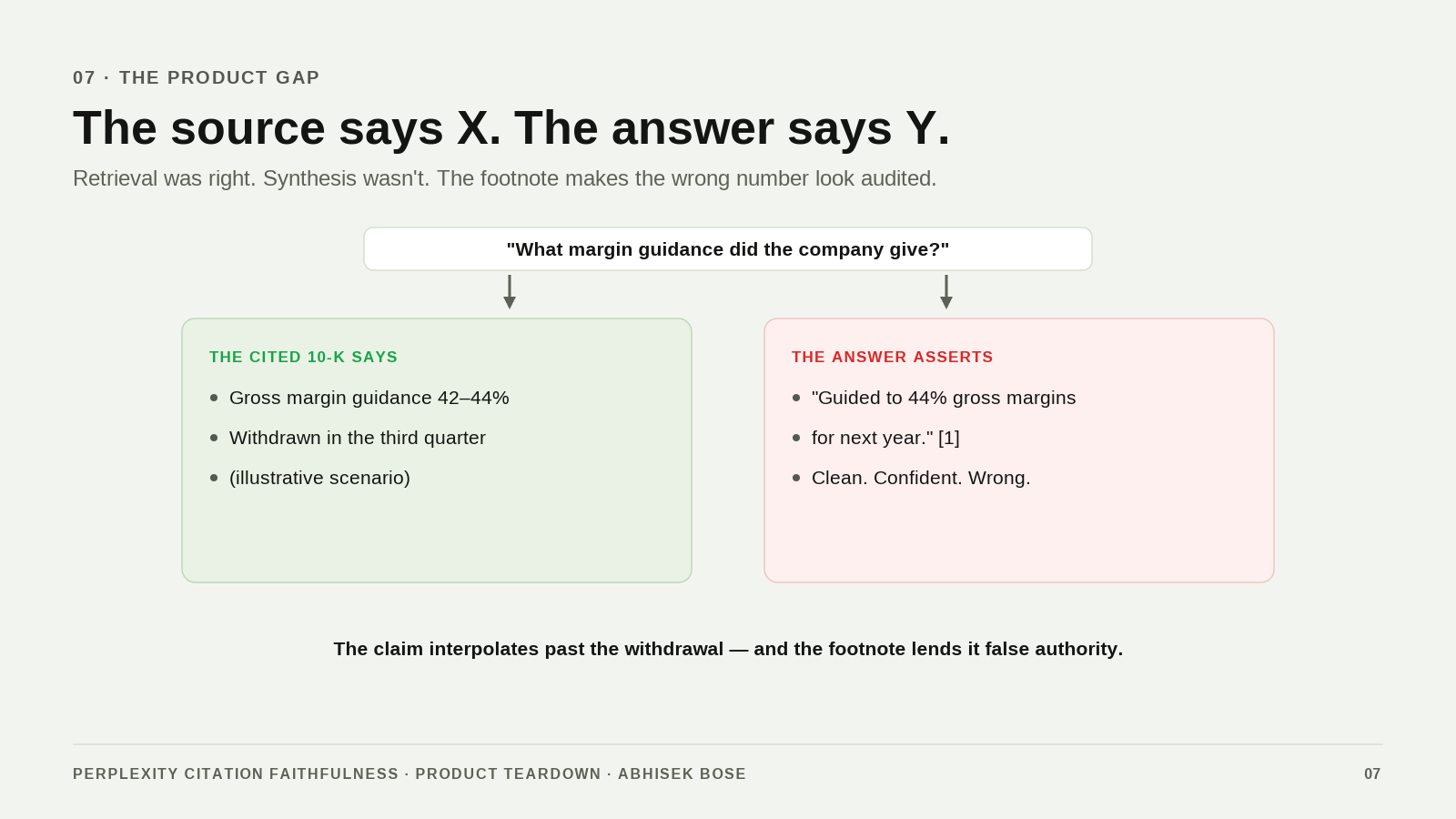
The source says X. The answer asserts Y. The footnote makes Y look audited.
08 · Current vs proposed trust model
Current: query → retrieval → synthesis → citations attached as decoration → render → user discovers the mismatch, if ever, at the most expensive possible moment.
Proposed: query → retrieval → synthesis → per-claim entailment gate → verified claims render with badges, unsupported claims regenerate or render flagged → user sees computed support, not asserted support.
A citation you haven't verified is a liability wearing the costume of evidence.
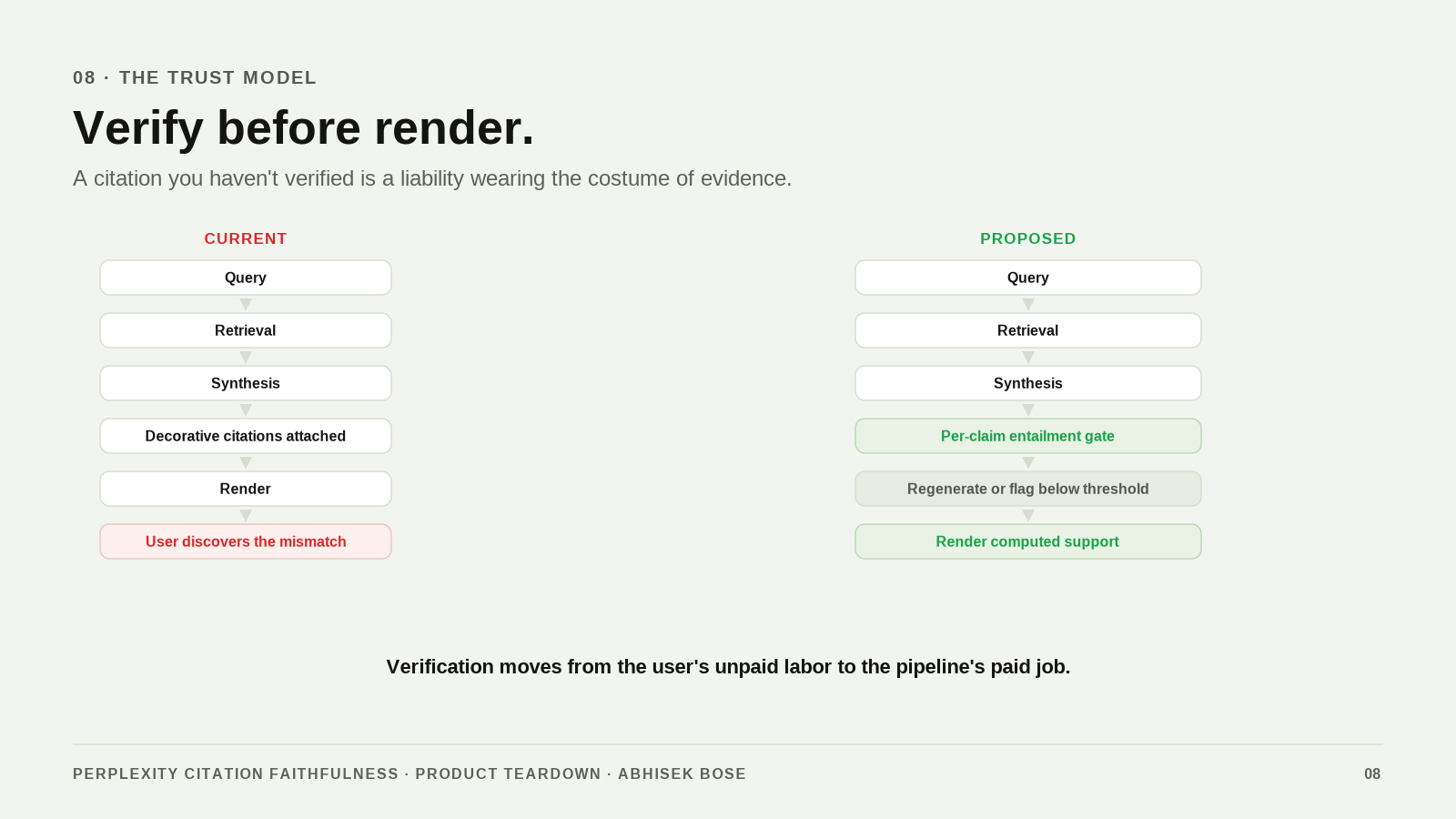
Verification moves from the user's unpaid labor to the pipeline's paid job.
09 · The artifact: the verified answer
"Add verification" is hand-waving unless you design the surface. This is the actual artifact — every rendered claim carries a support badge backed by an entailment score:
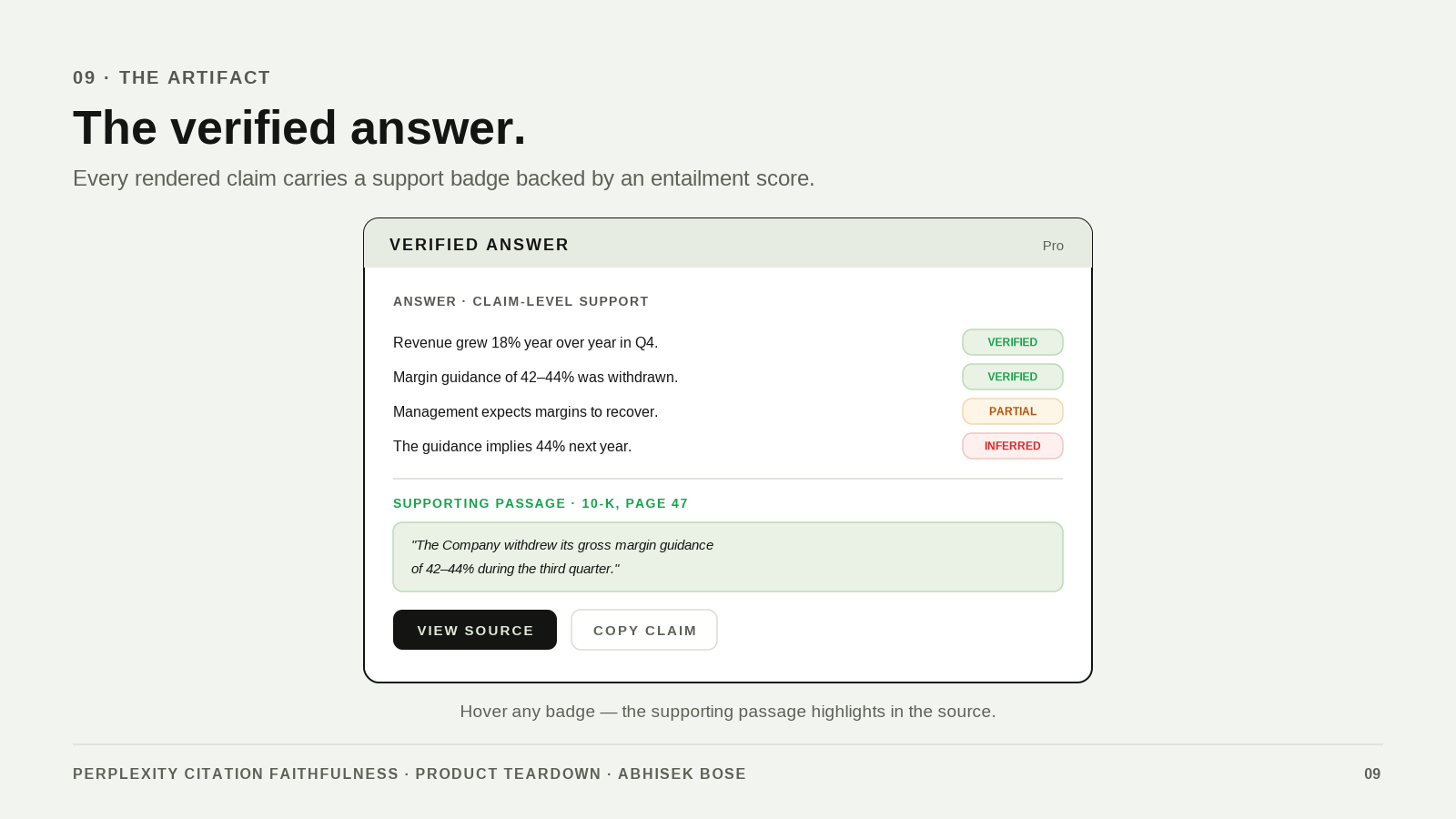
Three badge states — verified, partial, inferred — with hover-to-evidence: the supporting passage highlighted in the source.
Every state earns its place: verified means the passage entails the claim above threshold, partial means some support with interpolation, inferred means the model said it and no passage does. Hover shows the exact supporting sentence highlighted in context, so audit costs seconds instead of a tab-dive. I run this pattern in production: RAGOS, my RAG pipeline, scores every answer for faithfulness before it ships and holds 0.96 — the gate is buildable today. What's missing at Perplexity is the product decision to make it the render contract.
10 · Below the threshold — the interaction
The gate isn't a report card, it's a runtime boundary. When a claim scores under the support threshold, it doesn't render as verified:
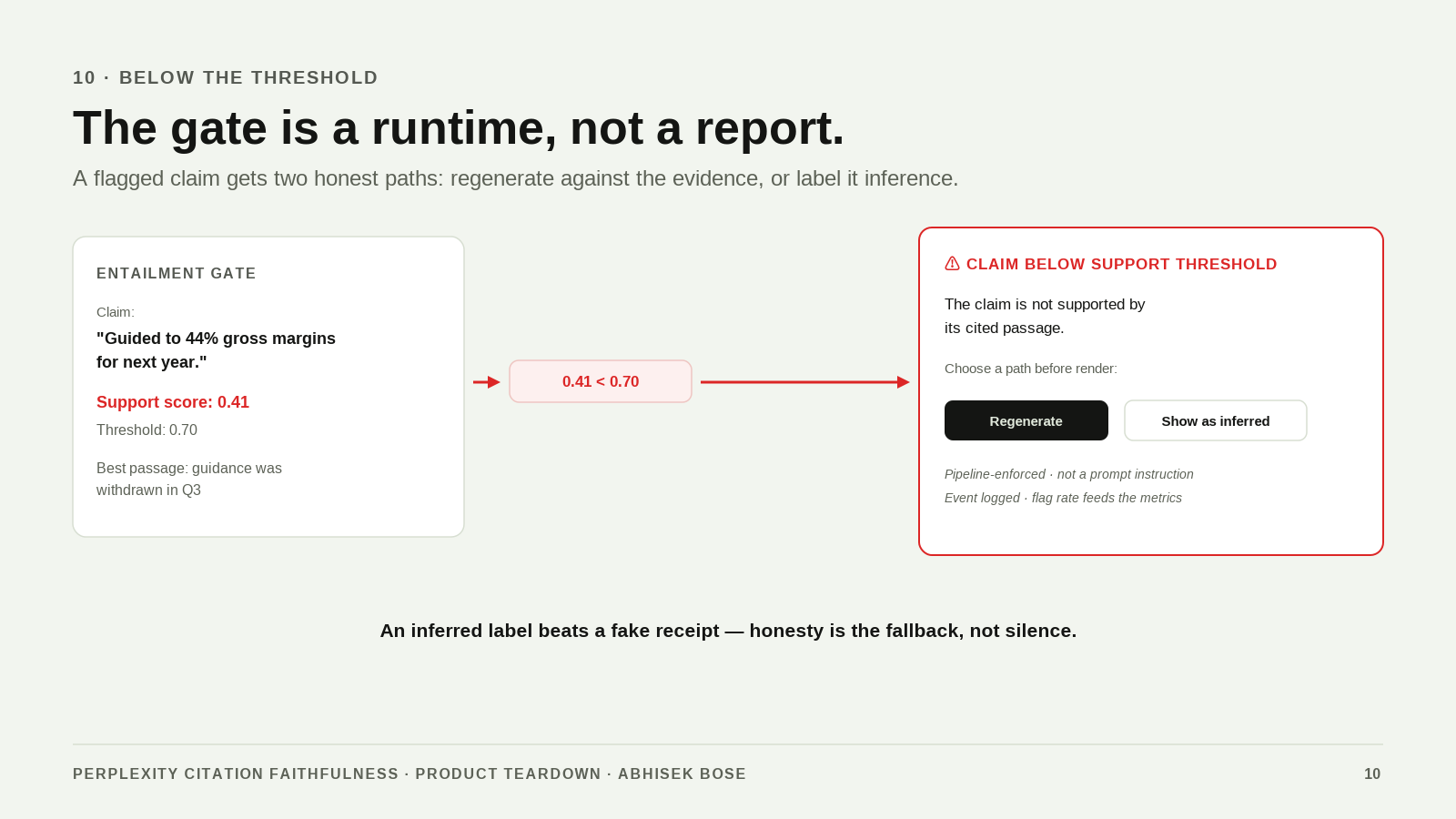
A flagged claim gets two honest paths: regenerate against the evidence, or render labeled as inference.
Three properties matter: the gate is pipeline-enforced (not a prompt instruction the model can ignore), the fallback is honest (an inferred label beats a fake receipt every time), and every below-threshold event is logged (the flag rate becomes a metric, see section 12). The latency cost is real — charge it to Pro, where the verifying persona lives.
11 · Category view: trust abstractions, not feature lists
Comparing Perplexity vs Google AI Overviews vs ChatGPT search feature-by-feature misses the point. Compare the trust abstraction each pattern ships:
| Product pattern | Primary trust mechanism |
|---|---|
| Uncited chat | User trusts the model's vibes |
| Links-only search | User reads and judges the sources |
| Decorated citations | User assumes the footnote means support |
| Verified citations | System computes support; user sees the score |
Every existing pattern puts verification either entirely on the user or nowhere. Nobody has shipped the fourth row: support computed per claim, surfaced per claim, gated per deploy. Perplexity is best positioned to build it — its brand is the footnote, and its rivals can lose the citation-quality fight indefinitely because neither is positioned on citations.
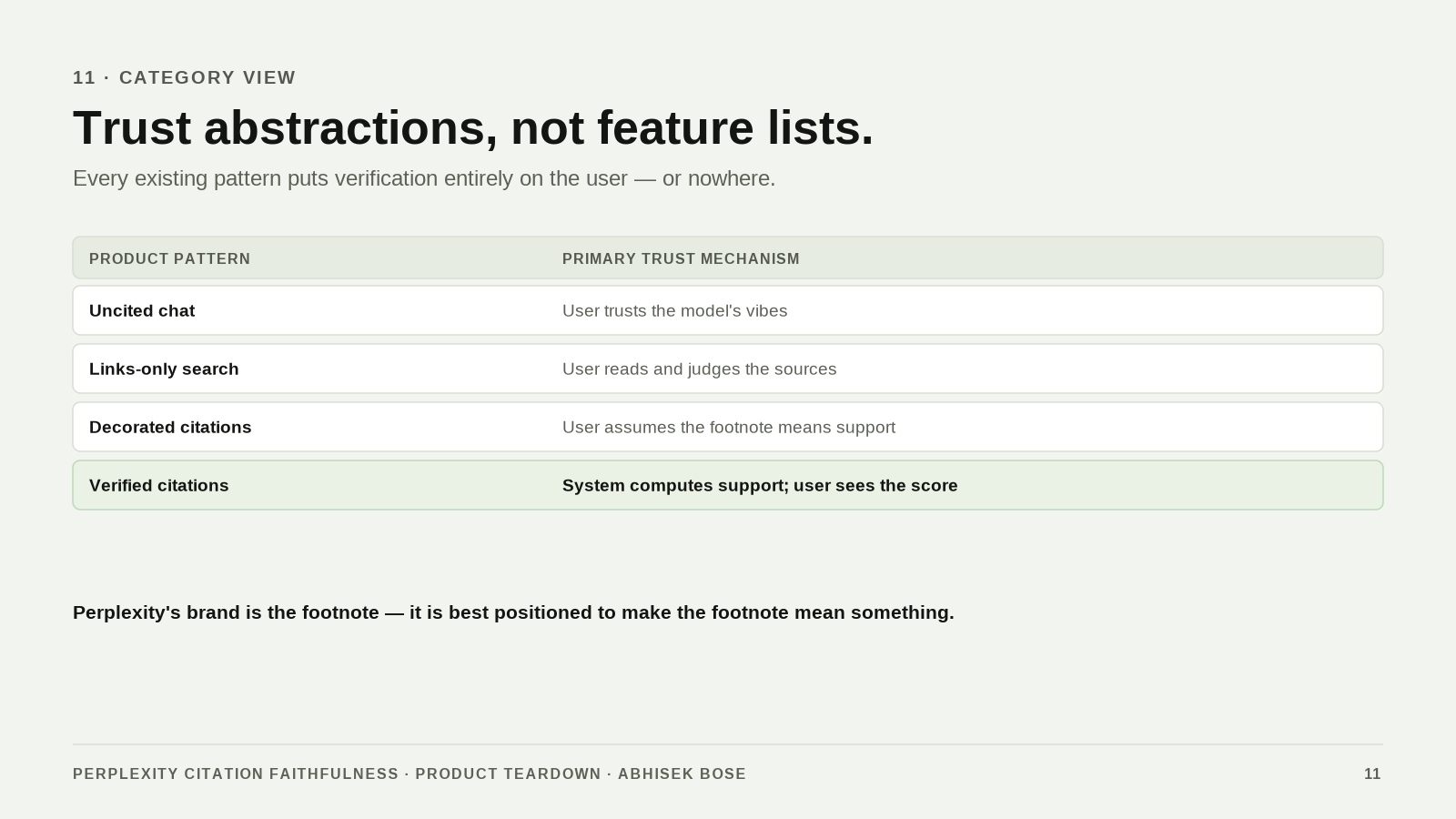
The open position in the category: support computed by the system, not assumed by the user.
12 · Metrics that prove the thesis
Not engagement. A measurement system where each metric tests one link in the trust loop — the same claim-level scoring discipline I run in RAGOS, where every production answer carries its own faithfulness score:
- Claim-level support rate — % of rendered claims passing entailment. The direct measure of whether footnotes mean what users think they mean.
- Citation CTR: flagged vs verified — tests whether badges are calibrated to real doubt, or decoration replacing decoration.
- Golden-set delta per deploy — tests whether model and reranker changes silently trade faithfulness for fluency.
- Retention after a caught error — tests whether the verification layer converts caught errors into forgiven errors.
- Verified-badge hover rate — tests whether users actually consume the evidence, or just the green.
- Enterprise seat retention — the only trust metric that can't be gamed: compliance-bound accounts don't renew products they've banned.
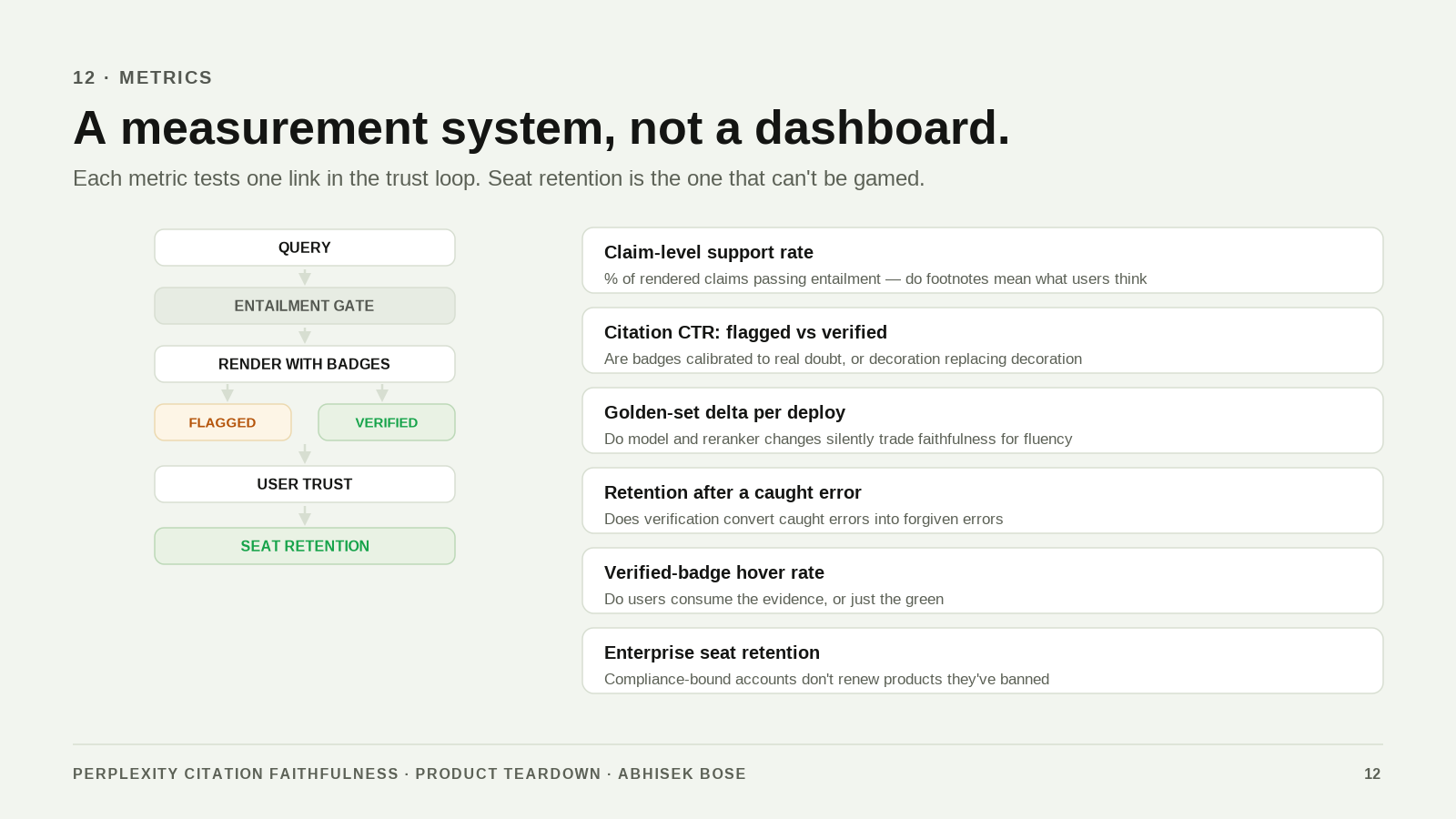
One loop, six instruments — seat retention is the metric the others exist to move.
13 · The experiment
Don't build it on conviction. Run the test:
Control: current render — citations attached, uniform confidence. Treatment: entailment-gated render — claim badges, hover-to-evidence, below-threshold flow.
Hypothesis: computed support increases retention among verifying users and does not reduce answer acceptance among casual users.
Primary metric: retention of verifying users — the cohort that clicks citations at baseline. Secondary: claim-level support rate, badge hover rate, flagged-claim CTR, follow-up rate. Guardrail: answer latency — if the gate adds more than a beat of perceived wait (say, p95 +400ms) (illustrative estimate), the verification is right and the product is wrong.
Kill criterion: if verifying users retain no differently under badges and the hover rate rounds to zero, users don't want computed trust — they want the feeling of it — and the investment belongs in source quality, not verification UI.
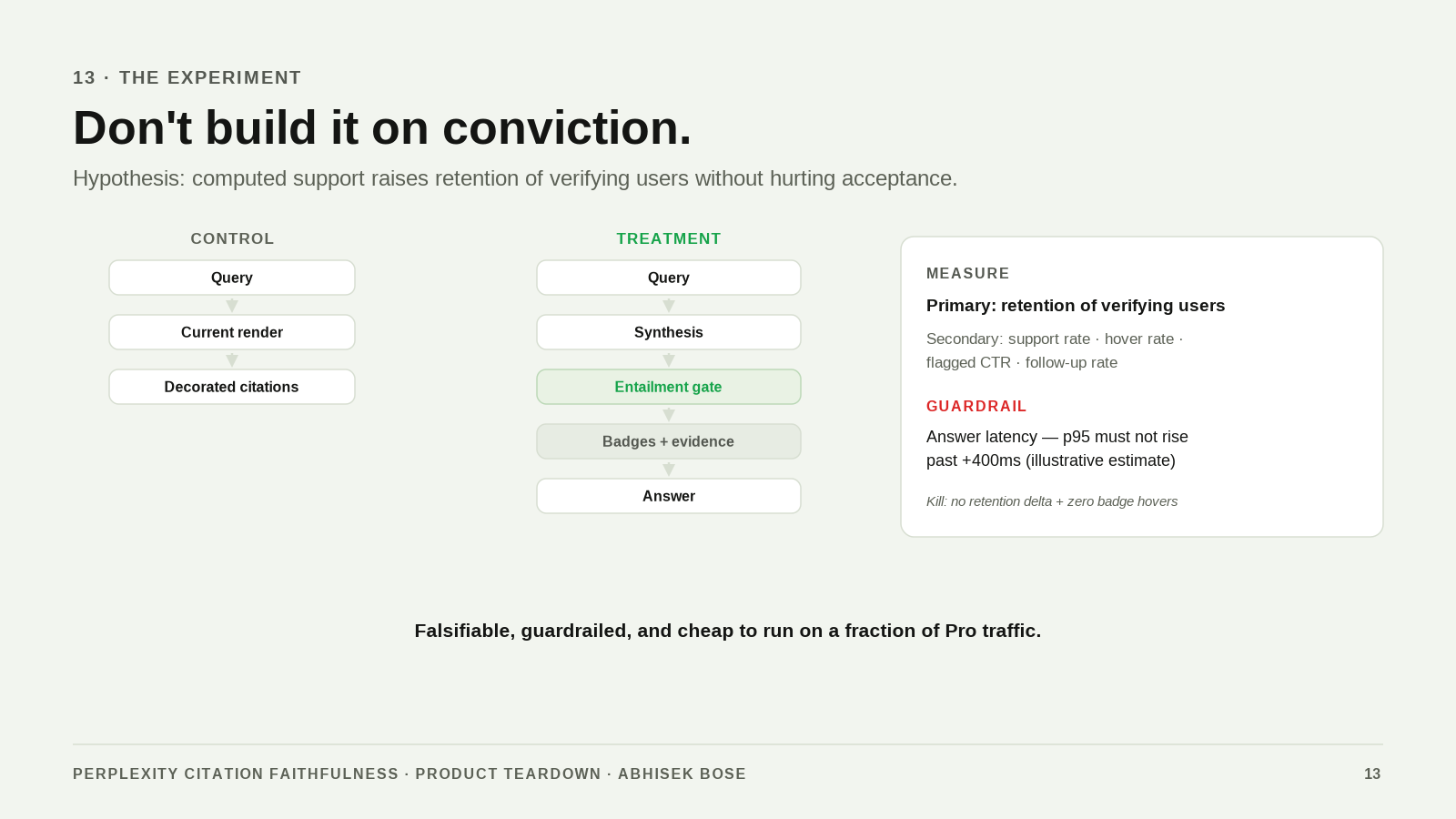
Falsifiable, guardrailed, and cheap to run on a fraction of Pro traffic.
14 · What I'd build first
| Feature | Impact | Effort | Priority |
|---|---|---|---|
| Golden set + offline entailment scoring | High | Medium | P0 |
| Claim badges on Pro answers | High | Medium | P0 |
| Below-threshold regenerate / inferred flow | High | Medium | P1 |
| Hover-to-evidence passage view | Medium | Medium | P1 |
| Public faithfulness scorecard | Medium | Low | P2 |
| Enterprise claim-level audit API | Medium | High | P2 |
The P0 pair ships the thesis: measure faithfulness before you gate on it, then put the score where users can see it. The golden set — a few thousand human-adjudicated claim-evidence pairs across verticals (illustrative estimate) — comes first because you cannot fix what you haven't measured. The scorecard is P2 by sequencing, not importance: publishing it turns a cost center into sales collateral.
15 · Final thesis
Answer engines won't win by synthesizing faster alone. They'll win by making answers verifiable.
The product opportunity isn't more citations. It's moving verification to the right point in the pipeline — from the user's unpaid, post-hoc audit to a computed gate the system enforces before render. Perplexity built its brand on the footnote and its pipeline on hoping nobody reads it. Verify the citation before you render it, publish the score, and the receipt stops being a liability and becomes the moat.
Trust computed, not claimed.
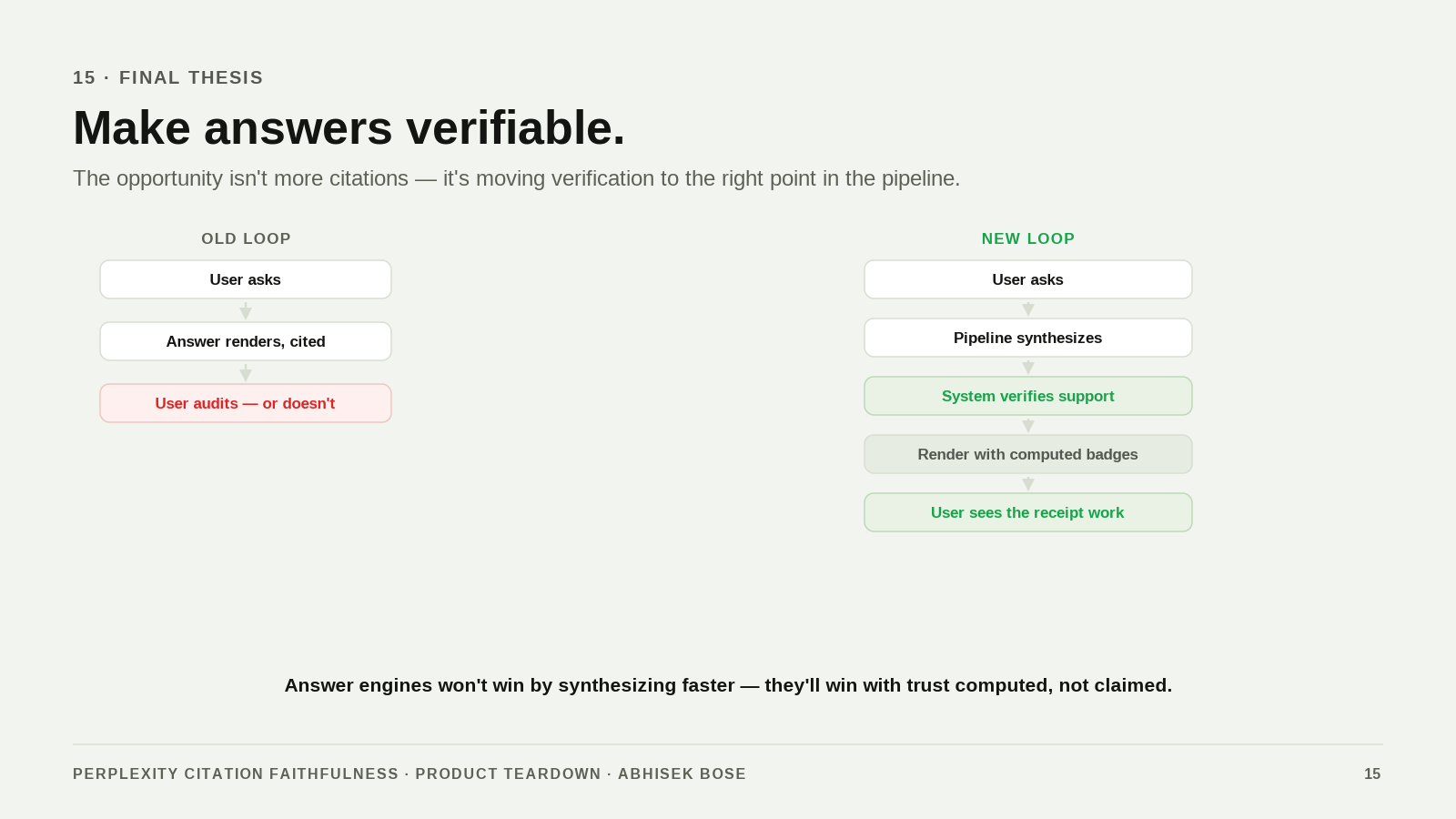
Old loop: verification is the user's job. New loop: verification is the pipeline's job, and the user sees the receipt work.
Sources
Observed claims in this teardown draw on:
- Introducing the Perplexity Publishers' Program — Perplexity's own announcement of ad-revenue sharing with cited publishers
- Perplexity launches ad revenue sharing program for publishers — sponsored related questions and the impressions-based ad model
- Perplexity begins sharing revenue with select publishers — launch partners and the double-digit revenue-share structure
Everything else is inferred product analysis or marked (illustrative estimate) inline.