Scenario: Tear down Intercom Fin — the AI support agent billed at $0.99 per resolution — and design the measurement layer that outcome pricing actually needs.
01 · The thesis
Intercom got the pricing model right. Outcome pricing beats seats: you pay for resolved conversations, not logged-in humans.
What's wrong: the outcome is graded by the vendor's own classifier, and every positive grade is a billable event. The grader and the payee are the same party.
My thesis: separate the grader from the payee. Outcome pricing is only honest when the outcome is verified by something the customer can audit.
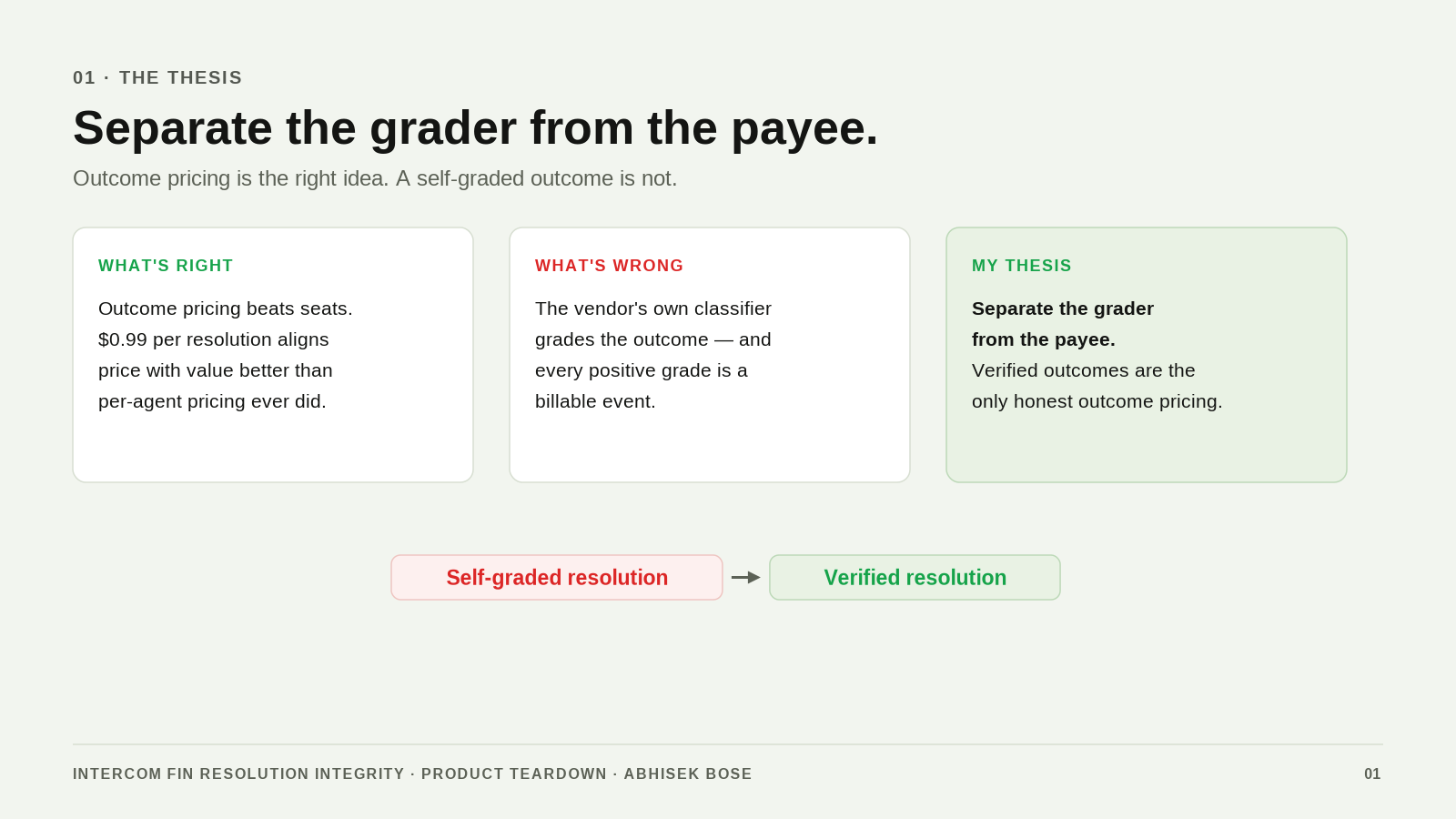
One screen: the pricing model is the right idea. The measurement architecture underneath it is the problem.
02 · Product evolution
Intercom's own history is the argument. Each step changed what the customer pays for — and quietly changed who decides whether the thing paid for actually happened:
| Era | User does | AI does | Billing unit |
|---|---|---|---|
| Help center | Reads articles | Nothing | A seat |
| Chatbot (Resolution Bot) | Picks from suggestions | Matches intents | A seat + add-on |
| Fin resolution agent | Asks in natural language | Retrieves, answers, closes | A seat + usage |
| Outcome pricing | Asks and (maybe) confirms | Answers and grades itself | A resolution — $0.99 |
The billing unit moved from "a human you employ" to "an outcome the vendor's classifier declares." The verification mechanism never moved with it. That gap is this teardown.
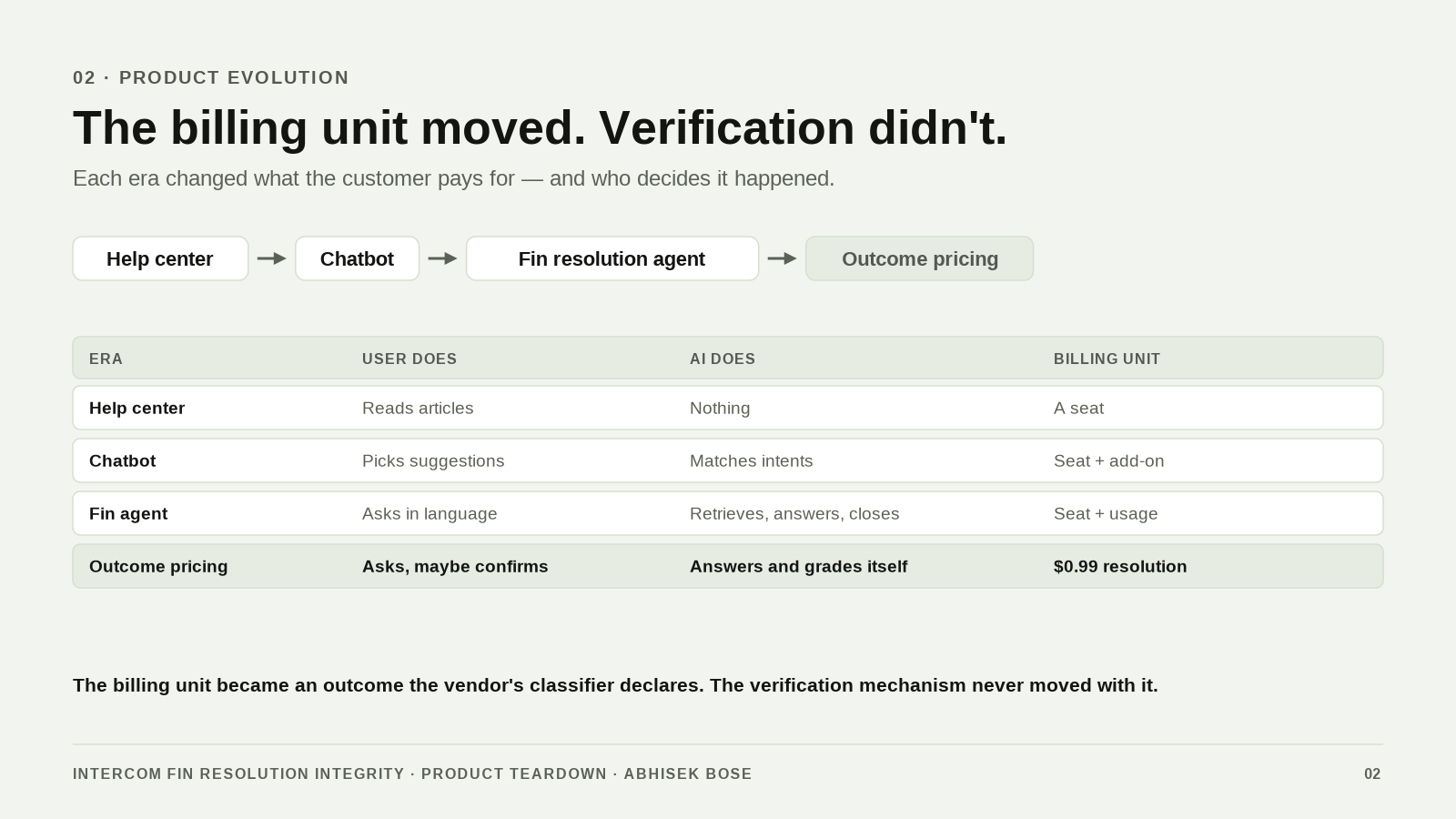
The billing unit evolved. The verification mechanism didn't.
03 · Who actually has this problem
Not "support teams." Three personas, three very different trust thresholds:
- SMB support lead — job: keep a two-person queue from drowning. Risk: an inflated invoice stings but the amounts are small. Trust threshold: medium.
- Mid-market head of support — job: defend a five-figure monthly Fin line (illustrative estimate) to a CFO. Risk: she promised a cost-per-resolution number she cannot currently prove. Trust threshold: high.
- Regulated-fintech support VP — job: scale support without compliance exposure. Risk: every customer-facing statement about fees or disputes must trace to an approved source; a billed wrong answer is both an invoice problem and an audit finding. Trust threshold: extremely high.
The pattern: the bigger the bill and the higher the stakes per wrong answer, the more the unverifiable resolution counter costs. Fin's current model serves the first persona and quietly taxes the two who fund the category.
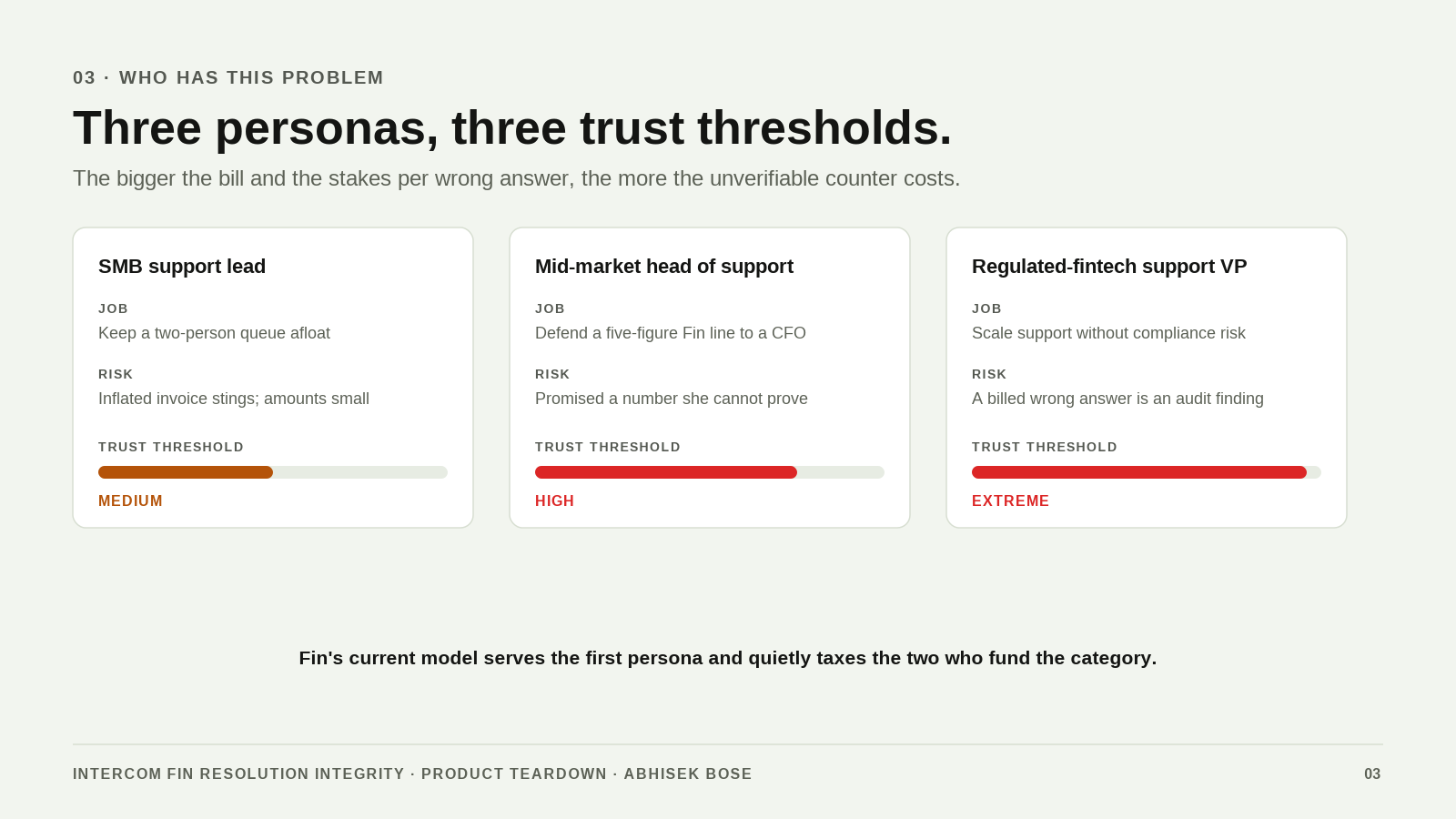
Trust threshold rises with the bill and the blast radius of a wrong answer.
04 · Jobs to be done
Functional JTBD: when tickets arrive, I want an AI agent to deflect the ones it can genuinely resolve, so my humans handle only what needs humans.
Emotional JTBD: I want to trust that the queue is handled — that silence in the dashboard means satisfied customers, not abandoned ones.
Trust JTBD: I need to know that a resolution I was billed for was a real resolution.
The third one is the foundation. Fin ships the functional job well, gestures at the emotional job with a resolution-rate dashboard, and has no product surface at all for the trust job.
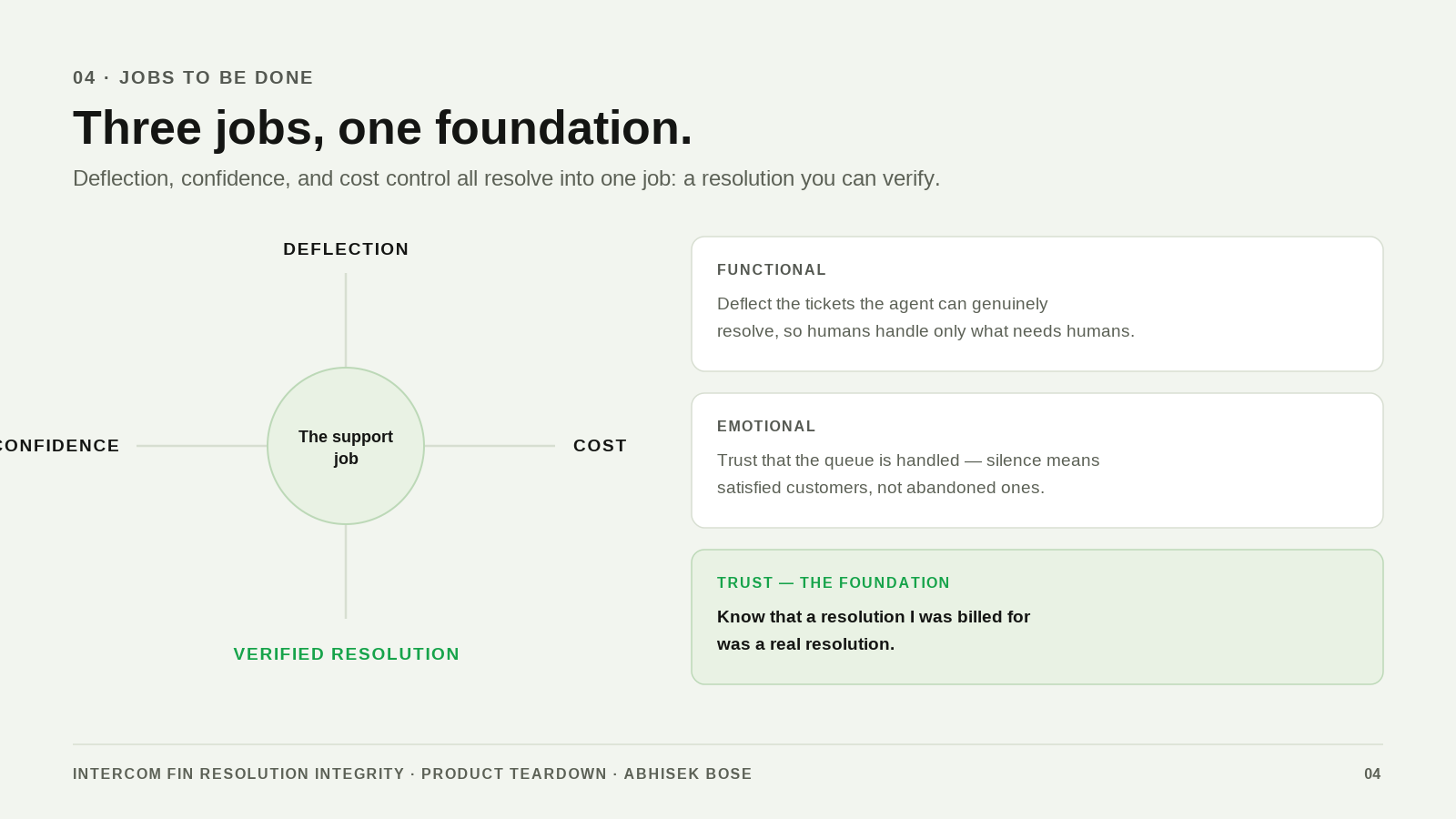
Deflection, confidence, and cost control all resolve into one underlying job: a resolution you can verify.
05 · How the product actually works
Fin is real infrastructure, not a FAQ widget. A customer asks a question → Fin retrieves from the help center and knowledge sources → generates an answer → then one of two things happens: the customer confirms it helped, or the customer goes silent. Both paths can end in a billable $0.99 event — the confirmed resolution explicitly, the silent one by assumption after a waiting window.
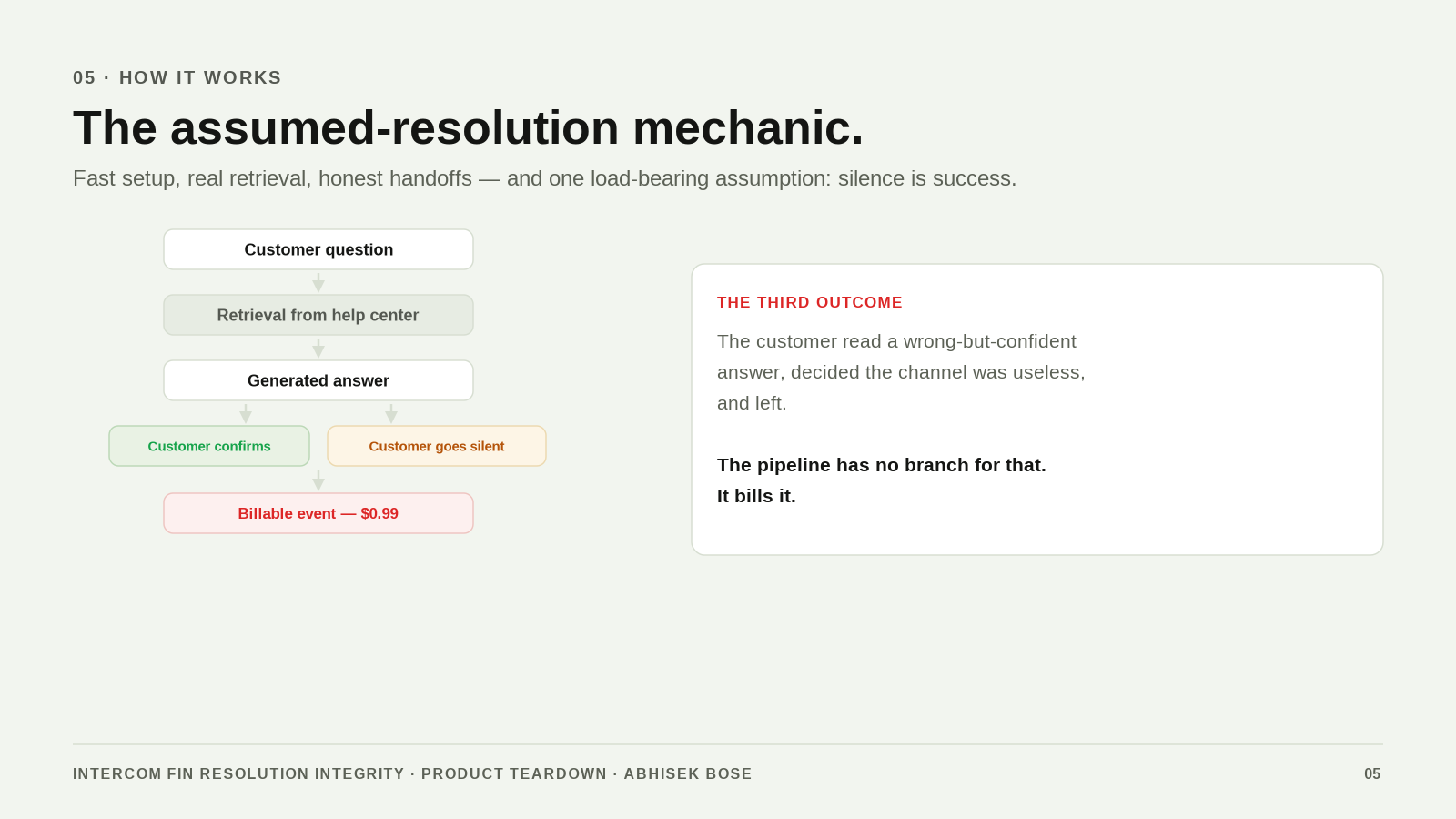
Good chassis: fast setup, real retrieval, honest handoff paths. The assumed-resolution mechanic is the load-bearing assumption.
Notice the mechanic: silence past the window is counted as success. Anyone who has run a production queue knows the third outcome — the customer read a wrong-but-confident answer, decided the channel was useless, and left. The pipeline has no branch for that. It bills it.
06 · Where trust actually lives
Map the trust decisions between a model output and an invoice and the problem becomes visible:
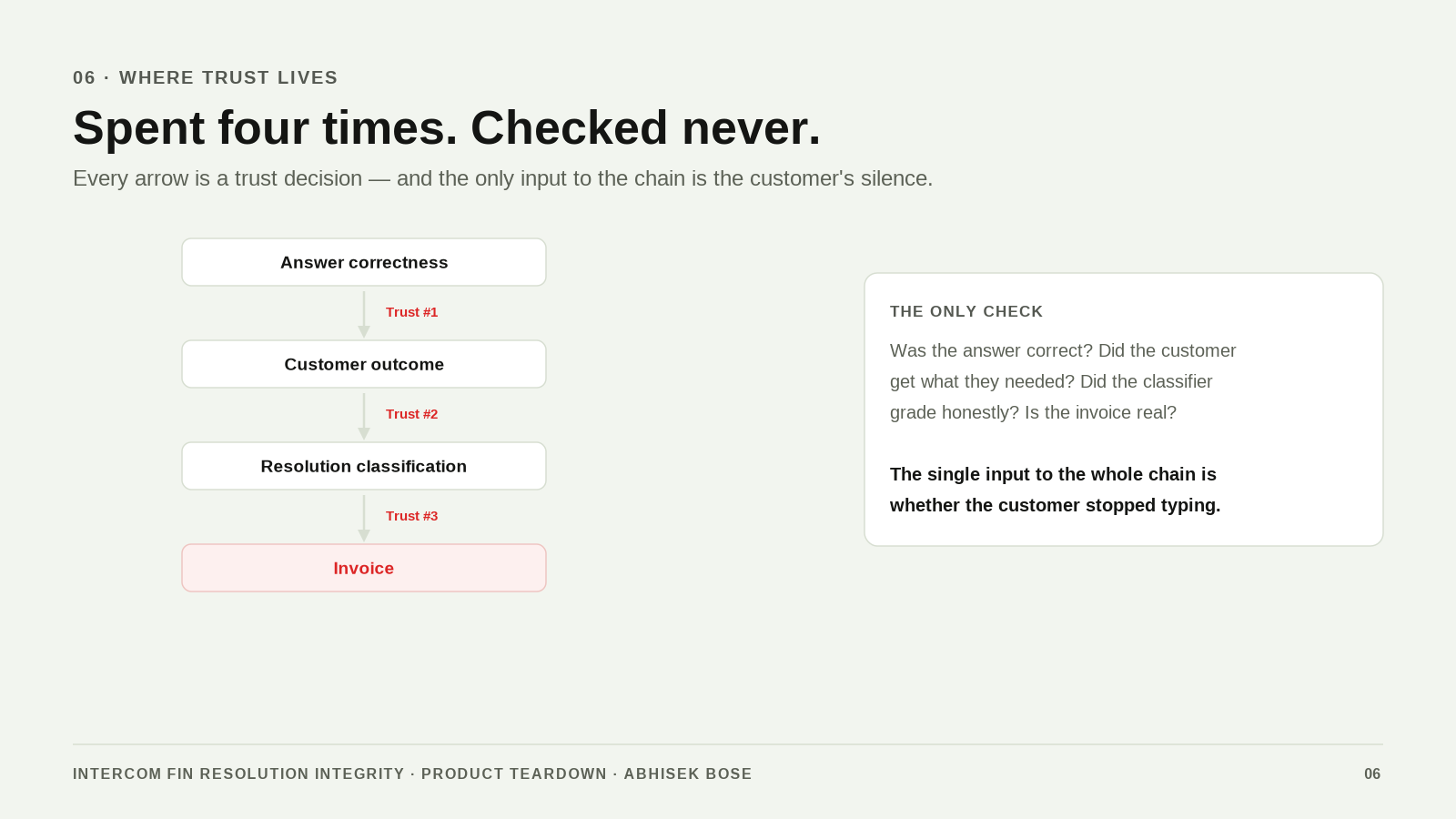
Four trust decisions between an answer and an invoice. The only check is the customer's silence.
Trust is spent four times per conversation — was the answer correct, did the customer actually get what they needed, did the classifier grade the outcome honestly, does the invoice reflect reality. The product surfaces exactly zero checkpoints. The single input to the whole chain is whether the customer stopped typing, and silence is the noisiest signal in support.
07 · The real product gap — a concrete scenario
A customer asks: "Can I get a refund if I cancel in the first month?"
Fin retrieves a help center article about the annual plan, answers confidently — and wrongly — that all cancellations are non-refundable. The customer reads it, decides arguing with a bot is pointless, and leaves.
No human requested. No reopen. The window closes. Billed: $0.99 — identically to a genuine fix.
The problem was never the hallucination rate in aggregate. It's that this specific failure mode is revenue. The abandonment and the resolution produce the same billable event, the same dashboard uptick, the same invoice line, and the customer's finance team has no way to tell them apart.
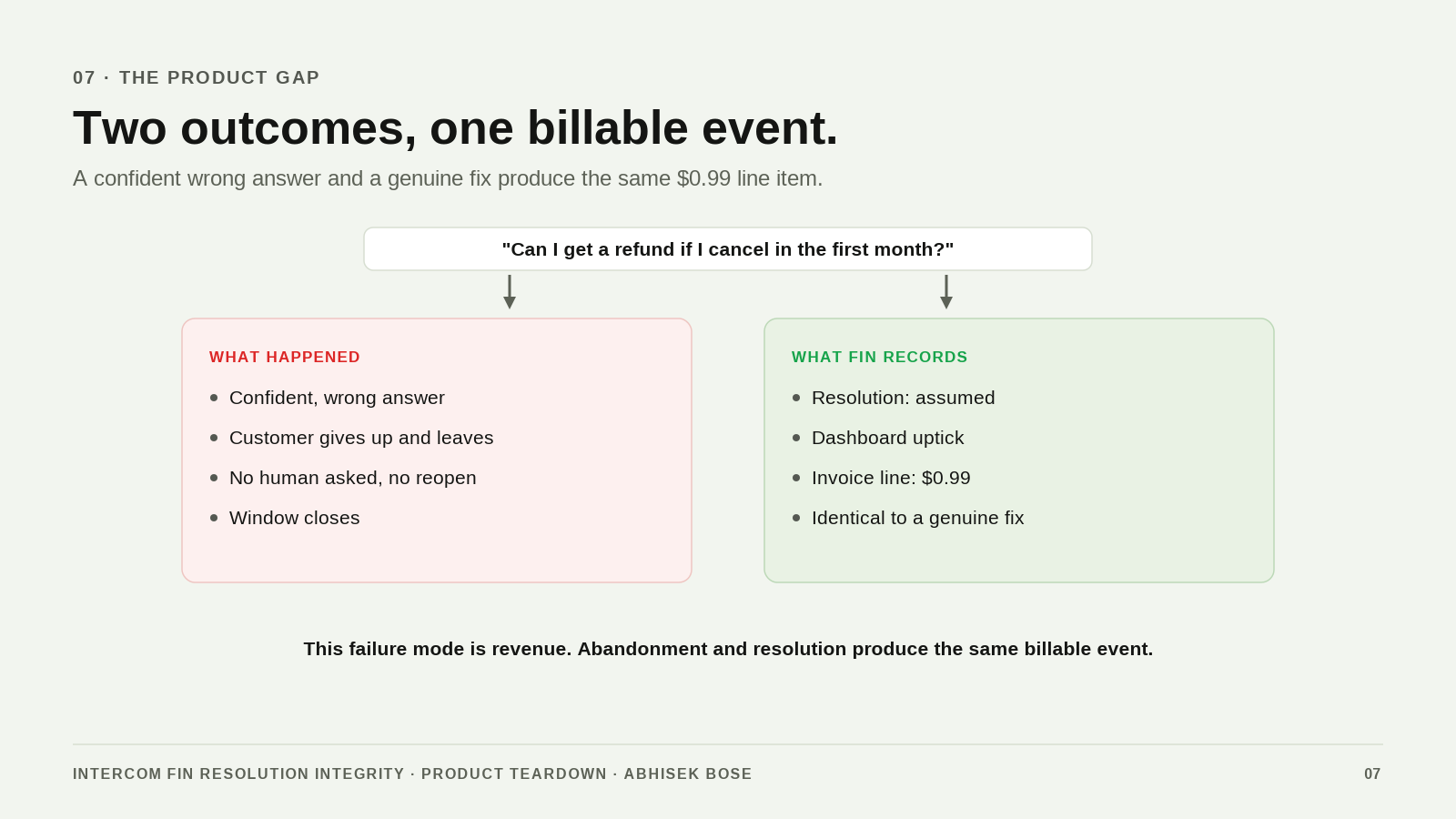
Two opposite outcomes, one billable event. The failure accrues as revenue.
08 · Current vs proposed trust model
Current: question → Fin answers → internal classifier marks it resolved → invoice → customer's only recourse is manual transcript archaeology, which dies of fatigue.
Proposed: question → Fin answers → evidence record attached (sources, faithfulness, classification confidence) → customer-auditable eval layer → invoice that references the evidence it's built on → dispute flow with billing credits.
A billing metric you can't audit isn't a metric. It's an invoice with a confidence interval.
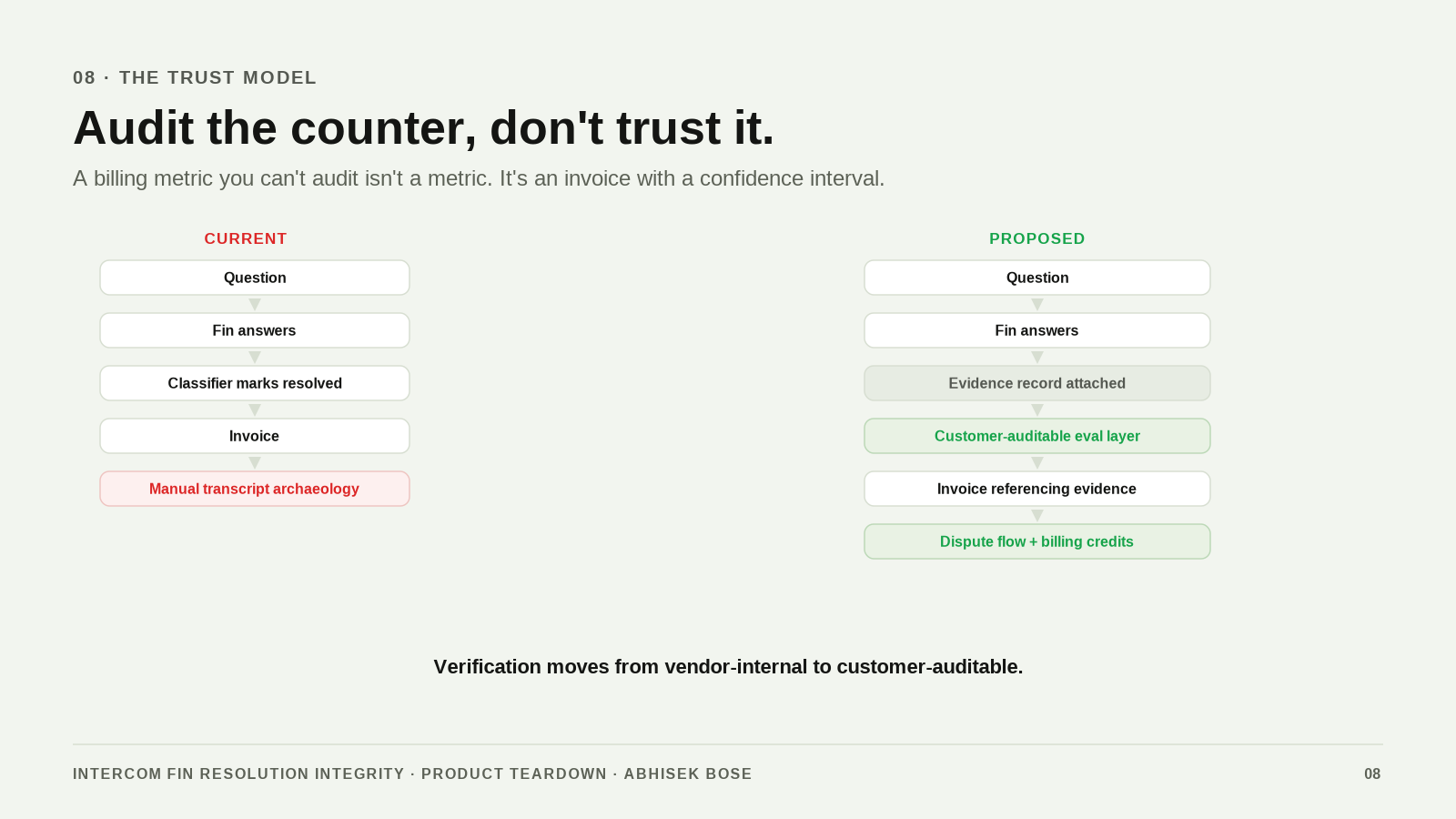
Verification moves from vendor-internal to customer-auditable — the only configuration in which outcome pricing is honest.
09 · The artifact: the resolution evidence record
"Make it auditable" is hand-waving unless you design the object. This is the actual artifact — attached to every billed event, small enough to scan in seconds, structured enough to dispute:
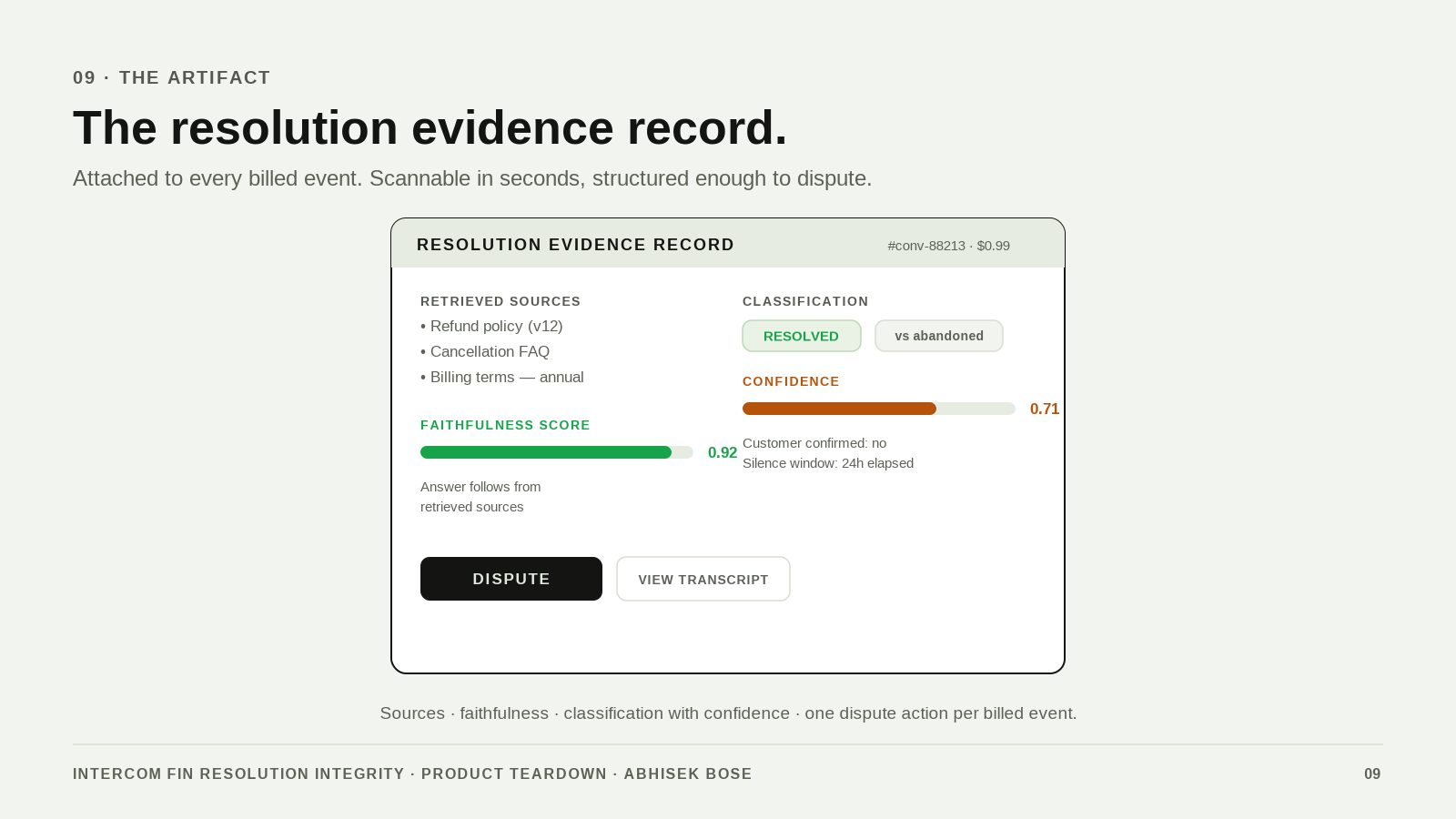
The evidence record: sources, faithfulness score, classification with confidence, one dispute action.
Every field earns its place: retrieved sources show what the answer was grounded in, the faithfulness score says whether the answer actually follows from those sources, the classification separates resolution from abandonment and states its confidence, and the dispute button makes the whole record contestable within the billing period. I run this pattern on the RAGOS support desk — a three-phase eval pipeline of golden-set retrieval checks, end-to-end answer tests, and LLM-judged production conversations — and none of it is exotic. What's missing at Intercom is the product decision to bill on top of it.
10 · The interaction: dispute and regrade
The evidence record isn't documentation, it's a runtime surface. A support leader flags a billed event → it's re-scored by an evaluator pipeline the customer can inspect → if the regrade overturns the classification, the event is credited on the next invoice:
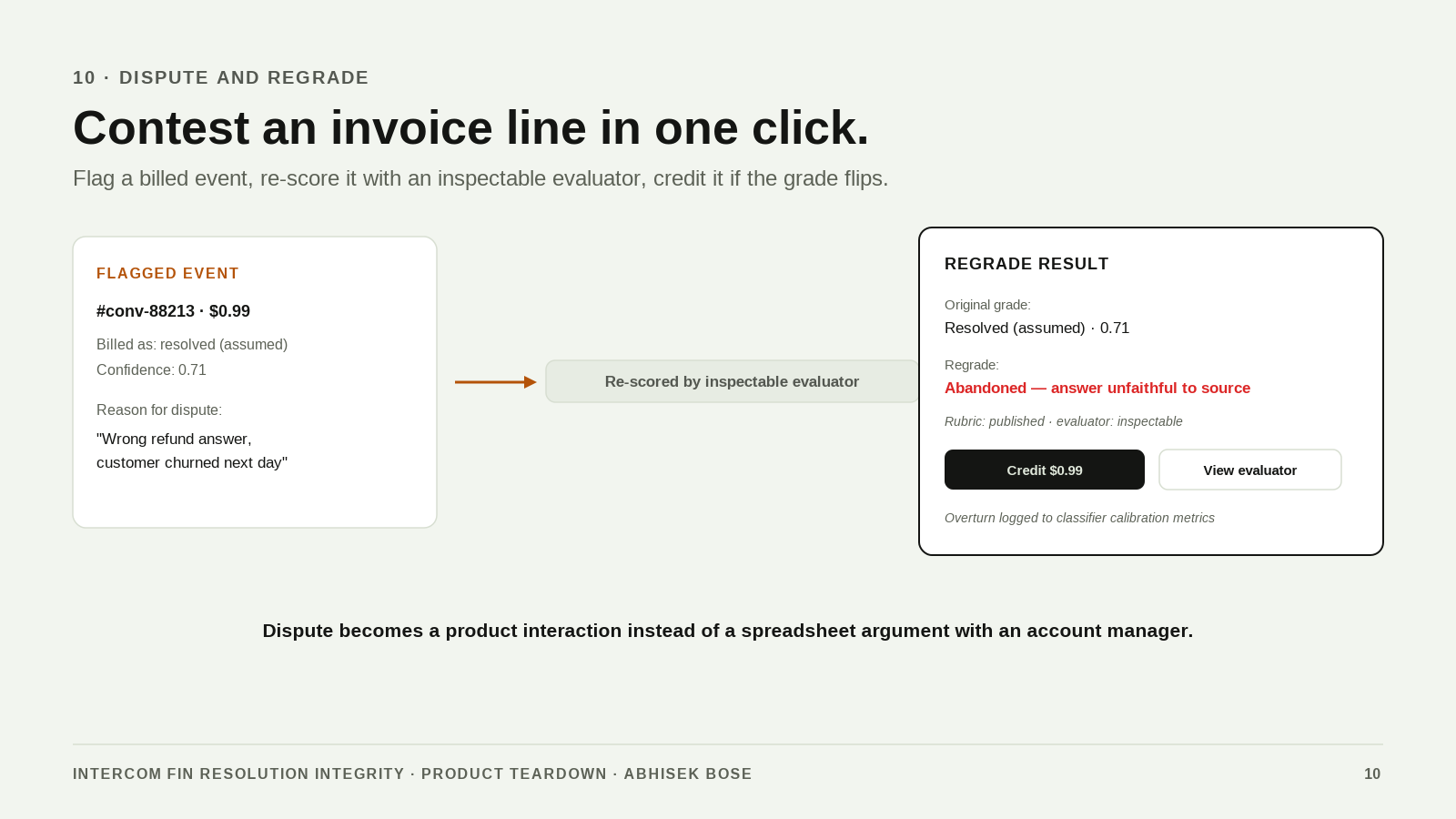
Dispute becomes a product interaction — flag, regrade, credit — instead of a spreadsheet argument with an account manager.
Three properties matter: the regrader is inspectable (published rubric, not another black box), the flow is cheap (one click per event, batch flagging for patterns), and every dispute is logged — dispute and overturn rates become the calibration check on the resolution classifier itself (see section 12).
11 · Category view: billing trust models, not features
Comparing Fin vs Zendesk vs Decagon feature-by-feature misses the point. Compare the billing trust model each pattern ships:
| Billing model | Who verifies the outcome |
|---|---|
| Seats | Nobody needs to — you pay for people, not outcomes |
| Per-conversation | Volume is self-evident; quality is unbilled |
| Self-graded per-resolution | The vendor's own classifier — the party getting paid |
| Verified per-resolution | A customer-auditable eval layer with a dispute path |
Zendesk moved to outcome pricing too, so self-graded resolution billing is becoming the category default, not Intercom's edge. Decagon and Sierra pitch enterprise buyers on custom evals where the customer sees the rubric. Nobody has shipped verified per-resolution as a product surface. First mover turns a pricing controversy into a moat — the RFP question becomes "whose resolution number can I defend to my CFO."
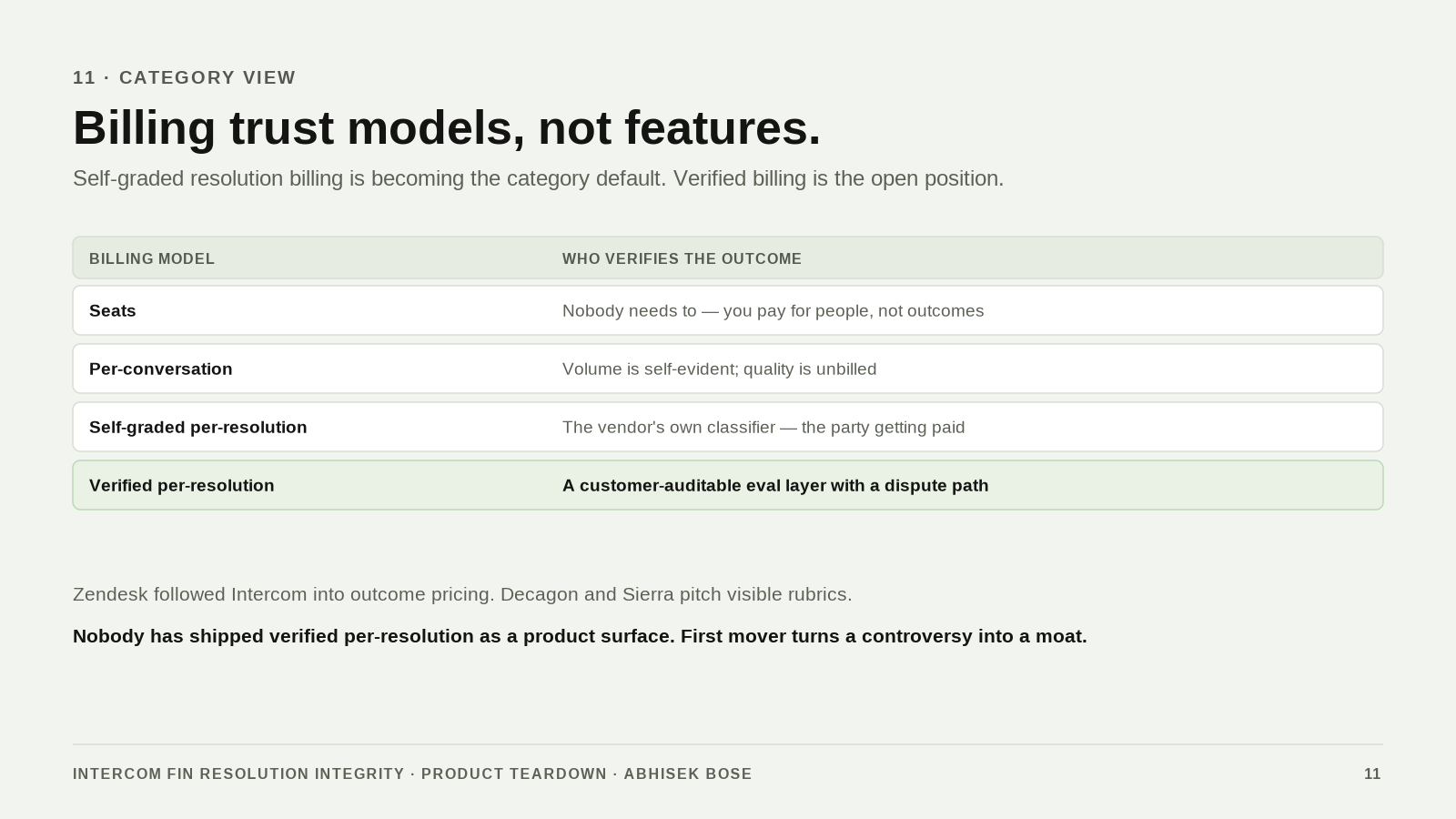
The open position in the category: outcome pricing with the grading taken away from the payee.
12 · Metrics that prove the thesis
Not engagement. A measurement system where each metric tests one link in the billing-trust loop:
- Deflection vs abandonment split — the headline. What share of "no human needed" outcomes were confirmed-satisfied versus silently-departed. Tells you whether the resolution rate is a quality number or a billing artifact.
- Dispute rate on billed events — whether customers trust the counter. Near-zero with audit tools available is earned trust; near-zero without them is just fatigue.
- Overturn rate on disputed events — the calibration check on the classifier. If regrades keep overturning, the grader is loose and the invoices were inflated.
- Escalation quality score — grades handoffs on context transfer and timing. A clean, well-summarized handoff is Fin's best behavior and currently its least rewarded.
- Golden-set drift across model updates — tells customers whether a Fin "improvement" improved their answers or just moved the billable-event distribution.
- Renewal after first audit — the metric that can't be gamed. Customers who audit their invoices and renew anyway are the trust signal everything else exists to move.
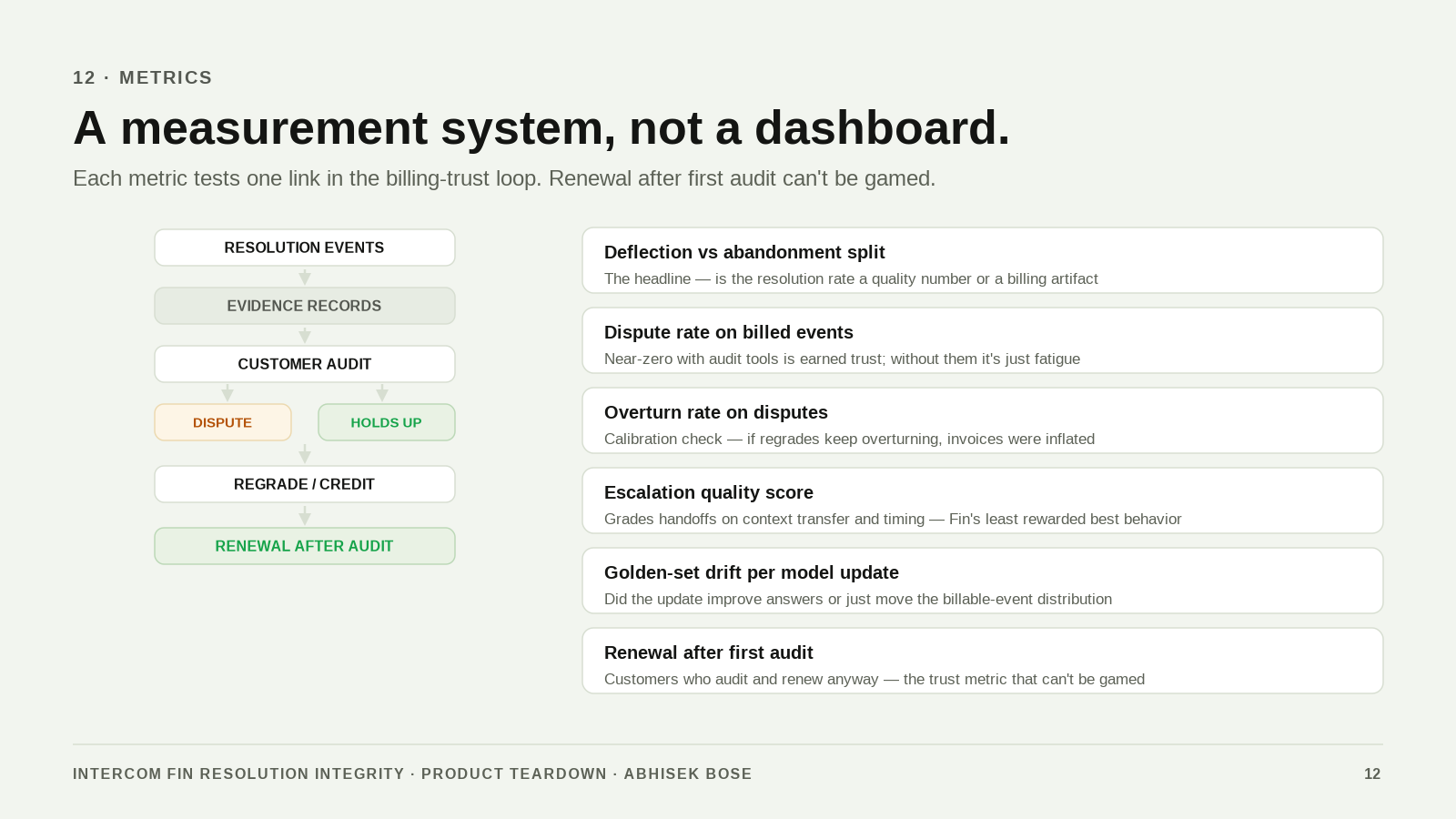
One loop, six instruments — renewal after first audit is the metric the others exist to move.
13 · The experiment
Don't build it on conviction. Run the test:
Control: current billing — classifier marks resolved, invoice ships. Treatment: evidence records on every billed event plus the dispute-and-regrade flow, on a customer cohort.
Hypothesis: auditability raises retention and net revenue — the credits paid out on overturned events are smaller than the churn and discounting avoided.
Primary metric: renewal rate and net revenue per account. Secondary: dispute rate, overturn rate, deflection-vs-abandonment split, expansion revenue. Guardrail: support-leader time spent on the audit surface must stay minutes per week — if auditing becomes a job, the tool failed.
Kill criterion: if audited resolutions overwhelmingly hold up as genuine, the measurement-integrity gap is overstated and the eval layer is compliance polish, not a category wedge.
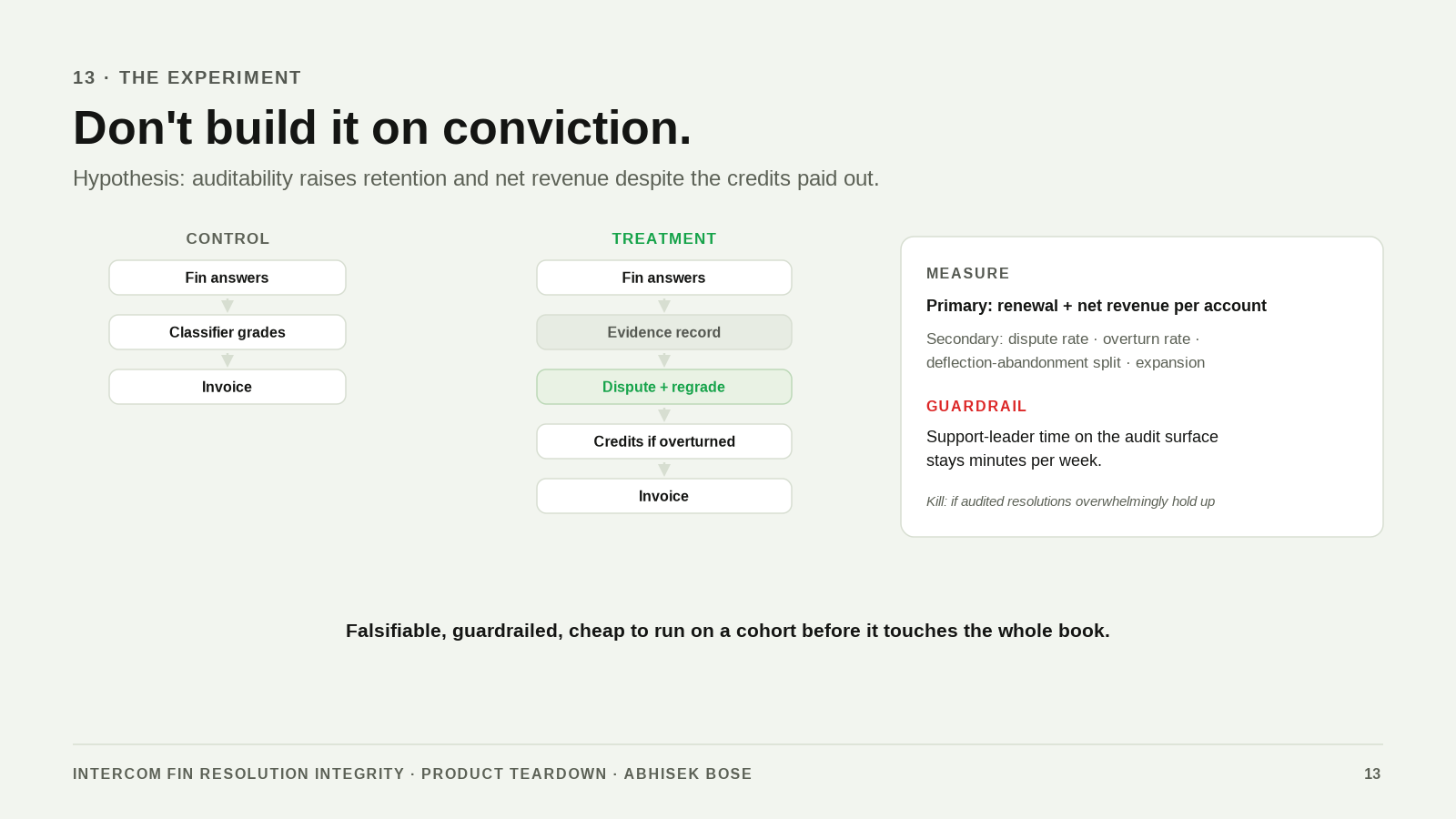
Falsifiable, guardrailed, and cheap to run on a cohort before it touches the whole book.
14 · What I'd build first
| Feature | Impact | Effort | Priority |
|---|---|---|---|
| Evidence record on every billed event | High | Medium | P0 |
| Deflection-vs-abandonment split in reporting | High | Low | P0 |
| Dispute-and-regrade flow with billing credits | High | Medium | P1 |
| Customer-runnable golden set per model update | High | Medium | P1 |
| Published resolution rubric + judge prompts | Medium | Low | P2 |
| Third-party attestation of the grading pipeline | Medium | High | P2 |
The P0 pair ships the thesis: per-event evidence worth auditing and a headline number that separates satisfaction from silence. The dispute flow is P1 because it needs the evidence record to exist first — sequencing, not importance.
15 · Final thesis
Fin got the pricing model right and the measurement architecture wrong, and the second will cap the first.
Outcome pricing is where AI software is heading, and Intercom deserves credit for shipping it first at scale. But an outcome only the vendor can grade isn't an outcome — it's a claim. Whoever ships the auditable resolution wins the category, because in outcome pricing the product isn't the answer — it's the proof.
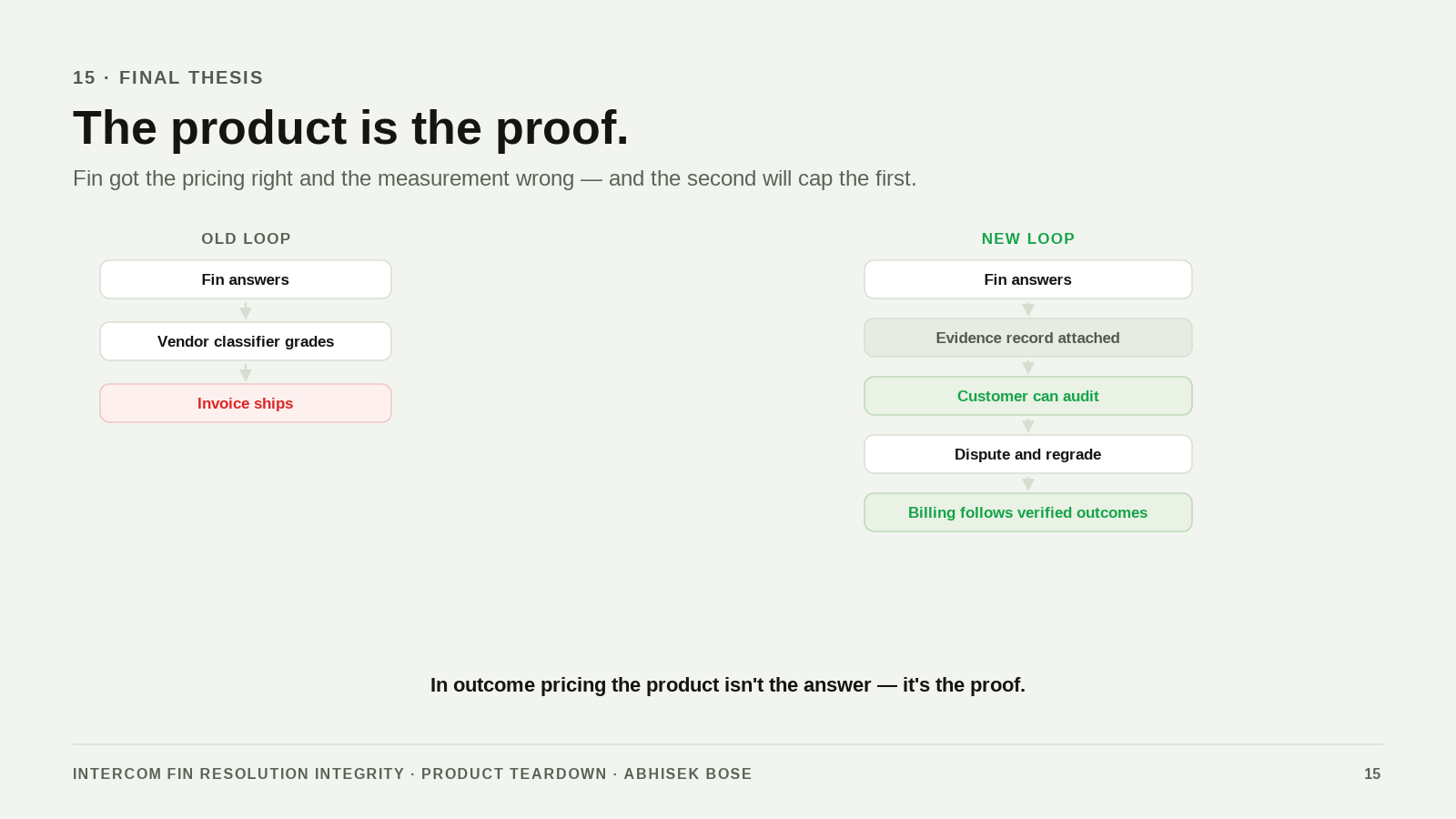
Old loop: the vendor grades its own revenue. New loop: the customer can check — and that's exactly why they'll pay.
Sources
Observed claims in this teardown draw on:
- Fin AI Agent pricing — Intercom's official $0.99-per-resolution pricing
- Intercom Fin AI pricing explained — the confirmed-vs-assumed resolution definition, including billing when a customer simply leaves
- Zendesk first in CX industry to offer outcome-based pricing for AI agents — the competitive shift to outcome pricing referenced in Market & Competition
Everything else is inferred product analysis or marked (illustrative estimate) inline.