Scenario: Tear down Grammarly under AI disruption — a correction brand that now sells generation — and design the provenance product that makes the two stop indicting each other.
01 · The thesis
Grammarly built twenty years of trust on one promise: this is still your voice, made correct. Then it shipped generative rewrites that replace your voice — sold through the same green UI, to the same users, in institutions that now run AI detectors against everything those users submit.
What changed: the product's two value props now indict each other. Correction trust lends credibility to generation; generation erodes correction trust.
The product problem: the user cannot prove which parts of her text are hers, and neither can Grammarly — even though Grammarly watched every keystroke.
My thesis: when text itself is free, the record of human contribution is the product.
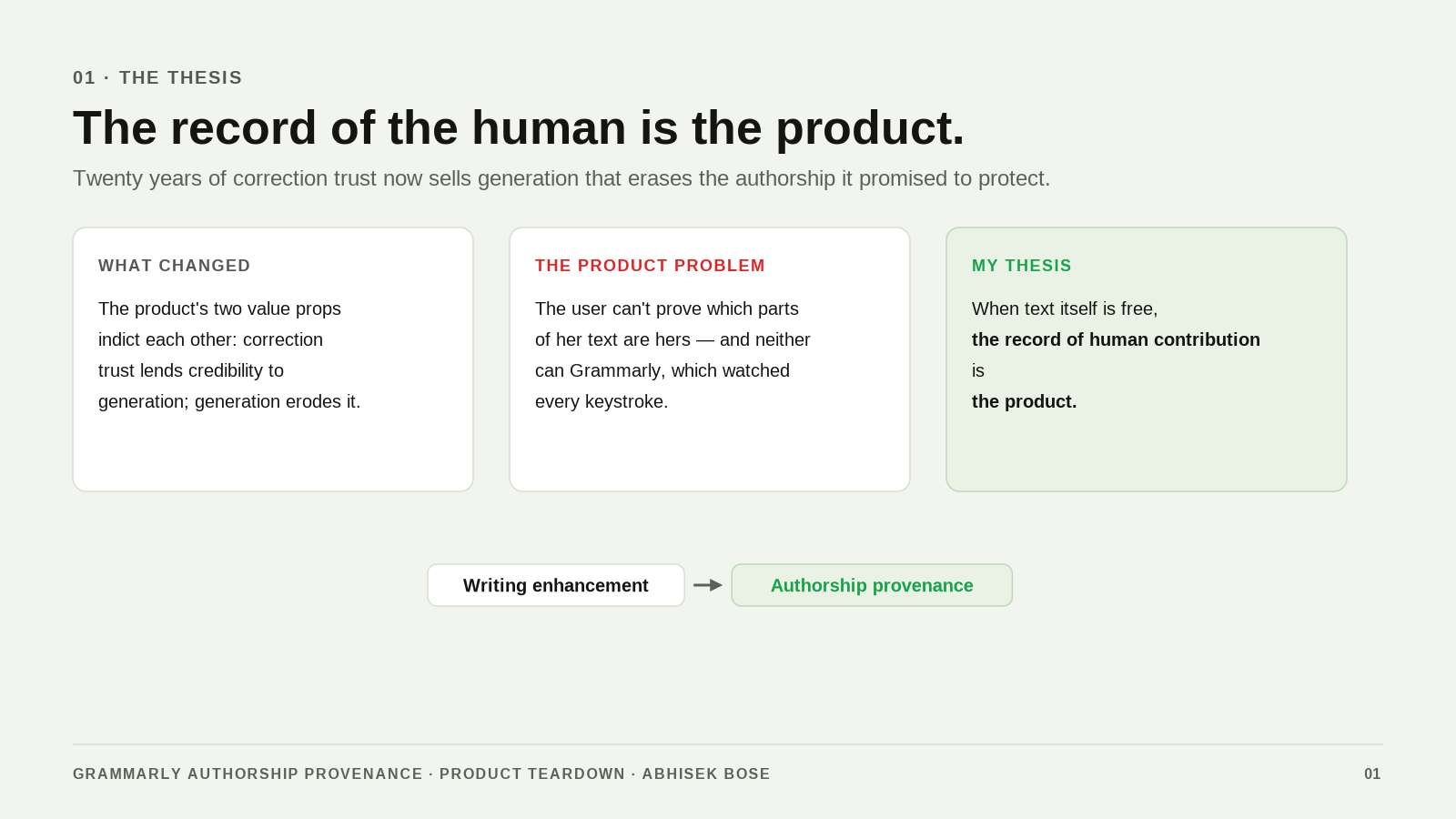
One screen: the collision between the correction brand and the generation feature, and where the product has to move.
02 · Product evolution
Grammarly's own history is the argument. Each era changed what the user submits — and quietly changed what the user can prove about it:
| Era | Promise to the user | What the user submits | What's provable |
|---|---|---|---|
| Grammar checker | Your writing, made correct | Their words, fixed | Everything — every edit was theirs |
| Tone & clarity | Your writing, made effective | Their words, reshaped | Mostly theirs — suggestions accepted one by one |
| Generative rewrites | Better writing, instantly | A blend they can't decompose | Nothing — no record separates them from the model |
| Superhuman / Coda agent suite | An AI that works for you | Output they may not have read | Less than nothing — authorship isn't even the frame |
The promise scaled. Provability collapsed. The Superhuman and Coda acquisitions push further toward the agent suite — the direction where the correction brand's core asset matters least, unless it's rebuilt as provenance.
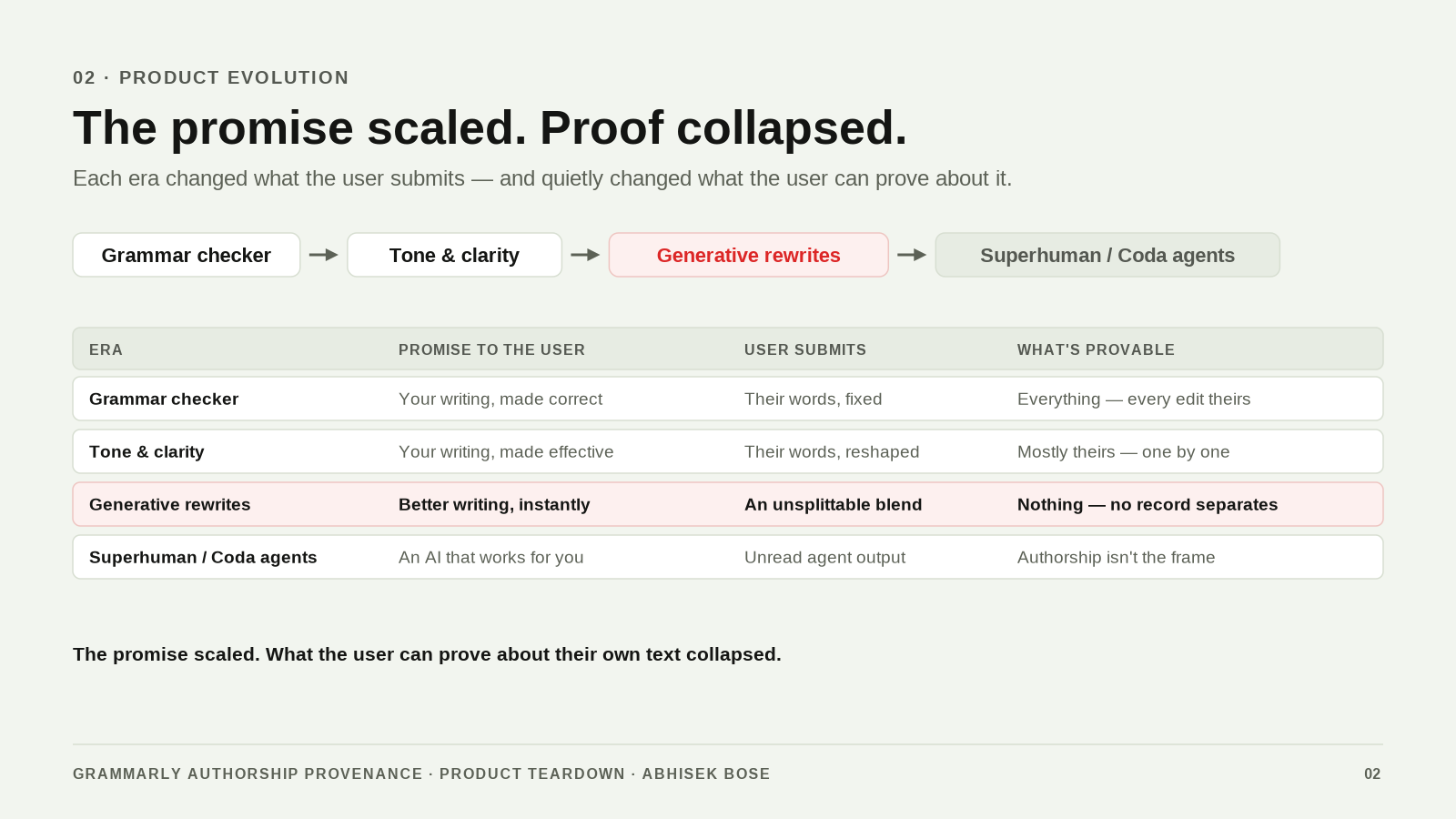
The promise scaled; what the user can prove about their own text collapsed.
03 · Who actually has this problem
Not "writers." Three personas, three very different authorship-proof stakes:
- Casual emailer — job: send a clean message. Audit risk: nobody ever checks. Proof stakes: near zero — and browser AI already serves her free.
- Sales ops templater — job: churn out on-brand templated copy at volume. Audit risk: brand review, occasionally legal. Proof stakes: medium — the org cares about consistency, not authorship.
- Non-native-speaker student under AI detection — job: submit graded essays in her second language. Audit risk: every submission runs through a detector, and detectors are demonstrably harsher on non-native English writing. Proof stakes: extreme — a false positive is an integrity hearing.
The pattern: the more likely someone is to audit your text, the more valuable a provenance record becomes. Grammarly's funnel optimizes for the first persona and quietly endangers the third — the one inside the education licenses that seeded the brand.
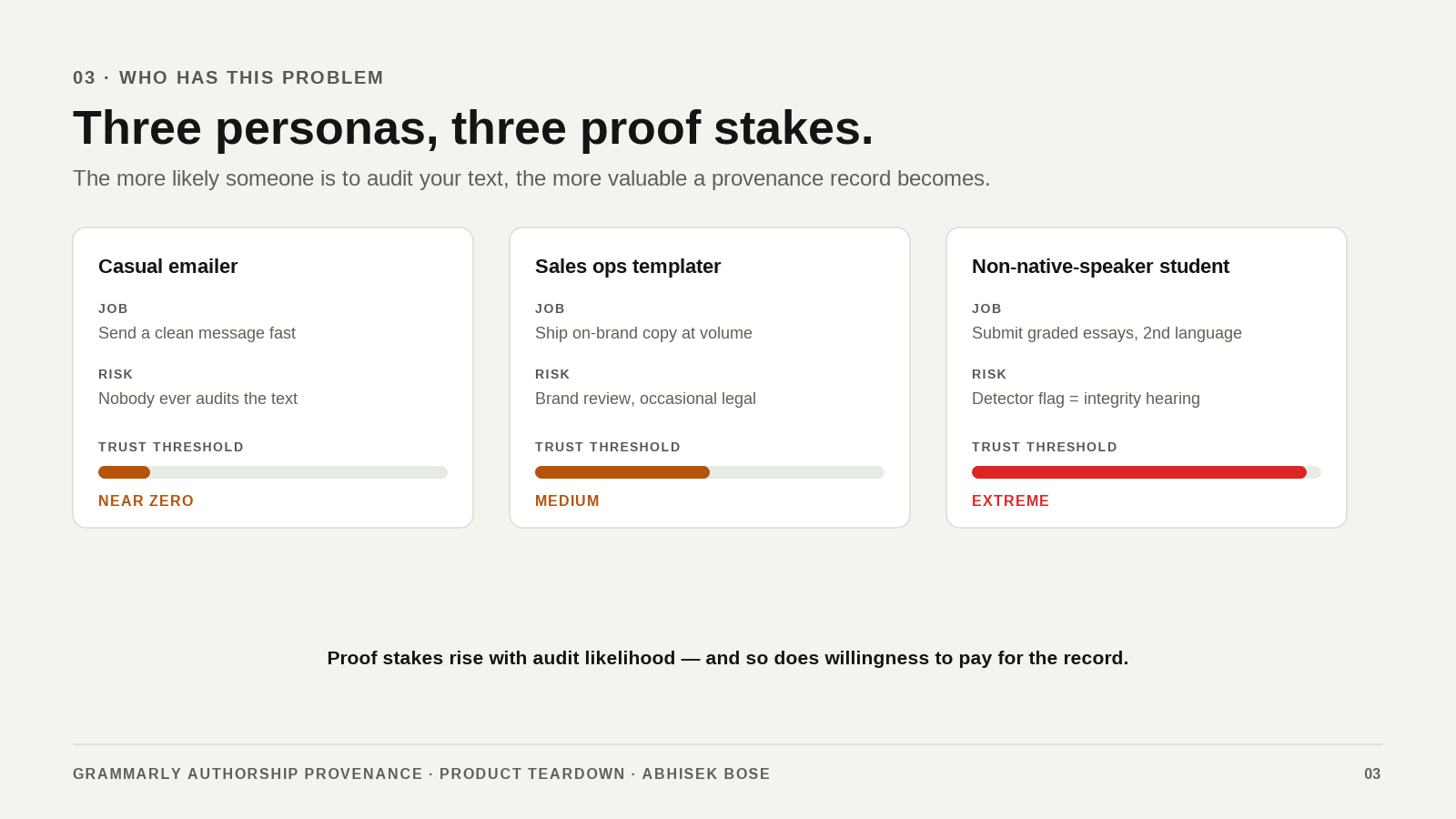
Proof stakes rise with audit likelihood — and so does willingness to pay for a record.
04 · Jobs to be done
Functional JTBD: when I write anything that matters, I want it shipped clean — grammar, tone, clarity — without slowing me down.
Emotional JTBD: I want to sound like my best self, not like a template and not like a robot.
Trust JTBD: when someone audits my work, I need to prove this is mine.
Grammarly ships the functional job better than anyone, gestures at the emotional job with tone detection, and has no real product surface for the trust job — which is now the job with the highest stakes and zero competition.
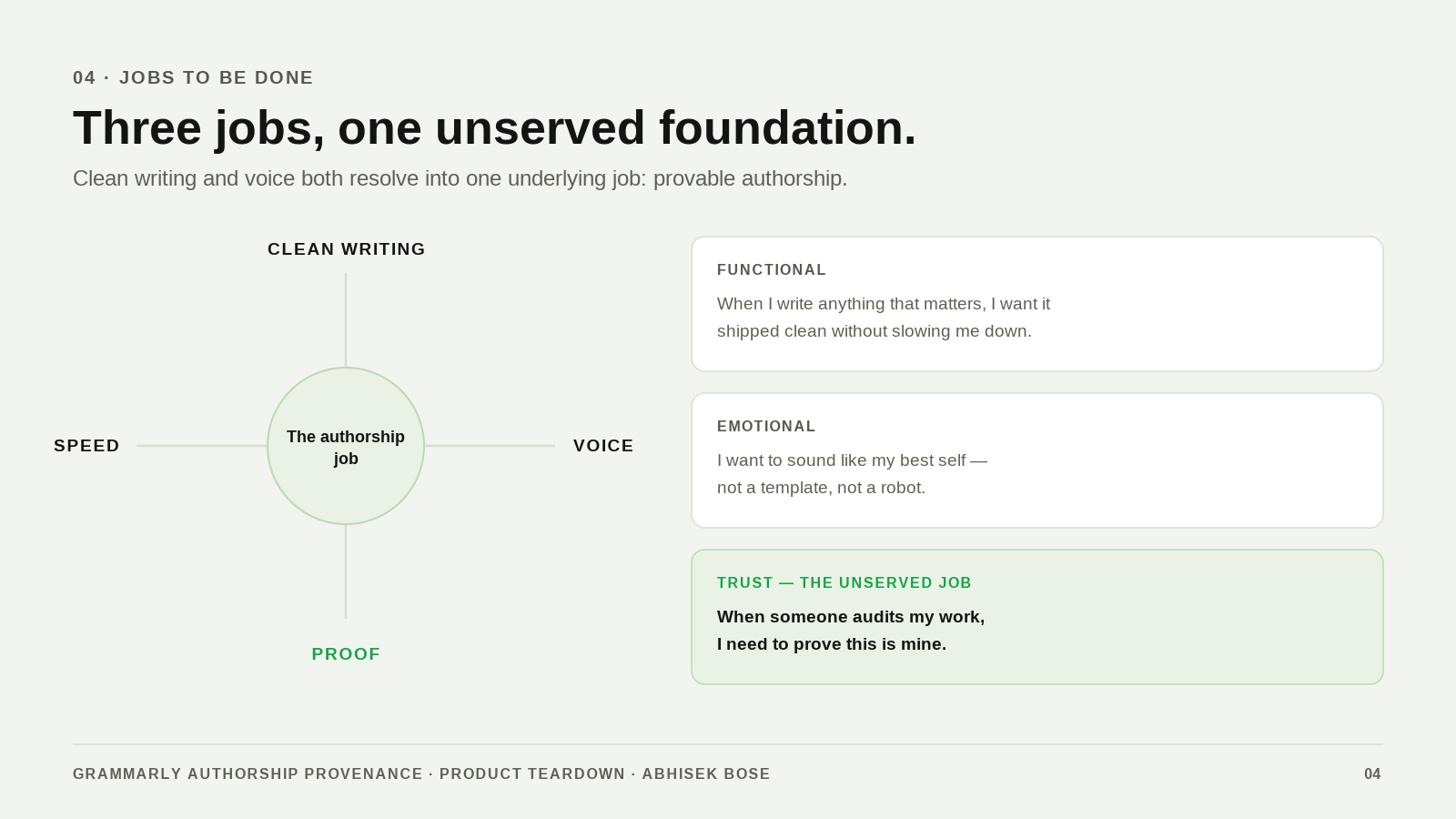
Clean writing and voice both resolve into one unserved job: provable authorship.
05 · How the product actually works
The everywhere-you-type distribution is still genuinely excellent. Grammarly meets users mid-keystroke, in the actual field where writing happens, with per-suggestion accept/reject granularity no chatbot matches. That interaction — review each change, keep agency — is the correct UX for provenance, and Grammarly already owns it.
Then the pipeline breaks its own pattern. A generative rewrite ("improve it," "make this professional") replaces the paragraph wholesale — in the same green visual language as fixing a comma. And the one feature that could tell the two apart, Authorship, exists — as an opt-in report, buried in settings, for some surfaces.
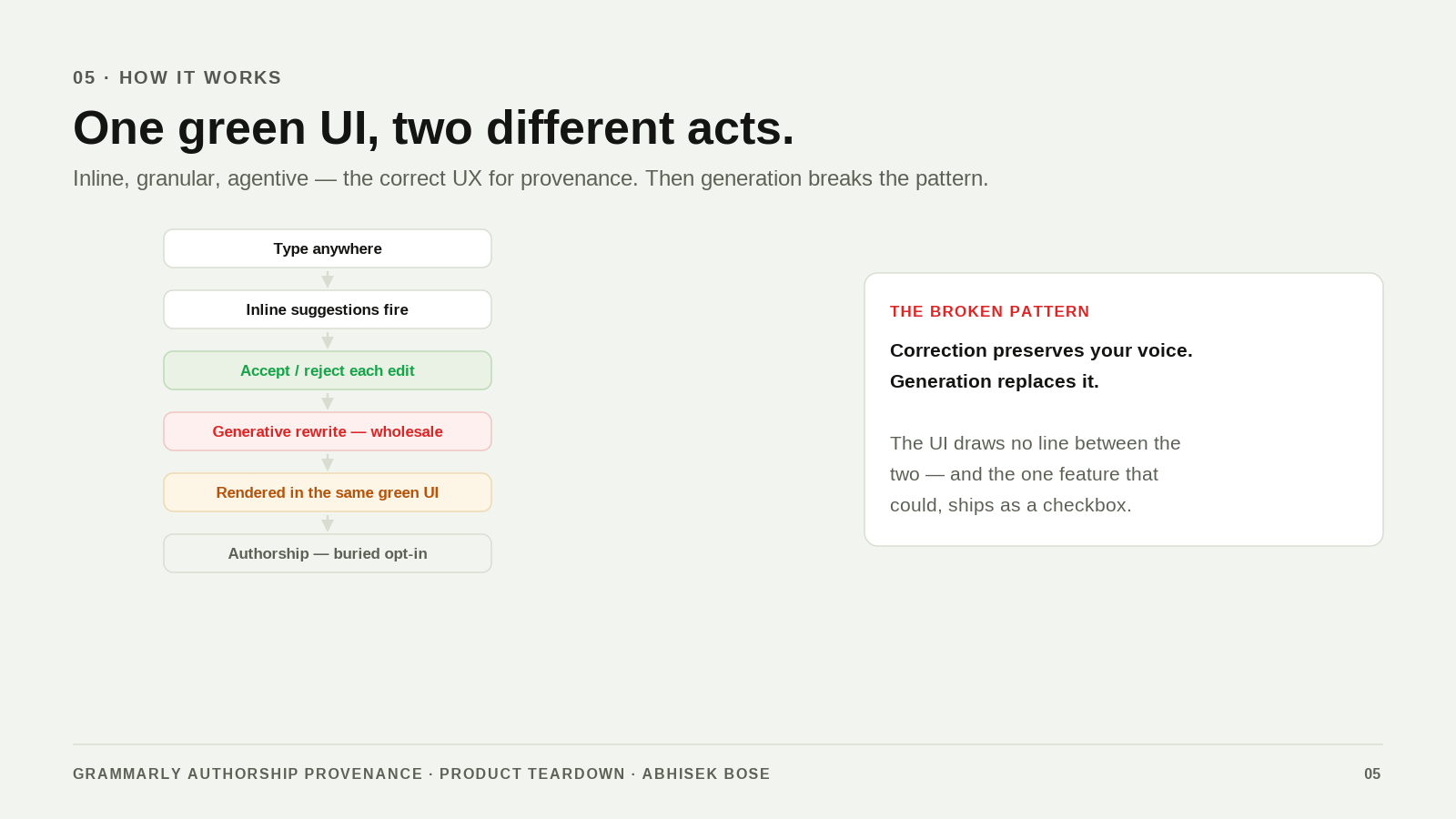
Great chassis: inline, granular, agentive. The one boundary that matters is the one the UI erases.
When your defensible asset ships as a checkbox, the org chart is telling you it's a side bet.
06 · Where trust actually lives
Map one essay from keystroke to verdict and the problem becomes visible:
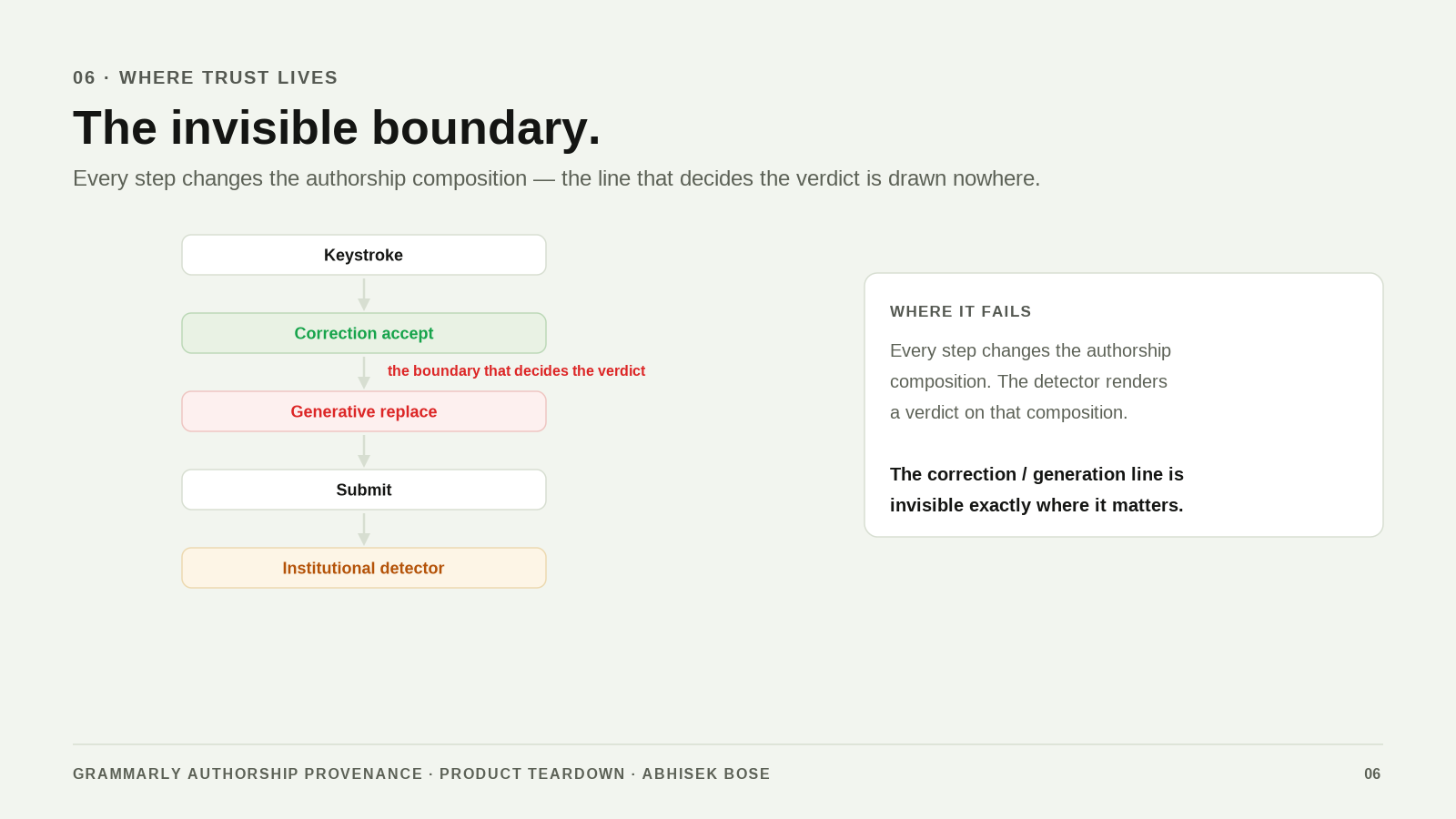
Five steps from keystroke to verdict. The one boundary that decides the verdict is invisible in the product.
Keystroke → correction accept → generative replace → submit → institutional detector. Every step changes the authorship composition of the text. The detector at the end renders a verdict on that composition. And the boundary between correction (voice-preserving) and generation (voice-replacing) — the exact line the detector is trying to find — is drawn nowhere: not in the UI, not in the data model, not in anything the user can export.
07 · The real product gap — a concrete scenario
A second-year university student, non-native English speaker, drafts an essay in Google Docs with Grammarly active.
She accepts grammar and punctuation fixes — legitimate, voice-preserving edits, the thing she installed Grammarly for. Stuck on one clunky paragraph, she clicks "improve it." The paragraph is replaced. Same green button, categorically different act.
She submits. The institution's detector flags the essay as partially AI-generated. She has no record distinguishing her hundred corrections from the one rewrite. Neither does anyone else — except Grammarly, which watched the whole session and kept nothing she can use.
She faces an integrity hearing with nothing but her word.
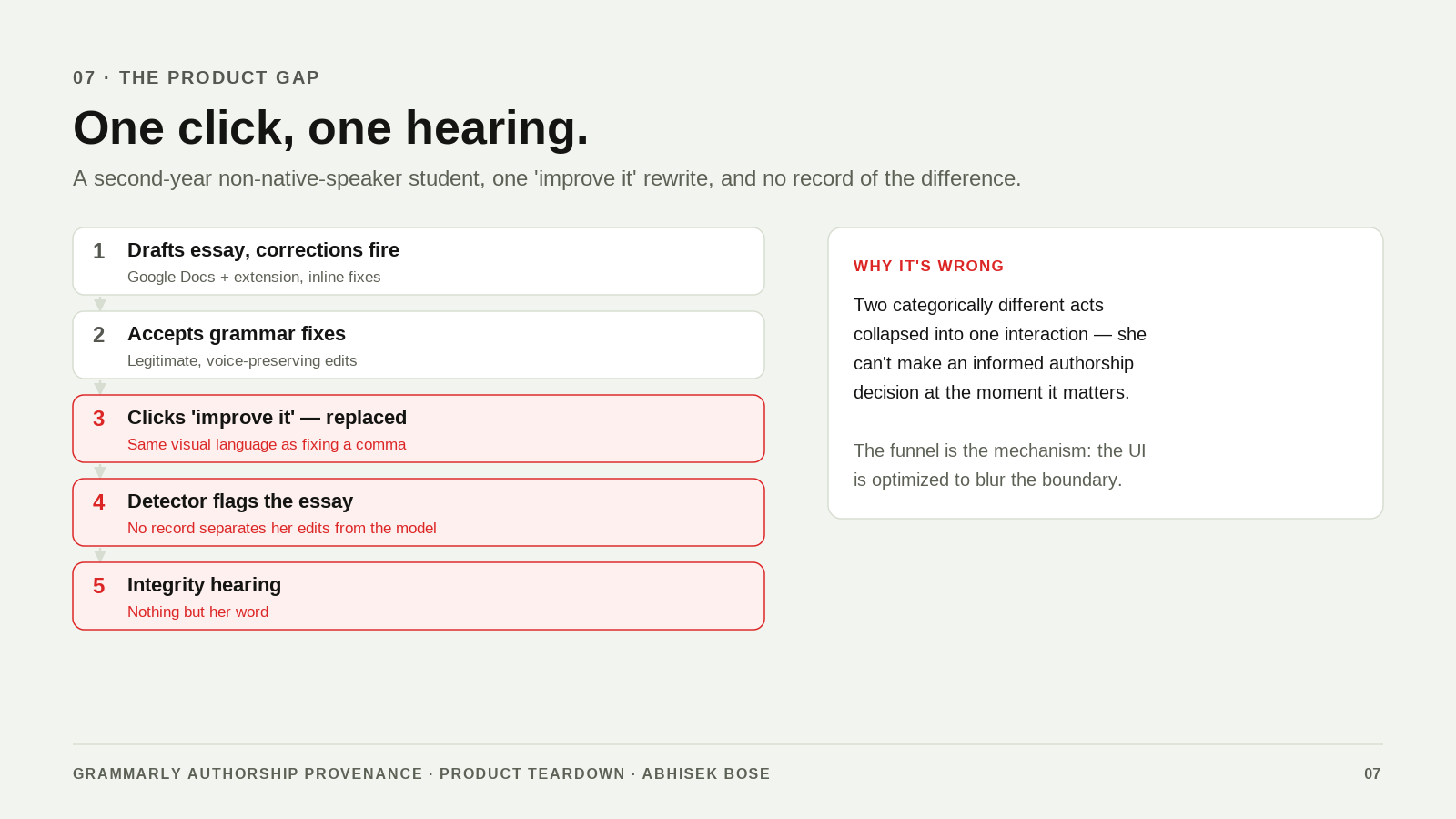
The product collapsed two different acts into one interaction — and the cost lands on the user, at the worst moment.
The failure was never bad writing. It's missing provenance — and no amount of better generation fixes it, because better generation is what caused it.
08 · Current vs proposed
Current: a writing-enhancement overlay drifting into a generic AI productivity suite — correction, generation, and now agents blurring into one undifferentiated assistant competing with free.
Proposed: an authorship platform. The core object is the provenance record: what you typed, what was corrected, what was generated, in what proportion, tamper-evidently attested. Correction and generation become inputs to that record. Writers get proof; institutions get a verification surface.
Grammarly spent two decades proving your writing was yours. Then it shipped a button that makes that unprovable.
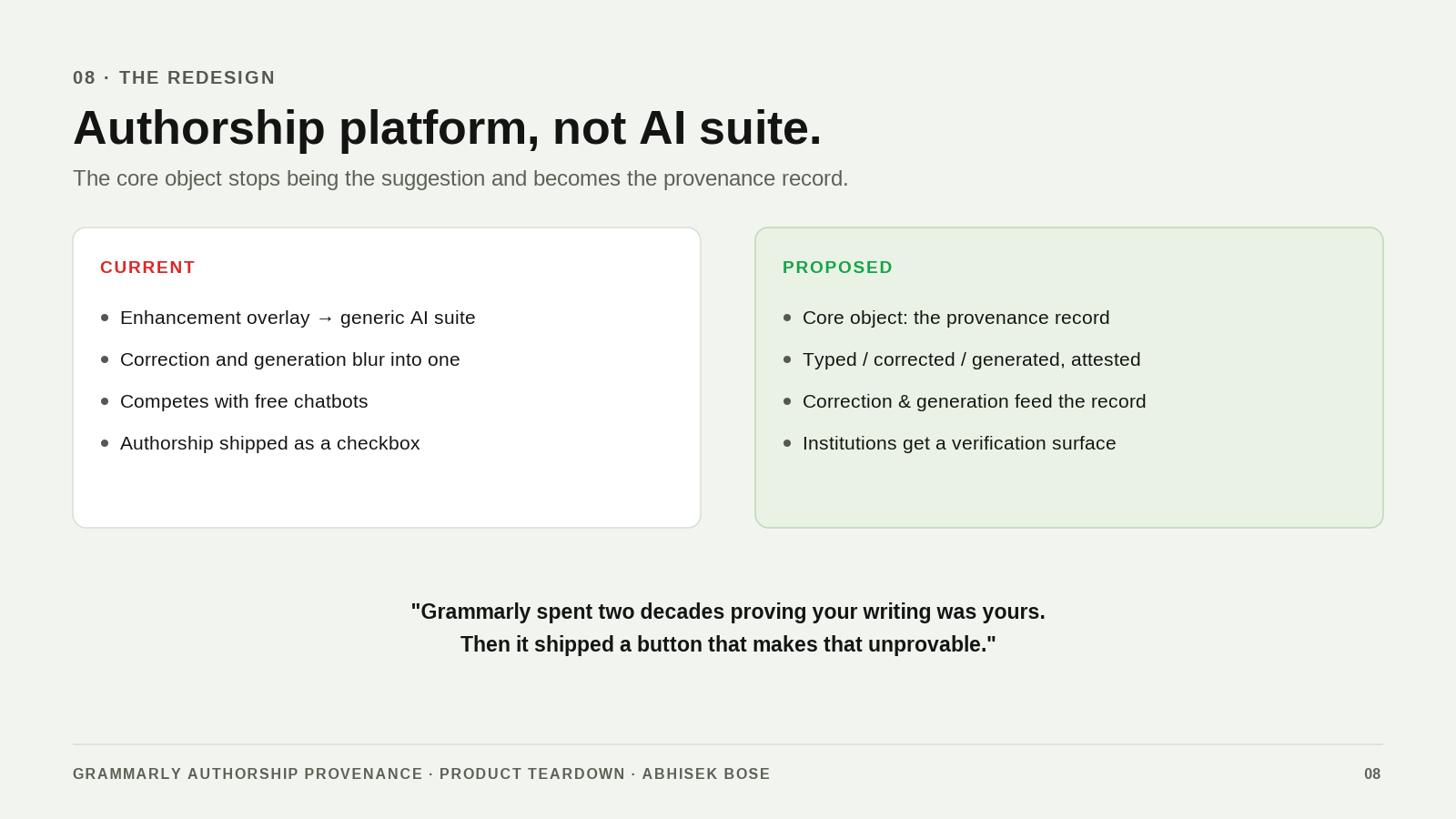
The strategic shift: from enhancing writing to certifying authorship.
09 · The artifact: the authorship report
"Unbury Authorship" is hand-waving unless you design the object. This is the actual artifact — legible to a student in ten seconds, verifiable by an integrity officer:
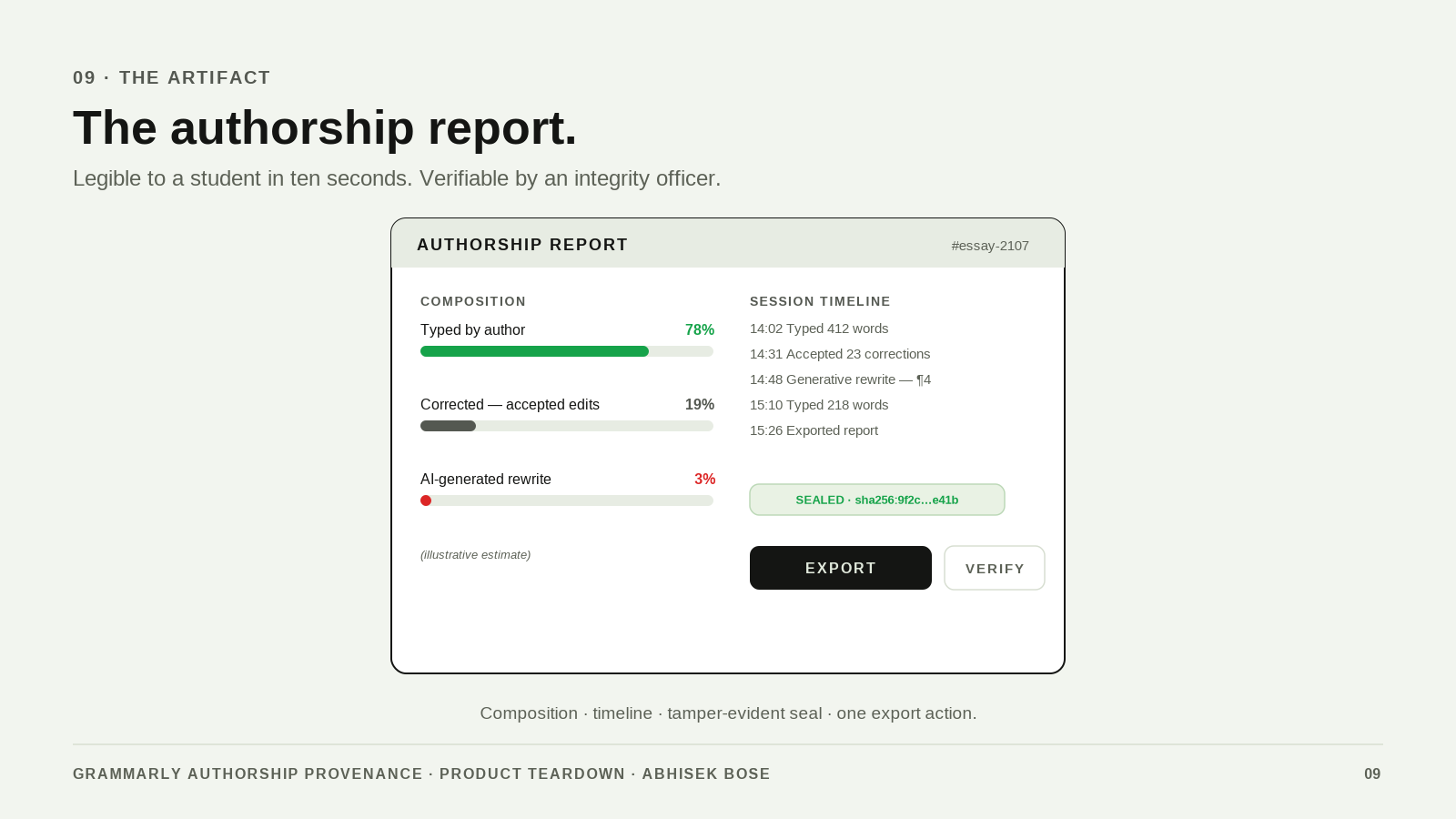
The report object: composition breakdown, session timeline, tamper-evident seal, one export action.
Every field earns its place: the composition breakdown — typed 78% / corrected 19% / AI-generated 3% (illustrative estimate) — answers the detector's question before it's asked; the session timeline shows the writing happened as a process, not a paste; the tamper-evident seal makes the record admissible rather than editable; the export turns it into something a student attaches to a submission.
I work on exactly this problem in Ultipad, where every AI-built feature traces back to the human-approved idea that authorized it — the same provenance problem, applied to code. The pattern is buildable today; what's missing at Grammarly is the product decision to make the record the default output of every session.
10 · The interaction: the generation boundary
The report is only honest if the boundary is enforced at the moment of generation. When the user invokes a generative rewrite, the product stops pretending it's a correction:
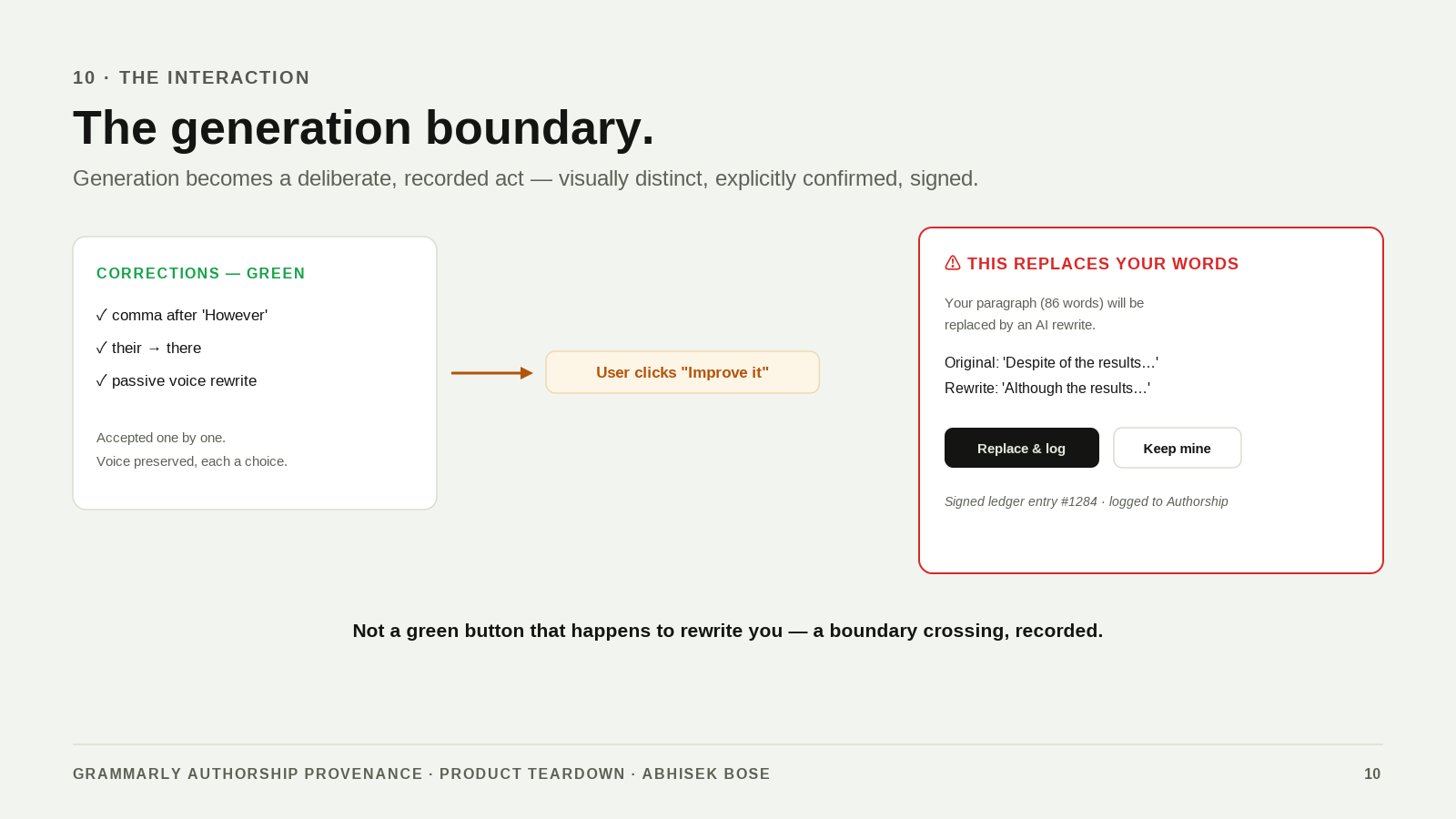
Generation becomes a deliberate, recorded act — not a green button that happens to rewrite you.
Three properties matter: the confirmation is explicit ("this replaces your words" — an informed authorship decision at the moment it matters), the visual treatment is distinct from green corrections (the boundary the detector cares about becomes the boundary the user sees), and every generative acceptance writes a signed ledger entry — so the authorship report is a record of events, not a reconstruction.
11 · Category view: trust models, not feature lists
Comparing Grammarly vs ChatGPT vs Notion AI feature-by-feature misses the point. Compare the trust model each pattern ships for the question "who wrote this":
| Trust model | How it answers "who wrote this" |
|---|---|
| Detector arms race | A classifier guesses, after the fact — biased, gameable, and wrong at the worst times |
| Watermarking | The model tags its output — breaks on edit, paste, or a different model |
| Self-declared disclosure | The writer promises — unverifiable by construction |
| Process provenance | The writing tool records the process as it happens — the open position |
Detection guesses, watermarking breaks, disclosure begs. Only the tool that was present at every keystroke can attest to the process — and Grammarly has been present at more keystrokes than anyone. Nobody has productized that position. It's the one seat in the category that gets more valuable as generation gets better.
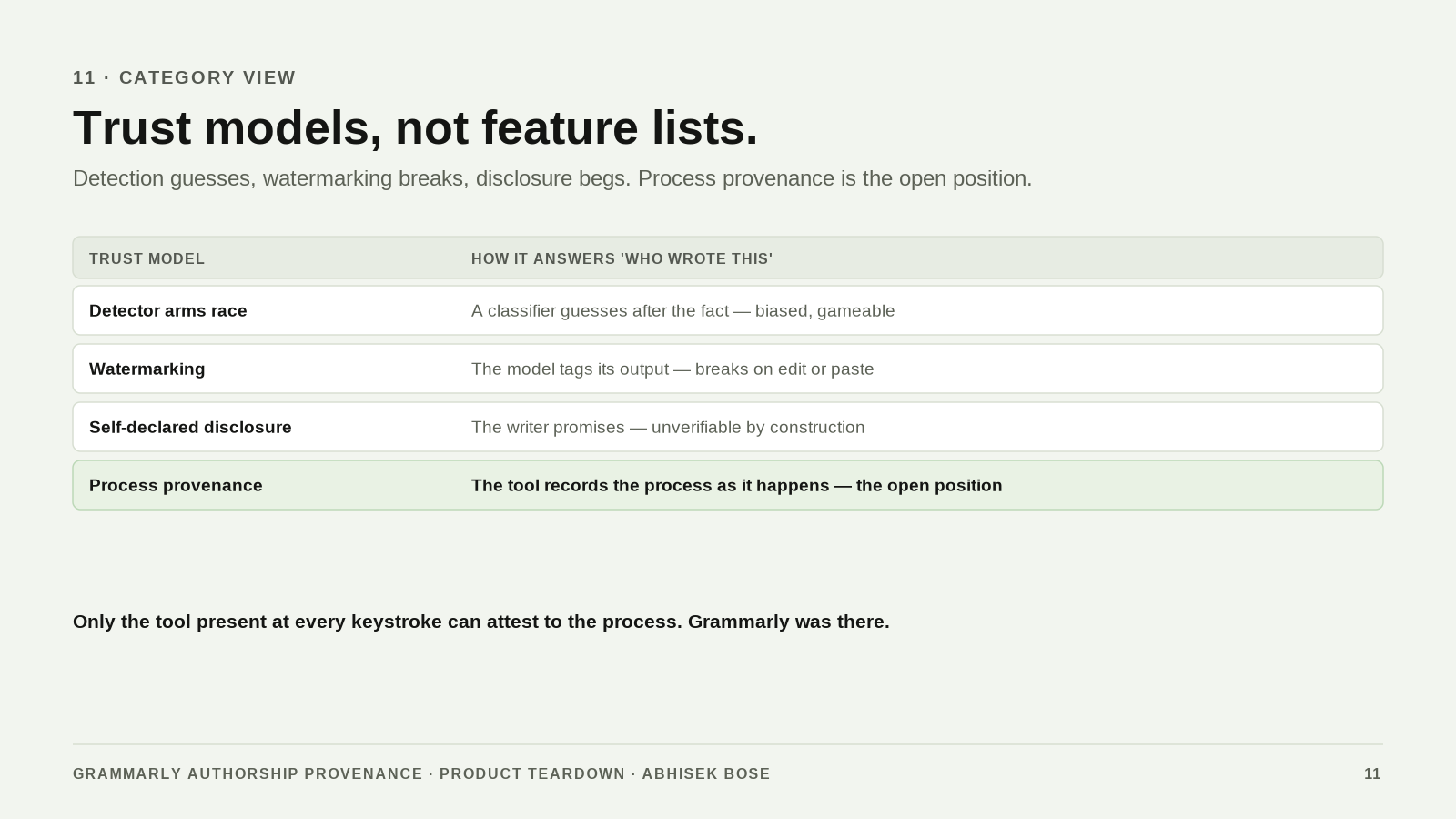
The open position: provenance recorded at the point of writing, by the tool that was there.
12 · Metrics that prove the thesis
Not engagement. A measurement system where each metric tests one link in the provenance loop:
- Provenance exports per active student — does the artifact have real defensive value, not just dashboard appeal.
- Education license renewal rate — have institutions flipped from detecting Grammarly output to requiring Grammarly records.
- False-accusation resolution rate with reports presented — does the proof hold up where it matters (illustrative estimate: track against a baseline cohort of hearings without reports).
- Correction-to-replacement ratio — is the product preserving voice or quietly becoming a ghostwriter again.
- Premium conversions from provenance vs generation — is the moat, not the commodity, carrying the business.
- Institutional verifier adoption — the only metric that can't be gamed: a provenance record without a verifier is a diary.
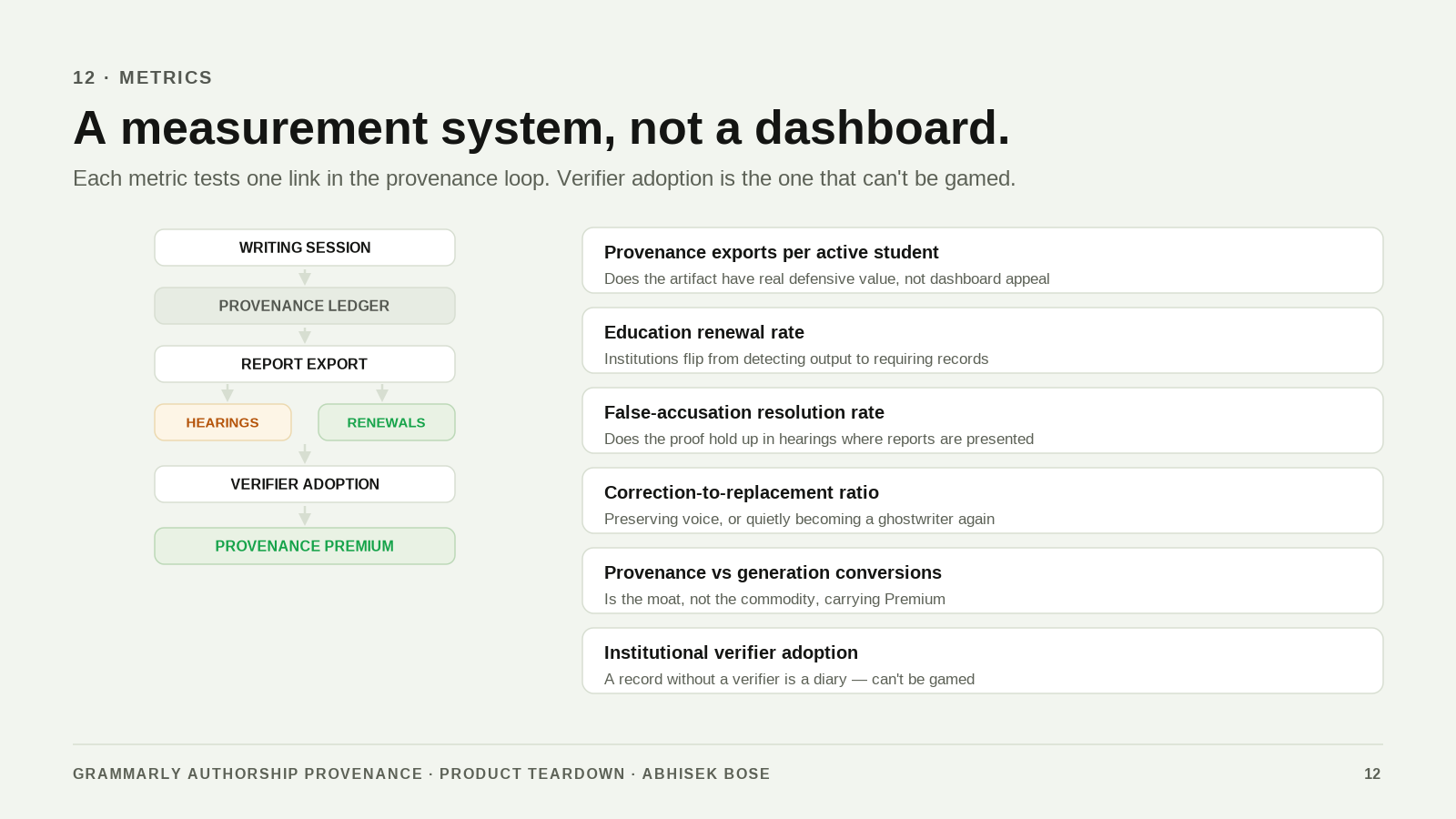
One loop, six instruments — institutional verifier adoption is the metric the others exist to move.
13 · The experiment
Don't build it on conviction. Run the test:
Control: current Premium funnel — generation features as the upgrade carrot. Treatment: provenance-led Premium for an education cohort — authorship reports, the generation boundary, and export as the headline features.
Hypothesis: provenance raises student retention and institutional renewals more than generation features do.
Primary metric: student-cohort retention and education renewal intent. Secondary: provenance exports, correction-to-replacement ratio, provenance-attributed conversions. Guardrail: writing throughput must not fall — if the boundary confirmation slows writers down enough to hurt output, it's friction, not product.
Kill criterion: if institutions won't accept process records as evidence in integrity reviews, the provenance product has no verifier and the moat collapses to a personal-reassurance feature.
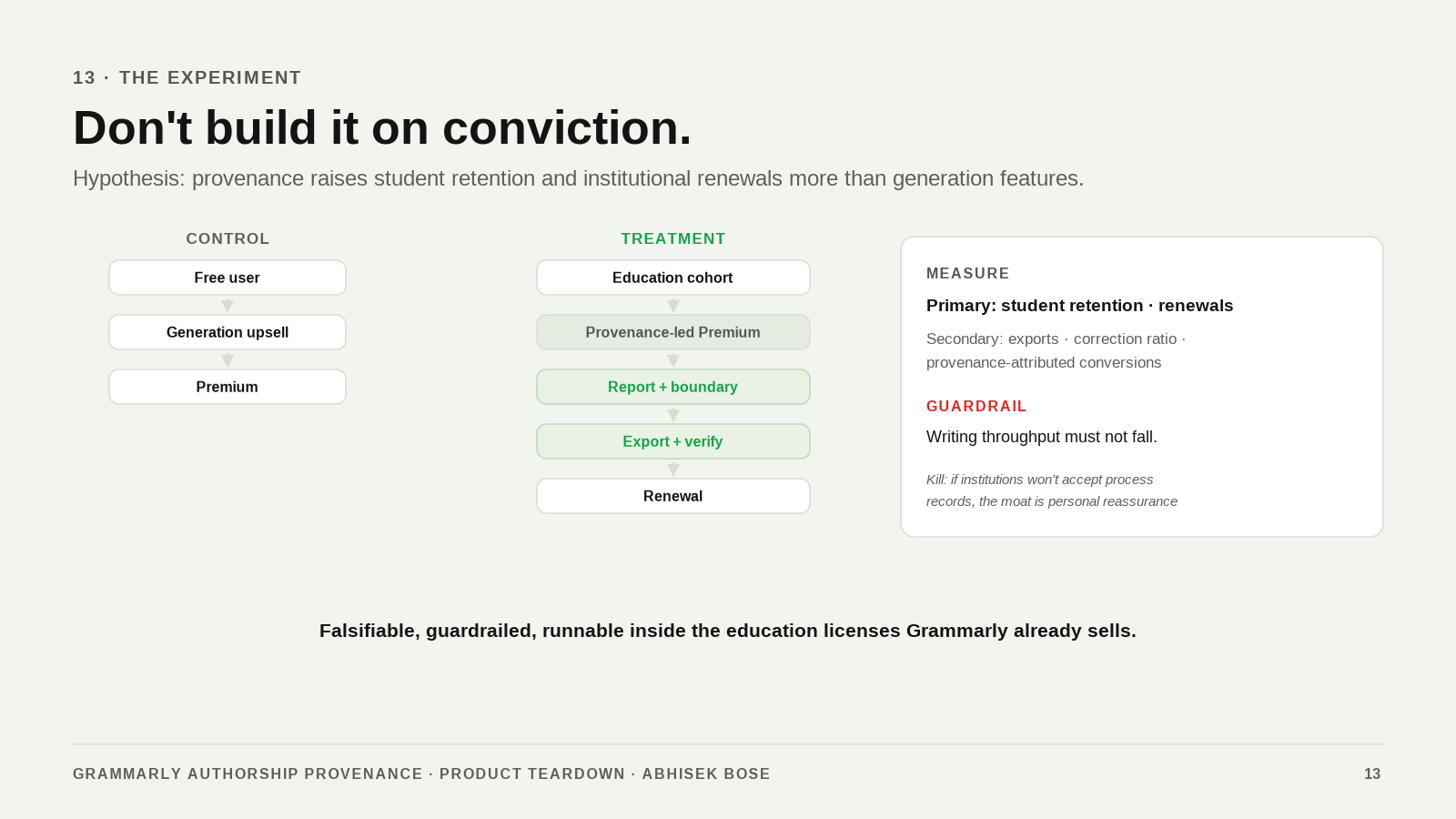
Falsifiable, guardrailed, and cheap to run inside the education licenses Grammarly already sells.
14 · What I'd build first
| Feature | Impact | Effort | Priority |
|---|---|---|---|
| Generation boundary ("this replaces your words") | High | Low | P0 |
| Provenance ledger on by default | High | Medium | P0 |
| Exportable authorship report | High | Medium | P1 |
| Institutional verification portal | High | High | P1 |
| Personal voice-preservation models | Medium | High | P2 |
| Provenance APIs for LMS / ATS platforms | Medium | High | P2 |
The P0 pair ships the thesis: an honest boundary and a record of every crossing. The report is P1 because it's only as good as the ledger underneath it — sequencing, not importance. The verification portal is what converts the detector conflict from threat to moat.
15 · Final thesis
Grammarly doesn't need to win the generation war. Generation is the commodity that started the war.
The company that watched every keystroke for twenty years is sitting on the only asset that gets scarcer as AI writing gets better — proof of the human — and it shipped that asset as a checkbox. The product opportunity isn't writing more of the user's words. It's being the only tool on earth that can prove which words were theirs.
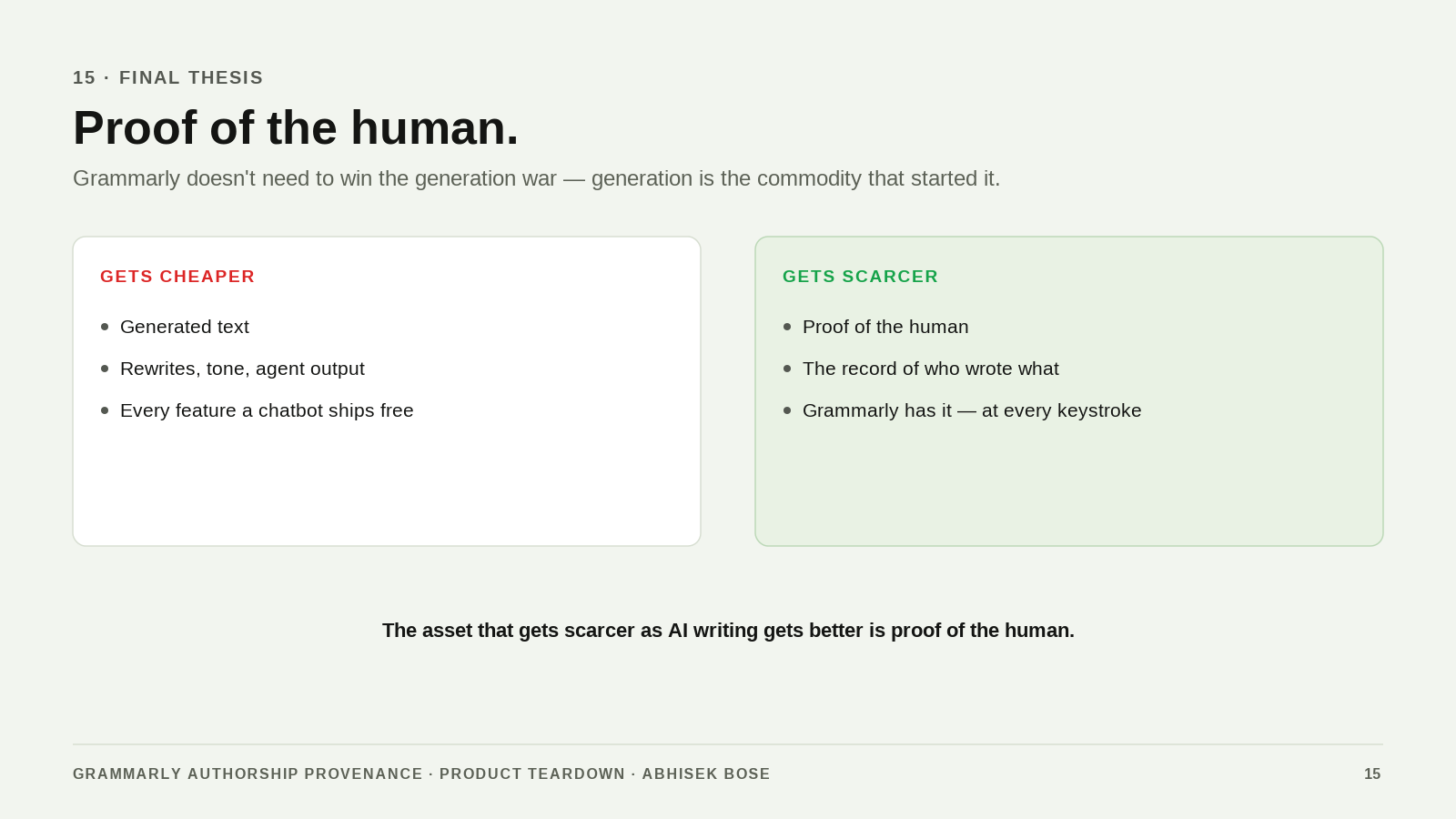
As generation gets better, text gets cheaper — and the record of the human gets more valuable. Grammarly already has the record.
Sources
Observed claims in this teardown draw on:
- Grammarly to acquire Superhuman and Grammarly rebrands company as Superhuman — the acquisitions and platform pivot
- Superhuman launches agent-specific attribution in Grammarly Authorship — the Authorship provenance feature this teardown argues should be the core product
- GPT detectors are biased against non-native English writers (Liang et al., Stanford) — the detector bias against non-native English writing patterns cited in the persona
Everything else is inferred product analysis or marked (illustrative estimate) inline.