Scenario: Tear down GitHub Copilot — autocomplete through cloud coding agent — and design the trust model that agentic delegation actually needs.
01 · The thesis
GitHub solved code generation. The next problem is delegation trust.
What changed: Copilot moved from suggesting code to executing multi-step engineering work — planning, editing across files, running tests, opening PRs.
The product problem: the user's biggest trust decision still happens after the agent has already done the work.
My thesis: the trust boundary should move from "review the diff" to "approve the intent."
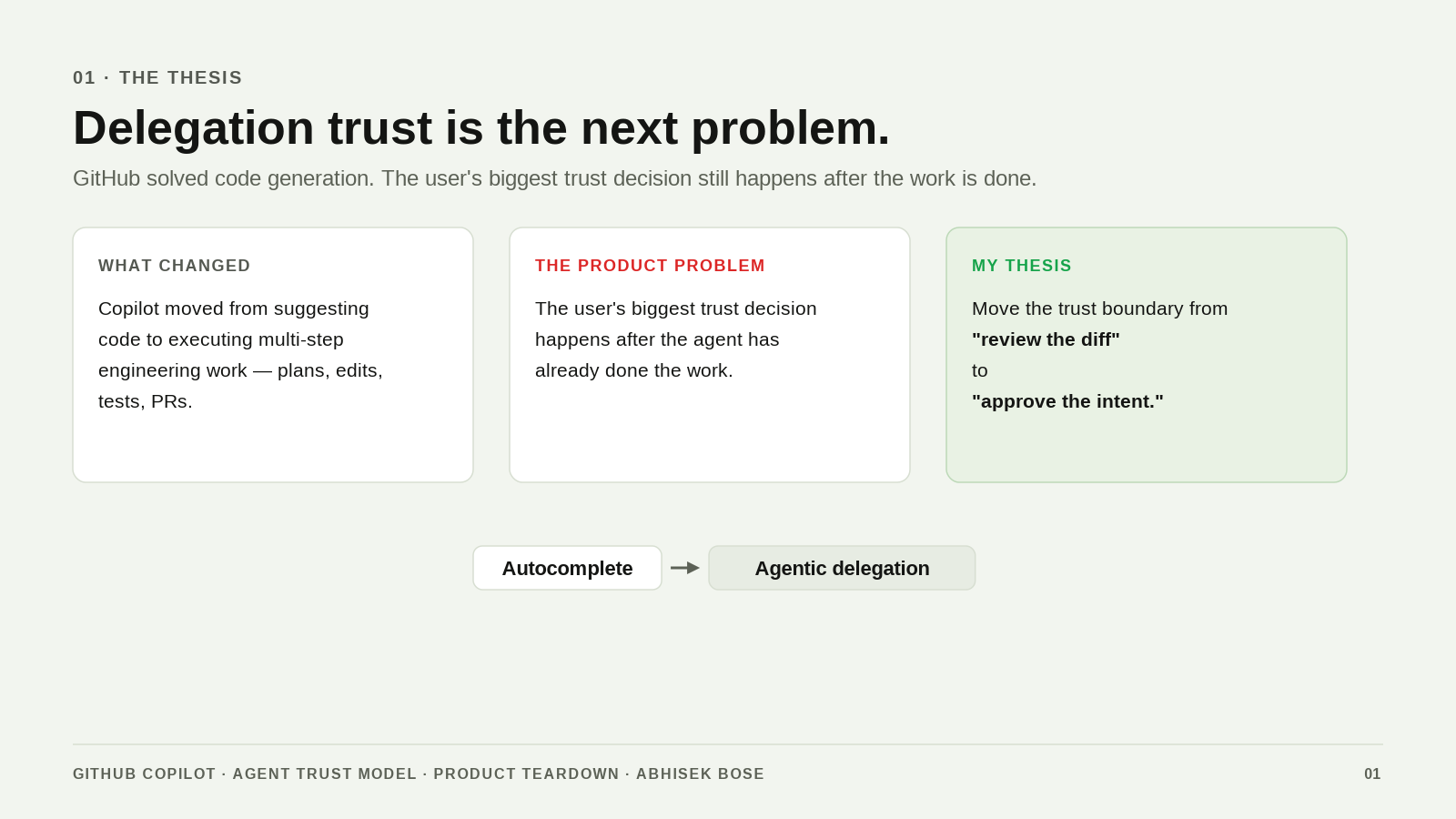
One screen: the shift from autocomplete to agentic delegation, and where trust has to move.
02 · Product evolution
Copilot's own history is the argument. Each step changed the user's job — and quietly changed what one unit of trust has to cover:
| Era | User does | AI does | Trust unit |
|---|---|---|---|
| Autocomplete | Writes | Suggests | A line |
| Chat | Directs | Answers | A response |
| Agent mode | Delegates | Executes | A task |
| Agentic workflows | Defines outcomes | Operates the workflow | A system outcome |
The trust unit grew from a line to a system outcome. The trust mechanism — a human looks at the output — never changed. That gap is this teardown.
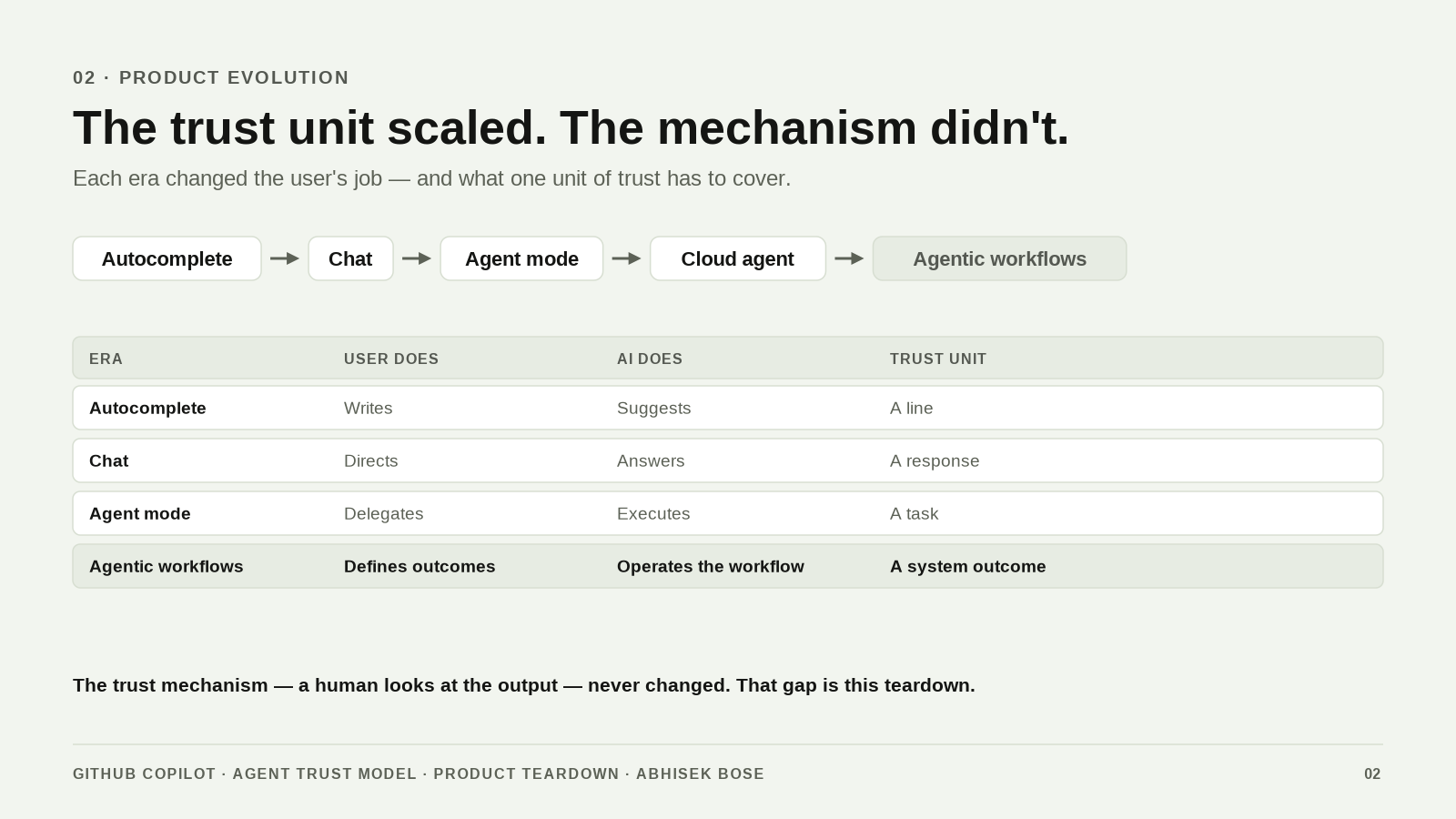
The trust unit scaled; the trust mechanism didn't.
03 · Who actually has this problem
Not "developers." Three personas, three very different trust thresholds:
- Individual developer — job: ship a feature faster. Risk: a wrong implementation costs an afternoon. Trust threshold: medium.
- Staff / senior engineer — job: delegate repetitive engineering work across services she owns. Risk: architectural drift she answers for. Trust threshold: high.
- Enterprise engineering org — job: scale throughput safely. Risk: security, compliance, accountability; every merged change needs a justification trail. Trust threshold: extremely high.
The pattern: the more expensive the consequence of a wrong agent action, the more valuable explicit intent becomes. Copilot's current model serves the first persona and quietly taxes the other two — the ones holding the enterprise contract.
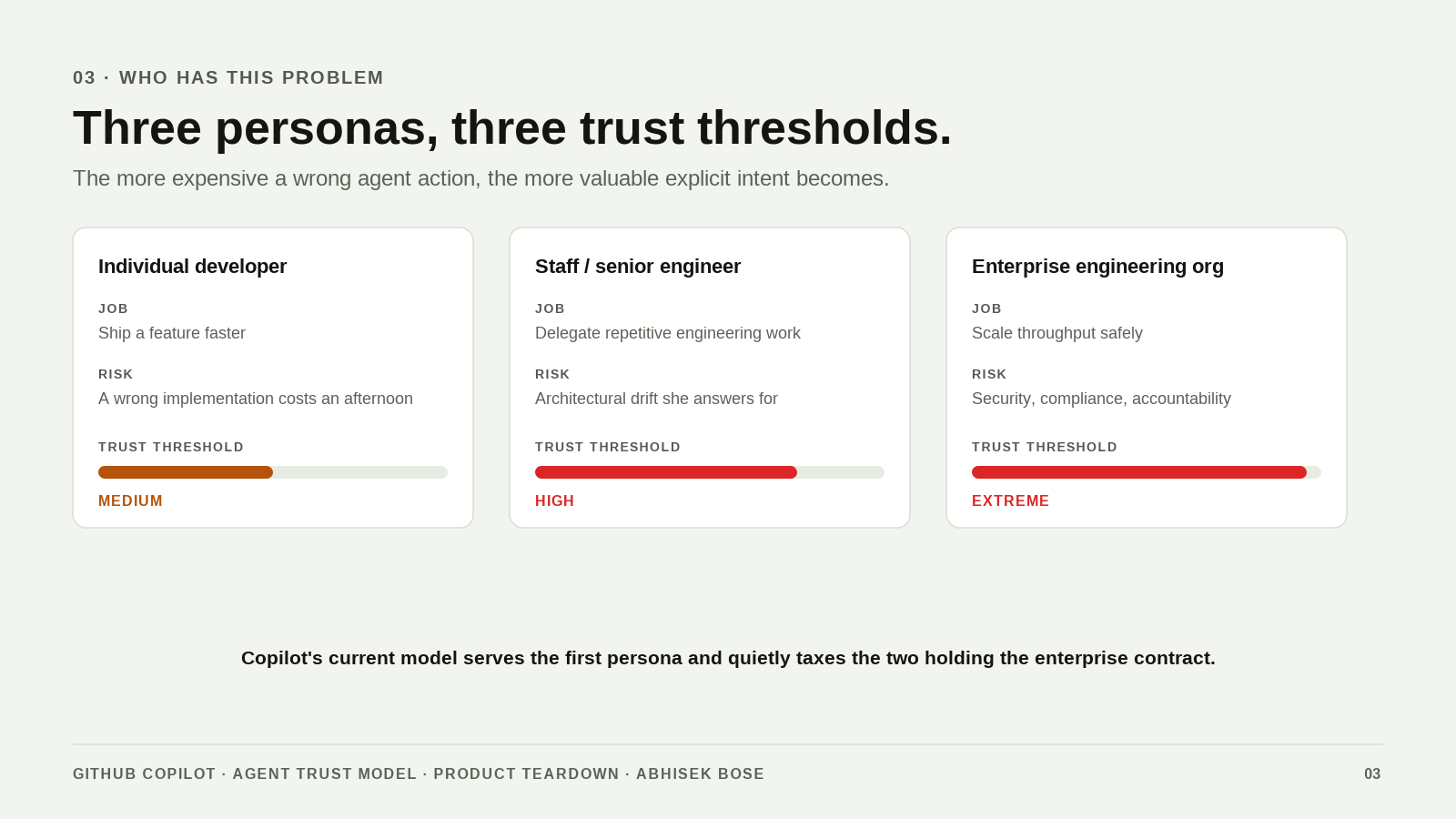
Trust threshold rises with consequence — and so does the value of intent capture.
04 · Jobs to be done
Functional JTBD: when I have a well-defined engineering task, I want an agent to execute it without requiring me to supervise every step.
Emotional JTBD: I want to feel that I remain in control even when I am not watching.
Trust JTBD: I need to know that the agent understood what I intended before it changed my codebase.
The third one is the foundation of everything that follows. Copilot ships the functional job well, gestures at the emotional job with session logs, and has no product surface at all for the trust job.
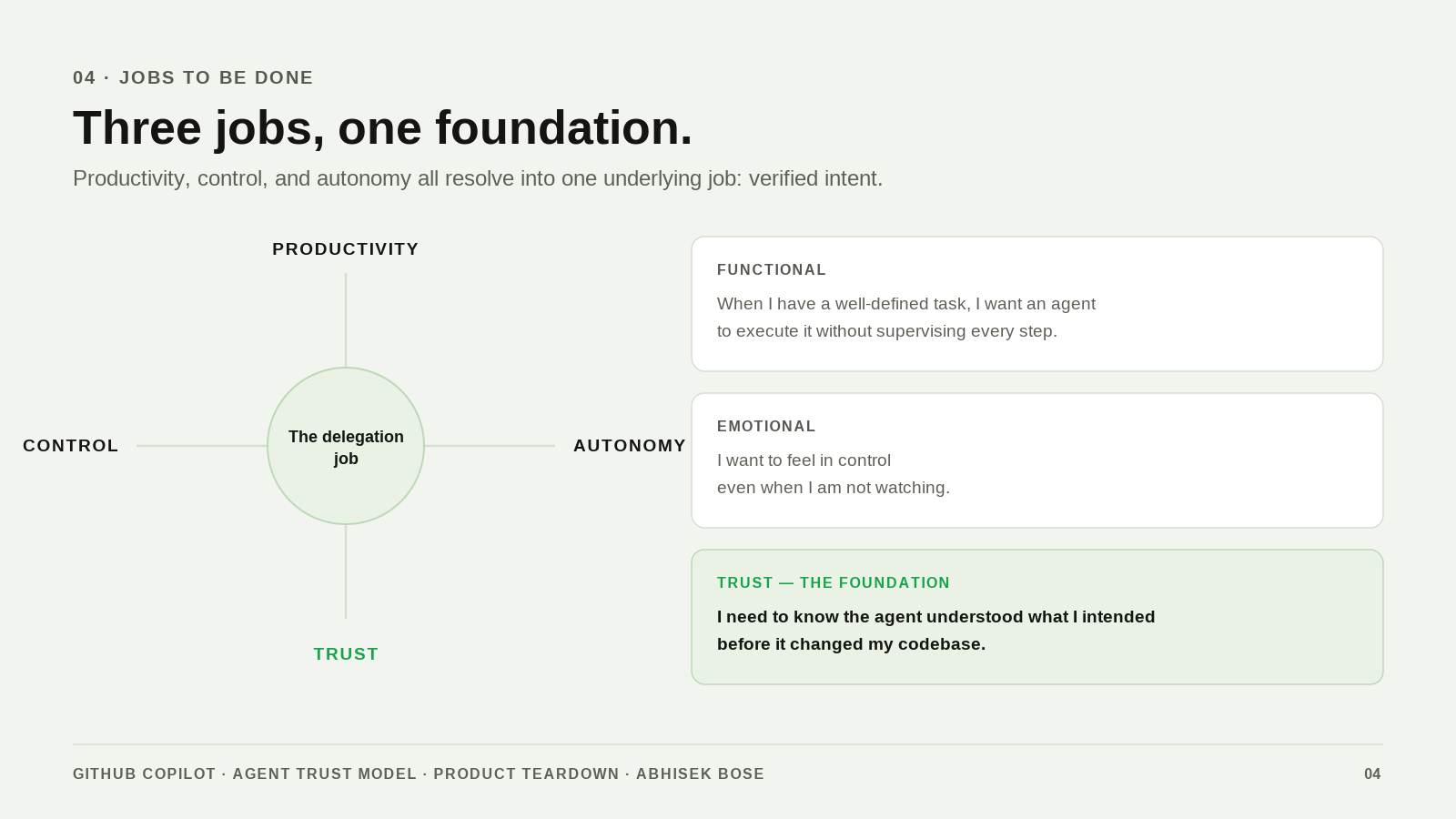
Productivity, control, and autonomy all resolve into one underlying job: verified intent.
05 · How the product actually works
The coding agent is real infrastructure, not a chat window. Assigned an issue, it gathers context (repository, custom instructions, skills, MCP tools, issue and PR history), reasons to a plan, executes tools — read, edit, run, test — in a firewalled Actions-powered environment, and opens a draft PR. It cannot approve or merge its own work; a human must review the PR, and GitHub's own docs tell you to review thoroughly before merging.
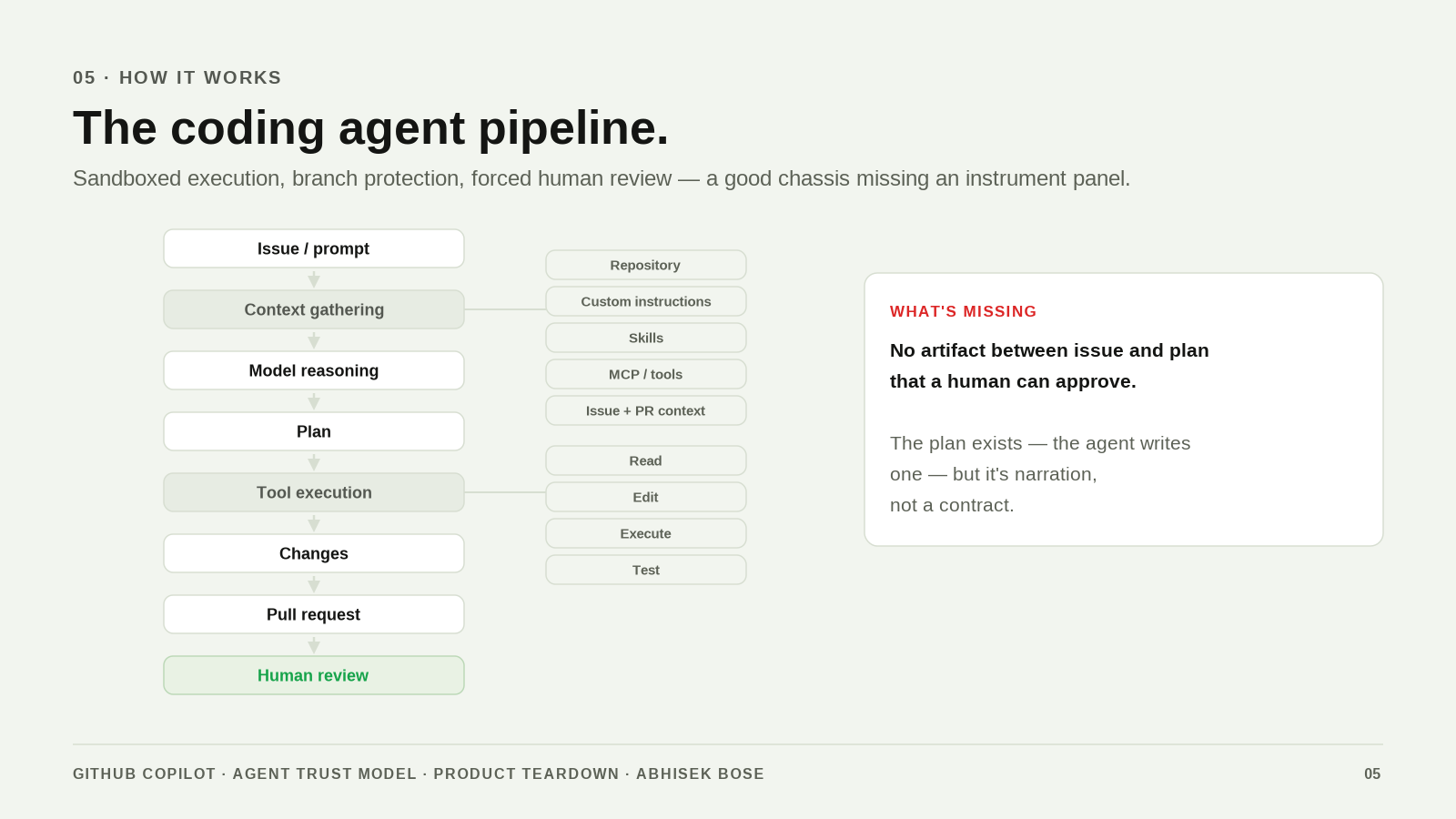
Good chassis: sandboxed execution, branch protection, forced human review at the end. The instrument panel is what's missing.
Notice what's absent from this pipeline: any artifact between "issue" and "plan" that a human can approve. The plan exists — the agent writes one — but it's narration, not a contract.
06 · Where trust actually lives
Map the trust decisions across one delegated task and the problem becomes visible:
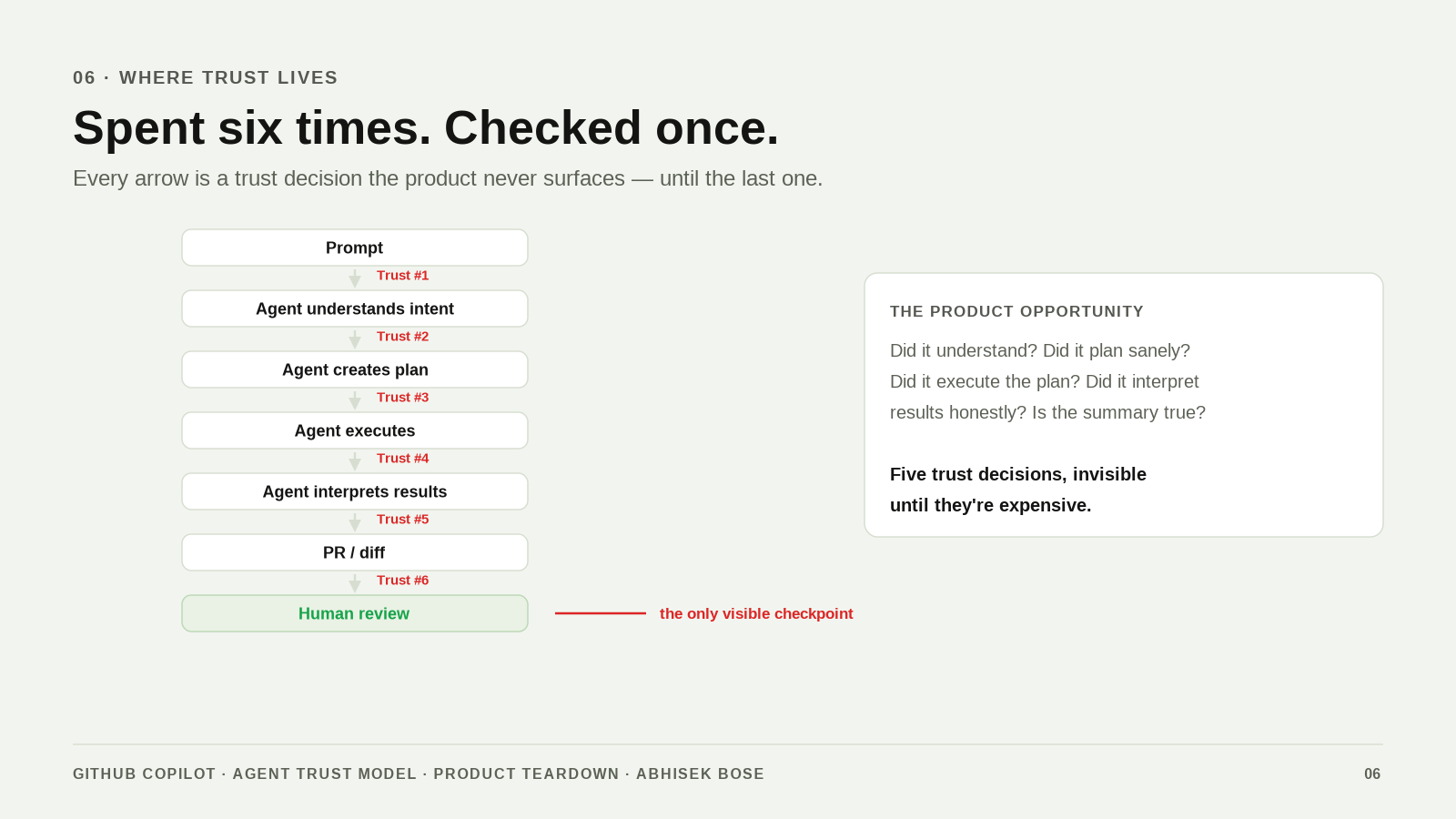
Six places trust is spent. One place it's checked.
Trust is spent six times per run — did it understand, did it plan sanely, did it execute the plan, did it interpret results honestly, is the PR complete, is the summary true. The product surfaces exactly one checkpoint: the last one. Everything upstream is invisible until it's expensive.
07 · The real product gap — a concrete scenario
The user says: "Add a retry mechanism to our payment webhook."
The agent interprets: 3 attempts, exponential backoff, retry on 5xx only.
The developer intended: 5 attempts, retry on 5xx and timeouts, idempotency key required, dead-letter queue after final failure.
The agent produces a clean, tested, perfectly reasonable PR. Code review passes. The missing idempotency key ships. The problem was never bad code — it's specification divergence, and no amount of diff review reliably catches it, because the diff faithfully implements the wrong spec.
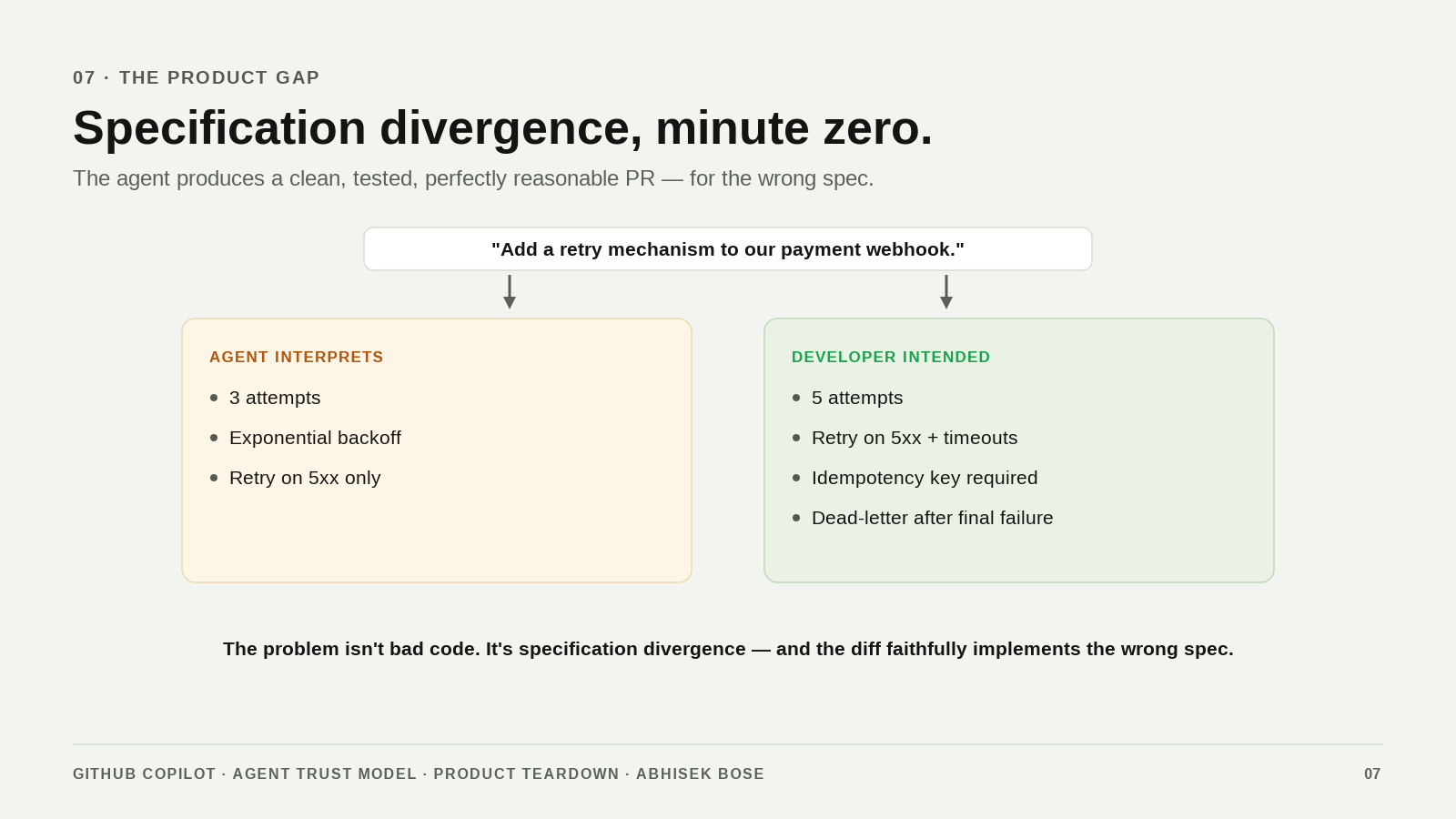
A reasonable interpretation and the actual intent, diverging invisibly at minute zero.
08 · Current vs proposed trust model
Current: prompt → agent → plan → execution → PR → human discovers the intent mismatch, at the most expensive possible moment.
Proposed: prompt → agent-generated specification → human approval → gated execution → conformance check → PR that references the spec it satisfied.
Don't make humans supervise execution. Make humans approve intent.
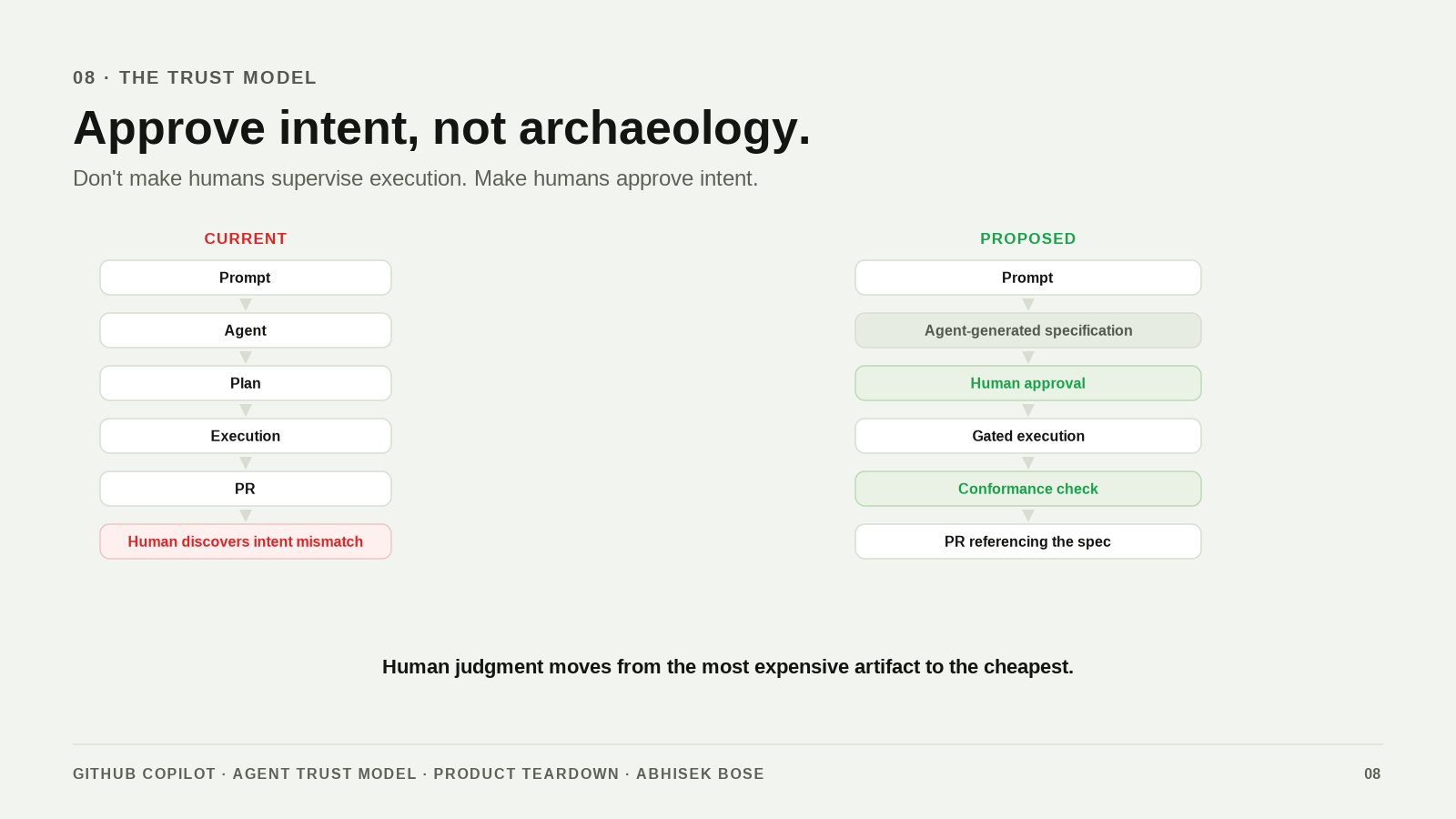
Human judgment moves from the most expensive artifact to the cheapest.
09 · The artifact: an agent task spec
"Add a spec" is hand-waving unless you design the object. This is the actual artifact — small enough to approve in under a minute, structured enough to be machine-checkable:
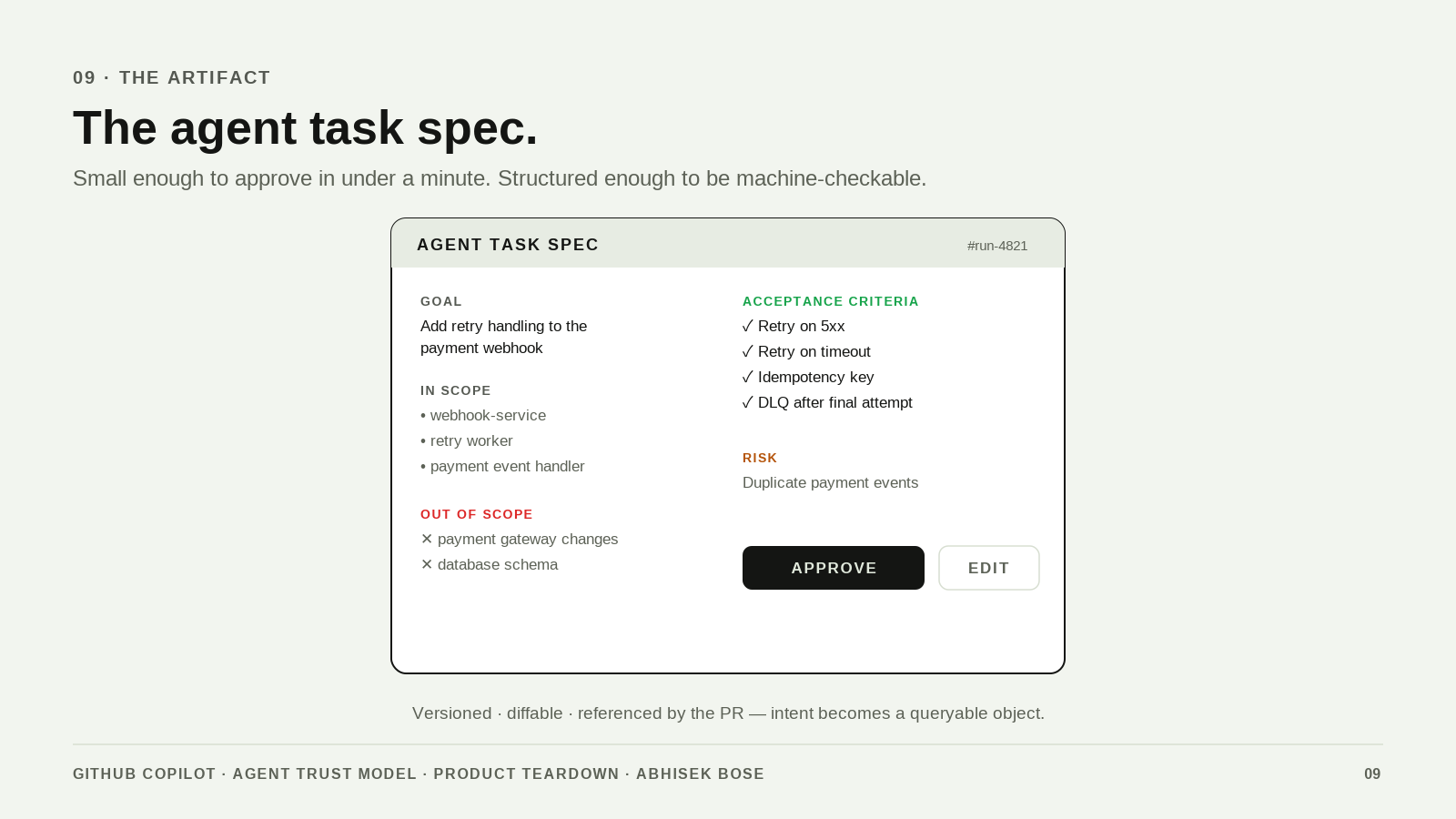
The spec object: goal, scope boundary, acceptance criteria, named risk, one approve action.
Every field earns its place: goal anchors the run, in/out of scope powers drift detection, acceptance criteria become the conformance report, risk forces the agent to state what could go wrong before it does. The spec is versioned, diffable, and referenced by the PR — so "which merged changes trace to which approved intent" becomes a queryable question.
I work on exactly this problem in Ultipad, where every AI commit is checked against the approved spec and scored for drift. The spec-as-contract pattern is buildable today; what's missing at GitHub is the product decision to make it the default interaction.
10 · Drift detection — the interaction
The spec isn't documentation, it's a runtime boundary. When the agent touches a file outside approved scope, the run pauses and asks:
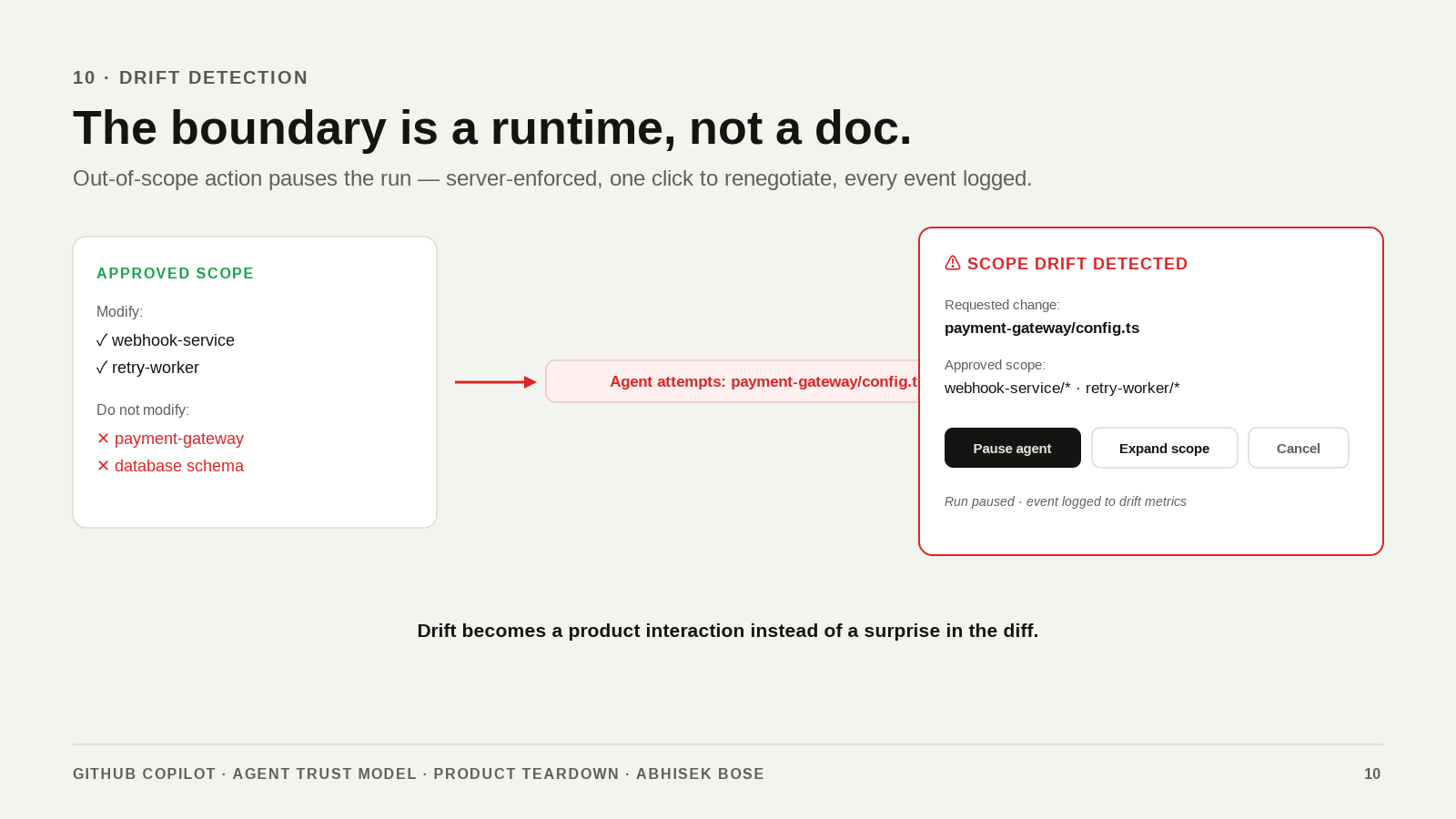
Drift becomes a product interaction — pause, expand scope, or cancel — instead of a surprise in the diff.
Three properties matter: the pause is server-enforced (not a prompt instruction the model can ignore), the expansion is one click (drift is often legitimate — the boundary should be cheap to renegotiate), and every drift event is logged (drift frequency becomes a metric, see section 12).
11 · Category view: delegation models, not feature lists
Comparing Copilot vs Cursor vs Claude Code feature-by-feature misses the point. Compare the trust abstraction each pattern ships:
| Product pattern | Primary trust mechanism |
|---|---|
| IDE autocomplete | Human reviews each suggestion |
| Agent mode (IDE) | Human supervises execution live |
| Cloud coding agent | Human reviews the finished PR |
| CLI agent | Permission prompts + human oversight |
| Proposed model | Human approves intent; system monitors drift |
Every existing pattern puts the human either everywhere (exhausting) or at the end (too late). Nobody has shipped the middle: approve once, at the point of maximum leverage, with the system enforcing the boundary afterward. GitHub is best positioned to build it — it already owns the issue (intent) and the PR (outcome), and connects them with nothing.
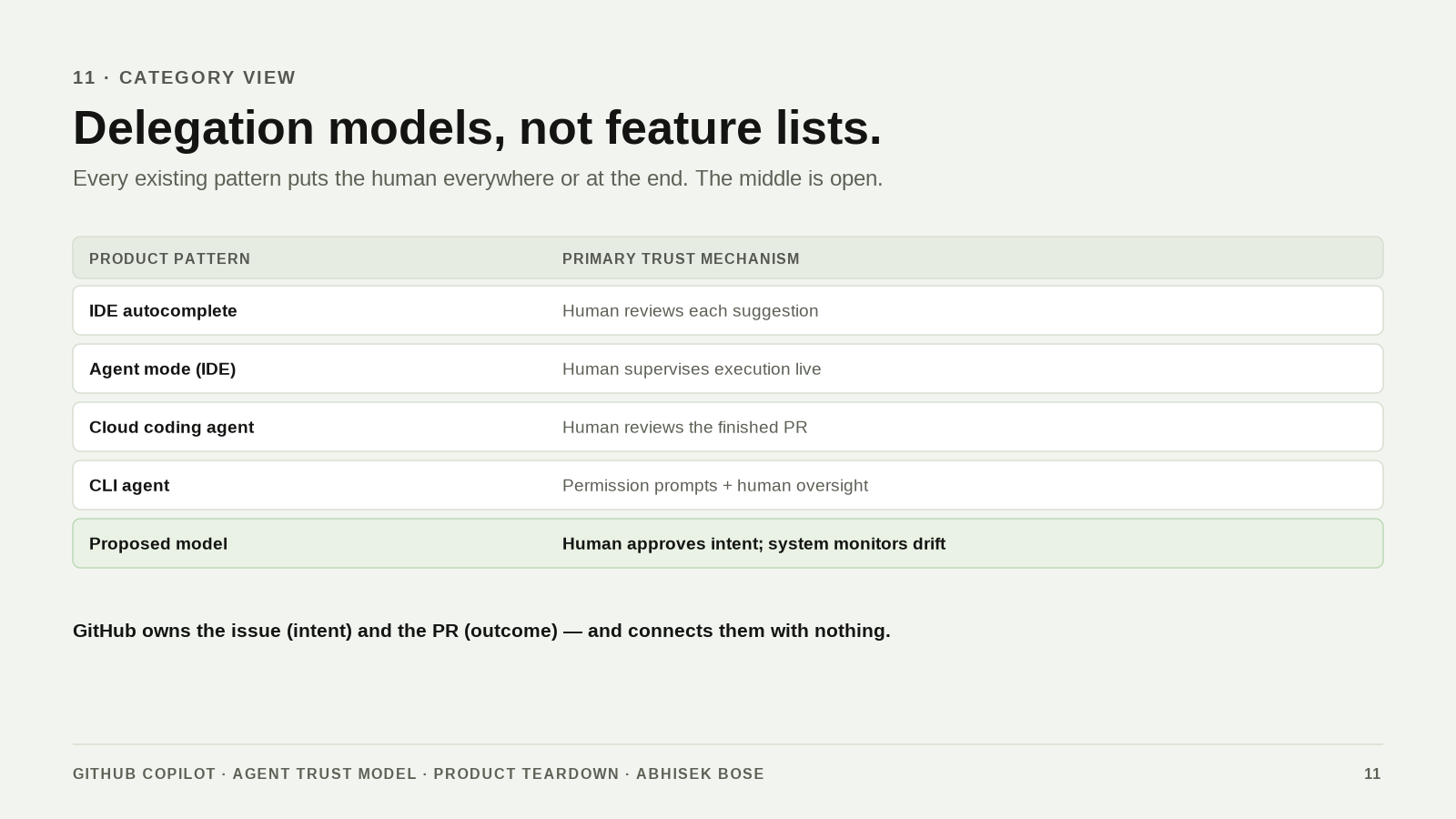
The open position in the category: trust placed at intent, enforced by the system.
12 · Metrics that prove the thesis
Not engagement. A measurement system where each metric tests one link in the delegation loop:
- Delegation rate — % of eligible engineering tasks handed to the agent. The demand signal.
- Spec acceptance rate — % of generated specs approved without edits. Tests whether the agent understands intent (and whether the spec format is teaching it).
- Scope drift rate — % of runs pausing on out-of-scope action. Rising early then falling means the boundary is training both sides.
- Post-PR rework rate — % of agent PRs needing substantial human rewrite. The direct measure of intent survival.
- Human review minutes per agent task — the efficiency claim, verified.
- Repeat delegation rate — % of users who delegate again after their last run. The only trust metric that can't be gamed: burned users don't come back.
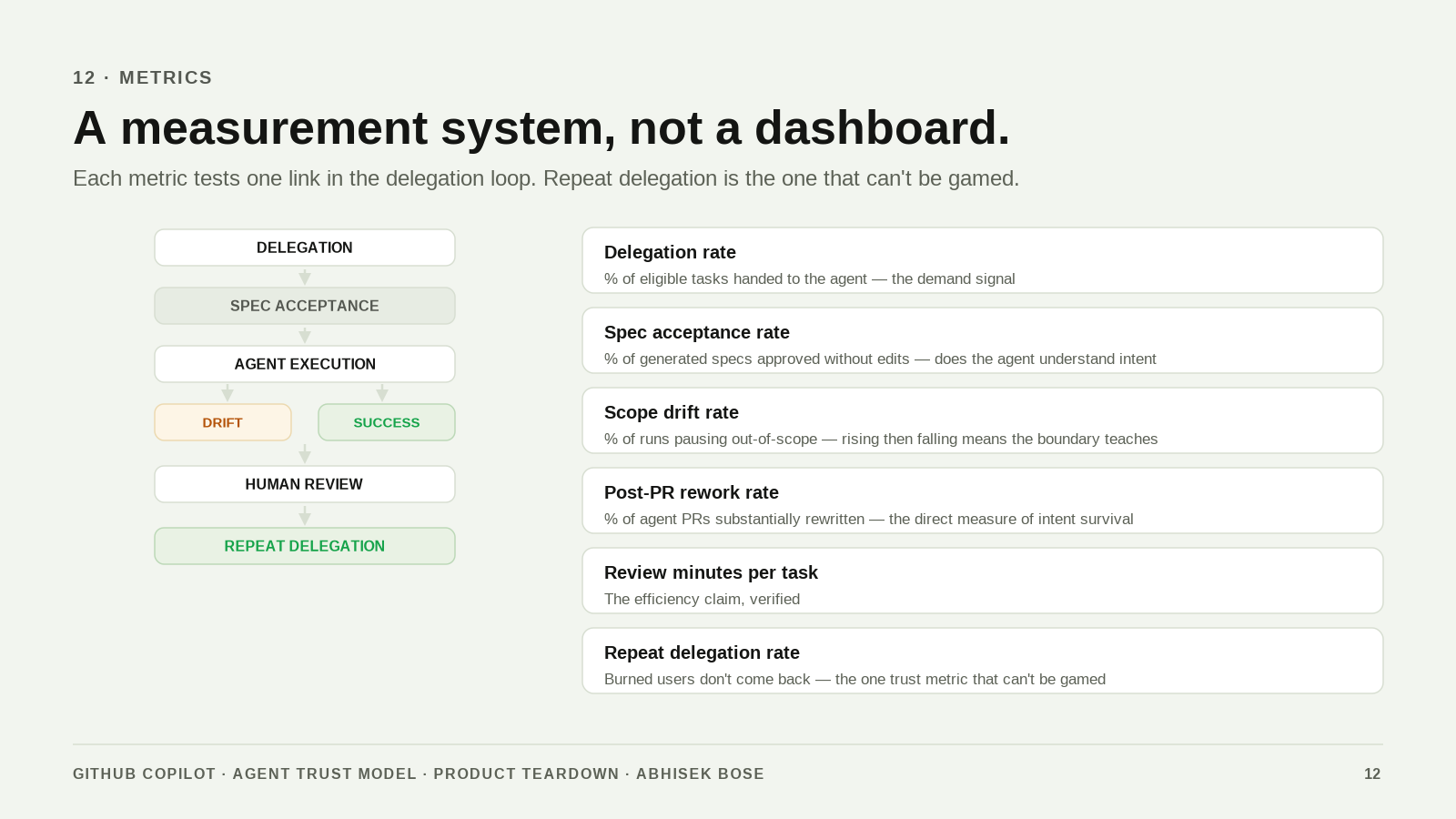
One loop, six instruments — repeat delegation is the metric the others exist to move.
13 · The experiment
Don't build it on conviction. Run the test:
Control: current workflow — prompt → agent → PR. Treatment: prompt → generated spec → human approval → agent → PR.
Hypothesis: explicit intent approval increases repeat delegation and reduces substantial PR rework, without increasing total developer time per task.
Primary metric: repeat delegation rate. Secondary: post-PR rework, review minutes, spec edit frequency, drift events, task completion rate. Guardrail: total developer time per completed task must not rise — if the spec gate costs more than it saves, it's bureaucracy, not product.
Kill criterion: if rejected agent PRs turn out to be dominated by code-quality failures rather than intent failures, the spec gate solves the wrong problem and the investment belongs in execution quality.
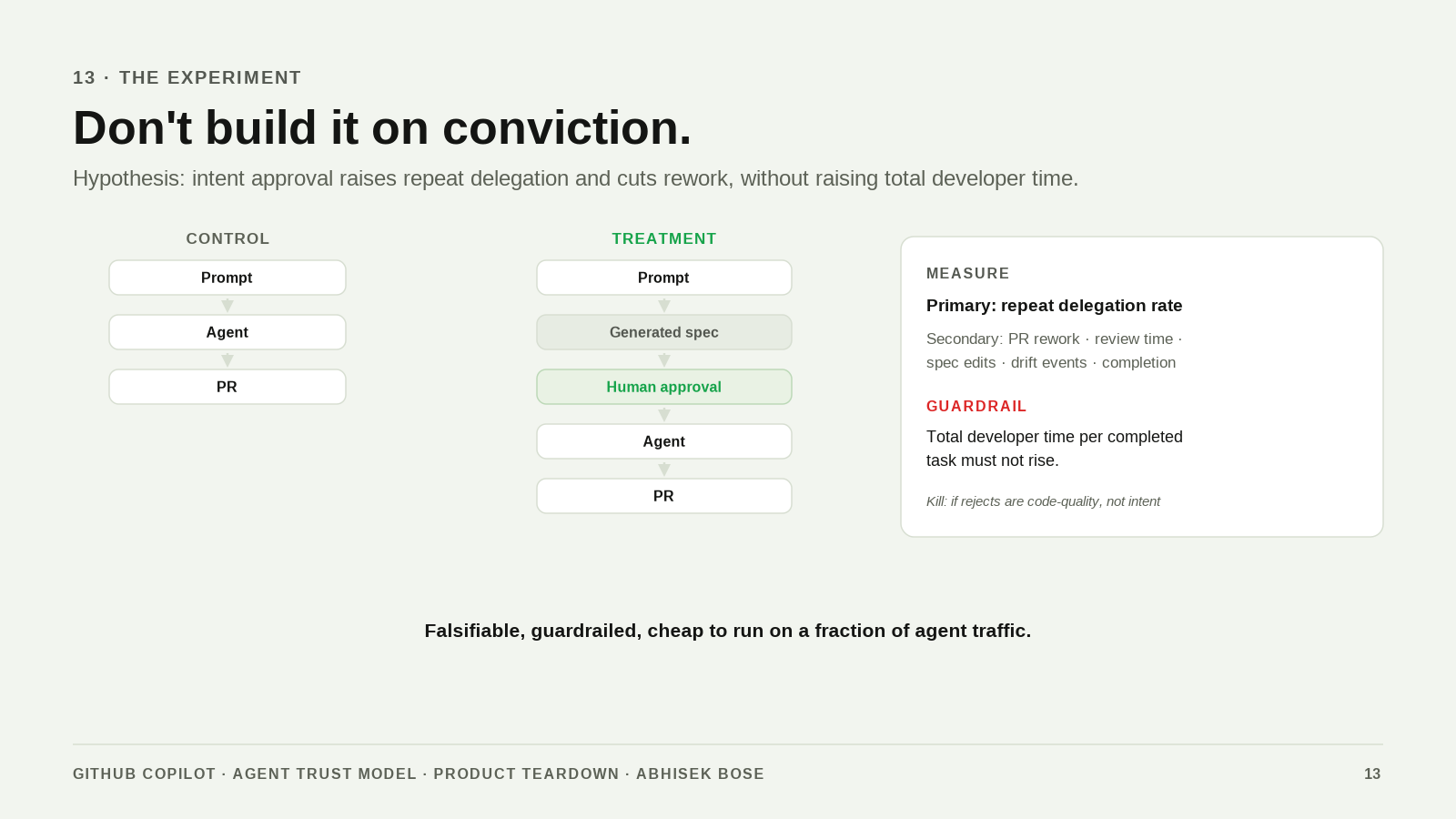
Falsifiable, guardrailed, and cheap to run on a fraction of agent traffic.
14 · What I'd build first
| Feature | Impact | Effort | Priority |
|---|---|---|---|
| Generated task spec | High | Medium | P0 |
| Human approval gate | High | Low | P0 |
| Scope drift detection | High | High | P1 |
| Acceptance-criteria conformance report | High | Medium | P1 |
| Requirement → PR traceability | Medium | High | P2 |
| Organization trust dashboard | Medium | High | P2 |
The P0 pair ships the thesis: a spec worth approving and a one-click way to approve it. Drift detection is P1 because it needs the spec's scope field to exist first — sequencing, not importance.
15 · Final thesis
The next generation of coding agents won't win by becoming more autonomous alone. They'll win by making autonomy predictable.
The product opportunity isn't removing humans from the loop. It's moving humans to the right point in the loop — from reviewing finished work they didn't scope, to approving intent the system then enforces.
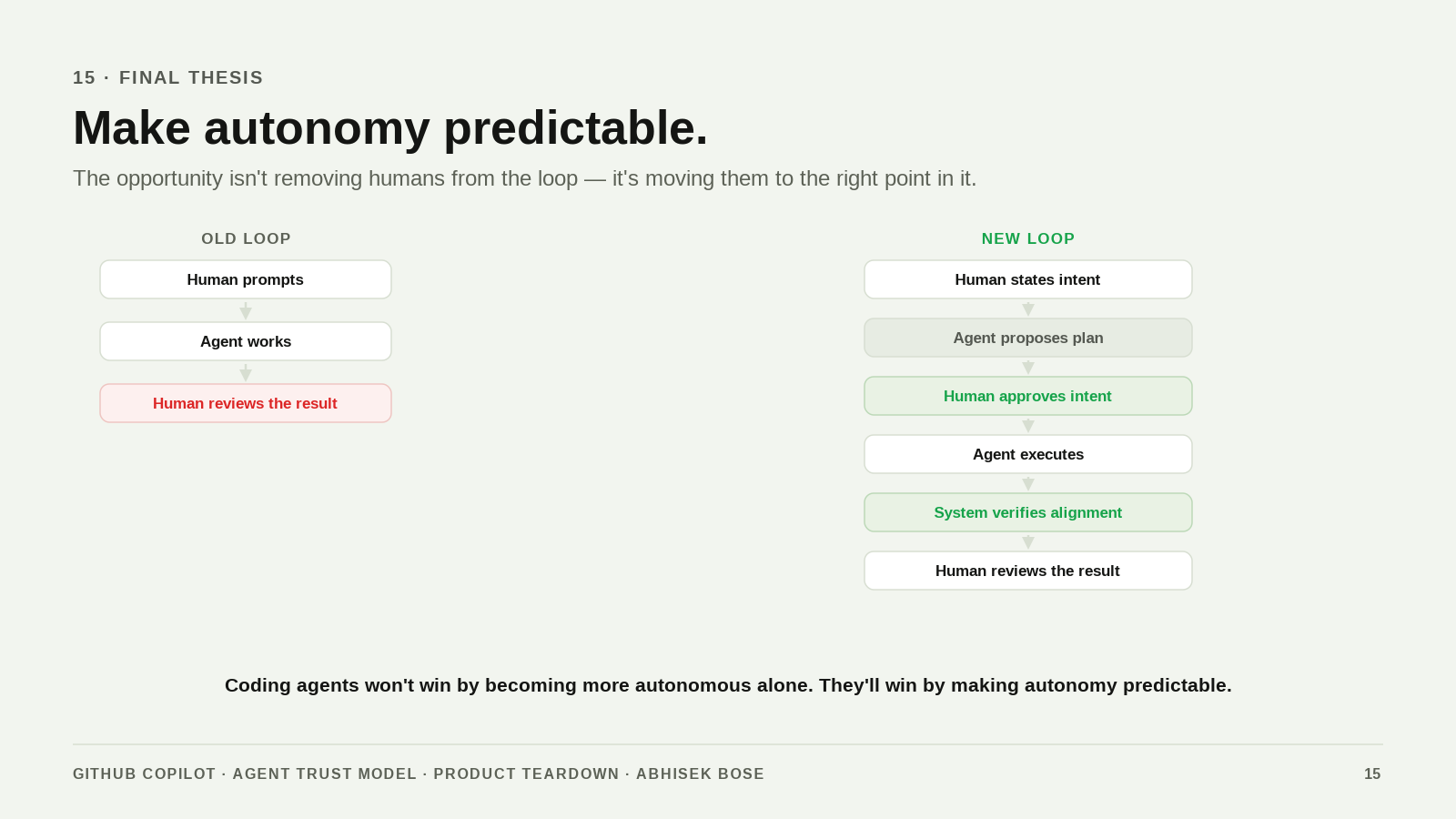
Old loop: judgment at the end. New loop: judgment at the point of leverage, verification everywhere else.
Sources
Observed claims in this teardown draw on:
- Reviewing Copilot's pull requests — GitHub's own docs: the agent cannot merge its own work, and output must be reviewed before merging
- Assigning and completing issues with coding agent — the issue-to-PR agent workflow and sandboxed Actions environment
- GitHub Copilot premium requests — metered billing for agent and advanced-model usage
- GitHub Copilot is moving to usage-based billing — the shift from flat seats toward usage-metered AI credits
Everything else is inferred product analysis or marked (illustrative estimate) inline.