Scenario: Tear down Devin, Cognition's "AI software engineer," through the lens of the demo-to-production gap — where autonomy is graded by benchmarks but experienced as supervision, failure recovery, and rollback.
01 · The thesis
Cognition graded one product and sold another.
What the eval measured: SWE-bench-style tasks — short-horizon, well-specified, self-contained fixes with a known ground truth. The launch figure was 13.86% of issues resolved.
What the claim sells: an "autonomous software engineer" doing long-horizon, ambiguously specified work where the ground truth is negotiated with a human mid-flight.
My thesis: grade supervised recovery, not first-attempt autonomy. The product's real job is failing legibly and getting unstuck cheaply — and no eval in the launch story ever measured getting unstuck.
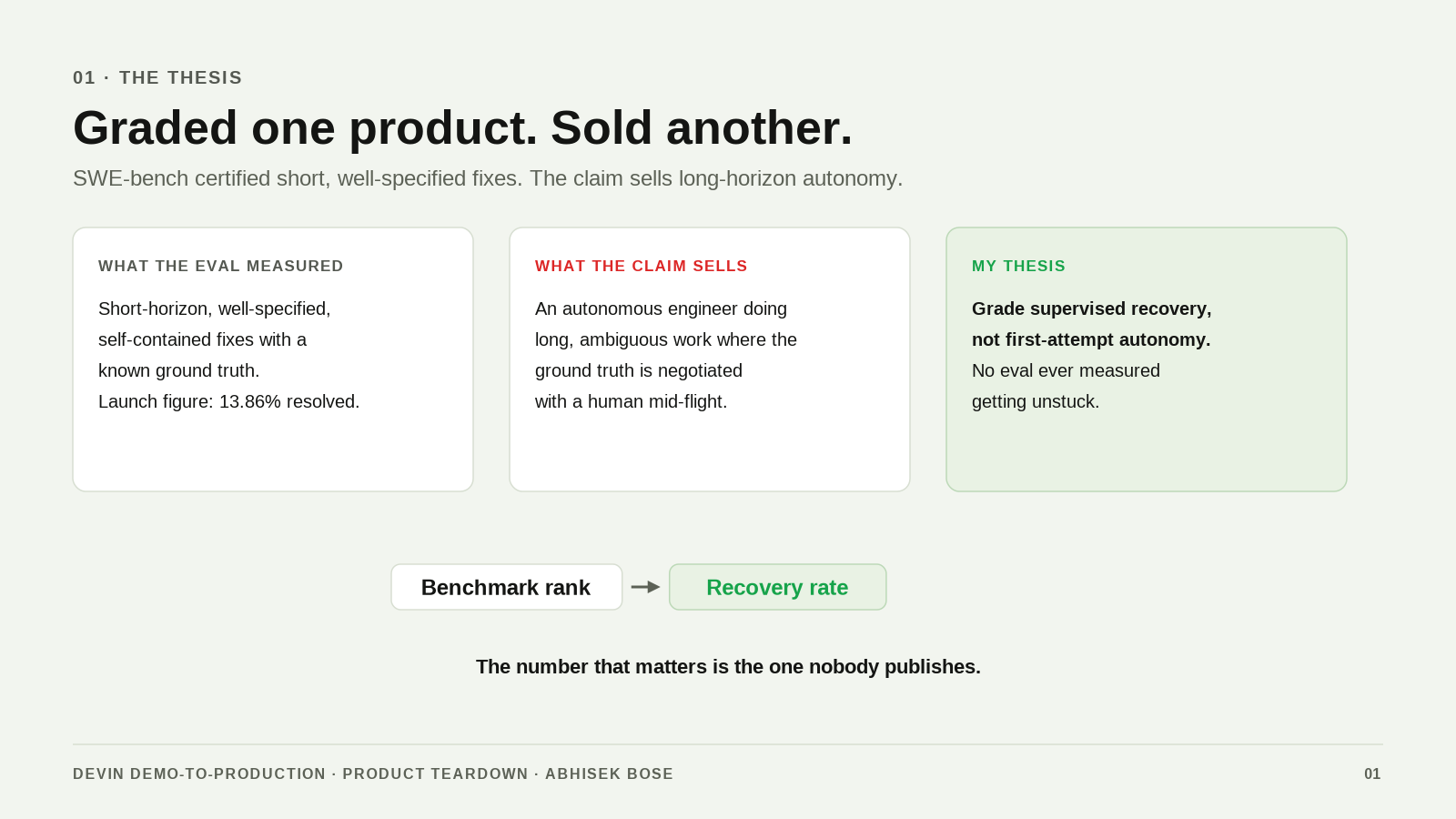
One screen: the benchmark certified a different product than the claim sells.
02 · Product evolution
Devin's history is the argument. Each era changed the shape of the task — and quietly changed what the eval could honestly certify:
| Era | Task shape | Ground truth | What the eval measures |
|---|---|---|---|
| Scripted demos | Curated, rehearsed | The video itself | Nothing — it's theater |
| SWE-bench agent | Short, well-specified fix | An existing test | First-attempt success |
| "AI engineer" claims | Long-horizon, ambiguous | Negotiated with a human | Unmeasured |
| Windsurf hedge | Human-in-the-loop editing | The human, live | Concedes the thesis |
Independent evaluations told the same story: community re-tests of the launch demos found the autonomous-completion narrative considerably less clean than presented, and an independent 20-task evaluation scored 3 satisfactory against 14 failures. The acquisition of Windsurf — a human-in-the-loop editor bolted onto a pure-autonomy bet — is the company hedging its own claim.
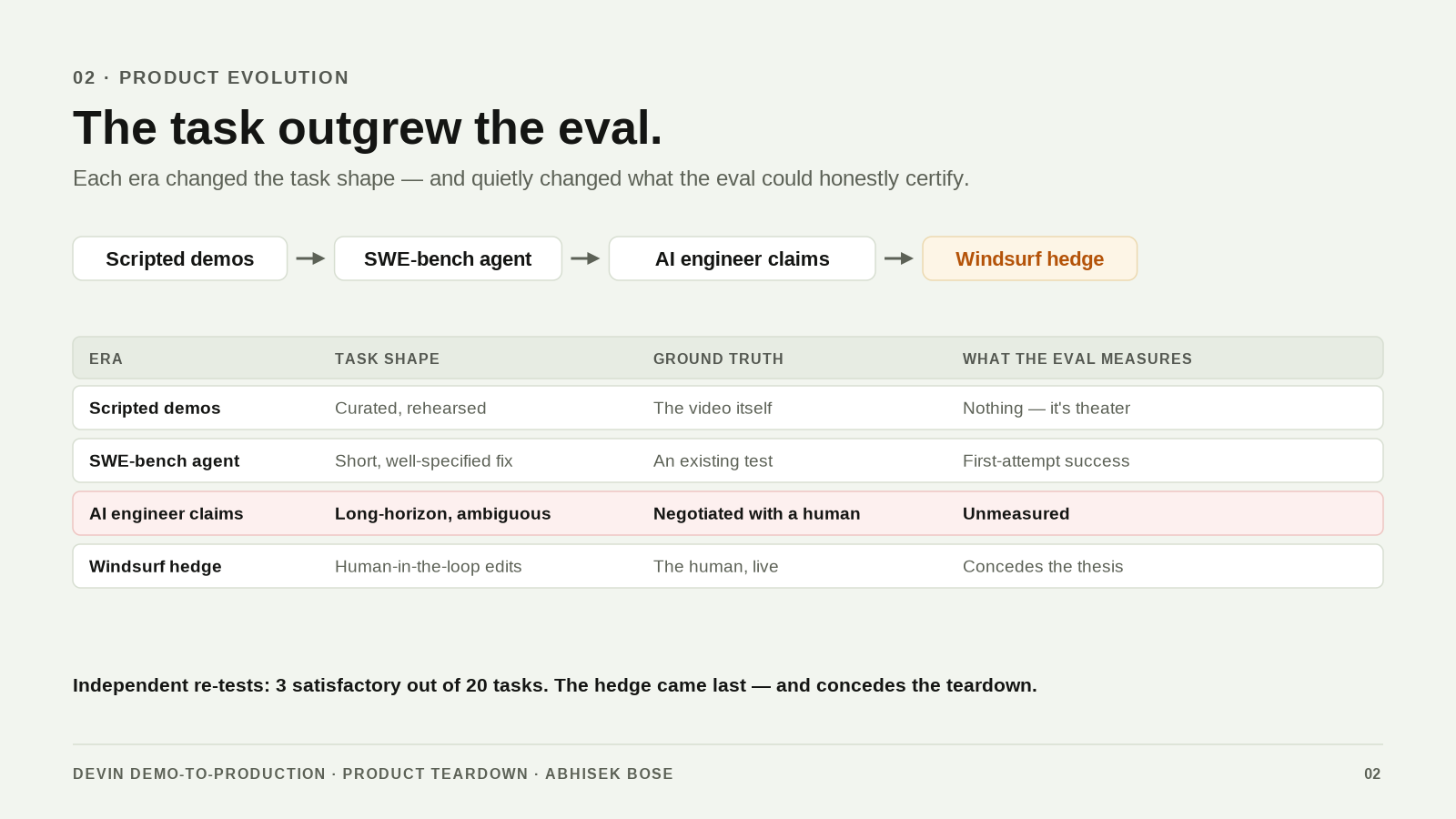
The task shape grew past what any eval measured. The hedge came last.
03 · Who actually has this problem
Not "engineering teams." Three personas, three very different supervision budgets:
- Platform lead clearing migration queues — job: bulk-ship framework upgrades and dependency bumps across dozens of repos (illustrative estimate). Risk: a botched migration merged without scrutiny breaks downstream teams, and she owns the incident. Supervision budget: PR review only — her seniors cannot spend afternoons watching an agent think.
- Startup founder prototyping — job: get a rough feature standing by Friday. Risk: a wasted day and some ACUs. Supervision budget: high — he's watching anyway, half out of curiosity.
- Understaffed team hoping to replace a hire — job: hand ambiguous work to the agent unsupervised. Risk: expensive, illegible failure discovered days later. Supervision budget: near zero — which is exactly why they bought it.
The pattern: the smaller the supervision budget, the more the product depends on stopping and asking — and the current product never stops. The marketing attracts the third persona; the product punishes them hardest.
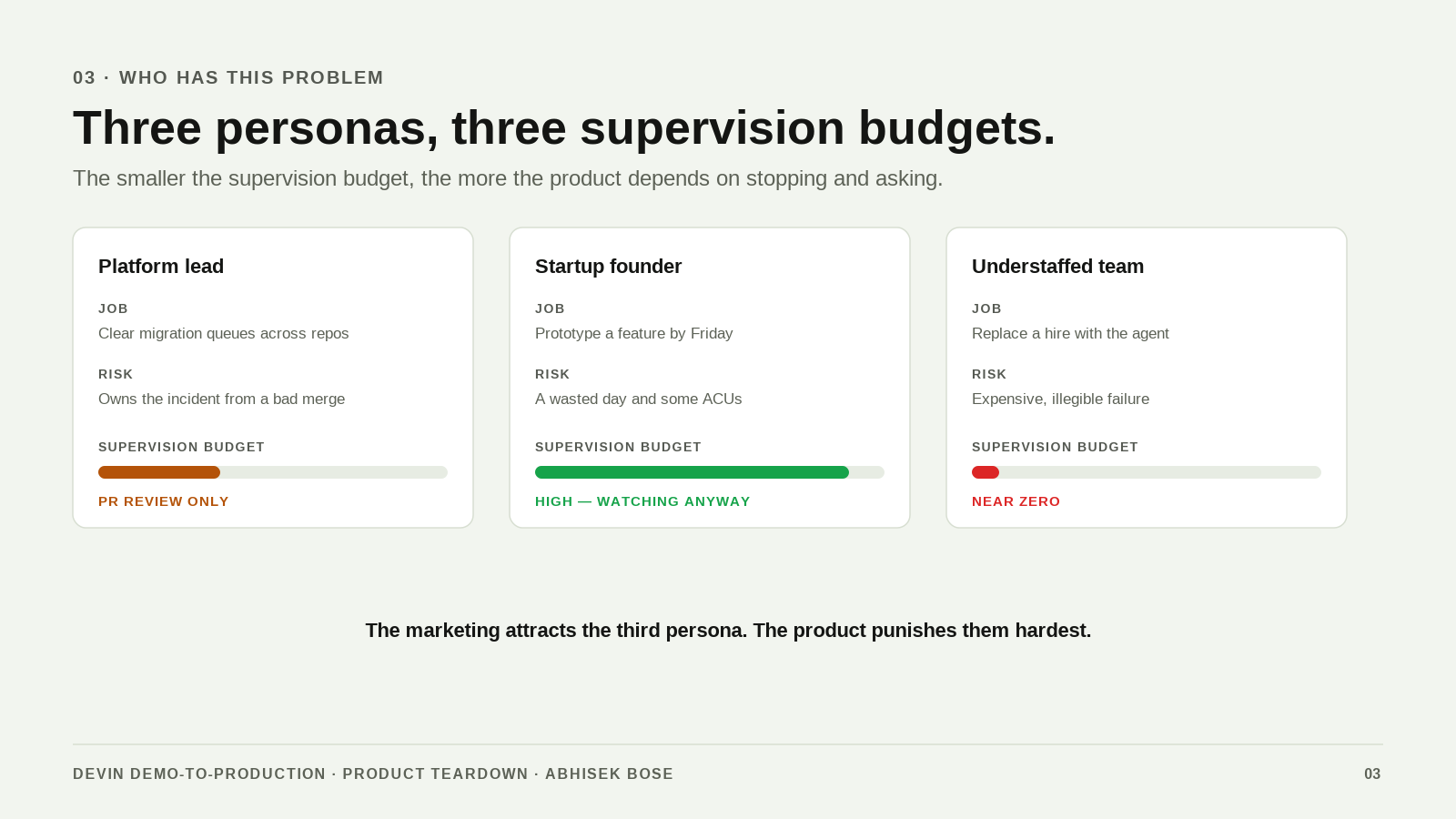
Supervision budget shrinks left to right — and the product's dependence on asking grows.
04 · Jobs to be done
Functional JTBD: when I have a queue of well-specified backlog tasks, I want an agent to clear it without a senior engineer in the room.
Emotional JTBD: I want to trust the run while I'm not watching it.
Trust JTBD: I need to know the agent will stop and ask when it's uncertain — before it spends hours and ACUs on the wrong interpretation.
The third job is the foundation and the one no benchmark grades. Devin ships the functional job on clean tickets, gestures at the emotional job with a scrubable session log, and has no product surface at all for the trust job. Asking has never scored a point on any leaderboard the product was tuned against.
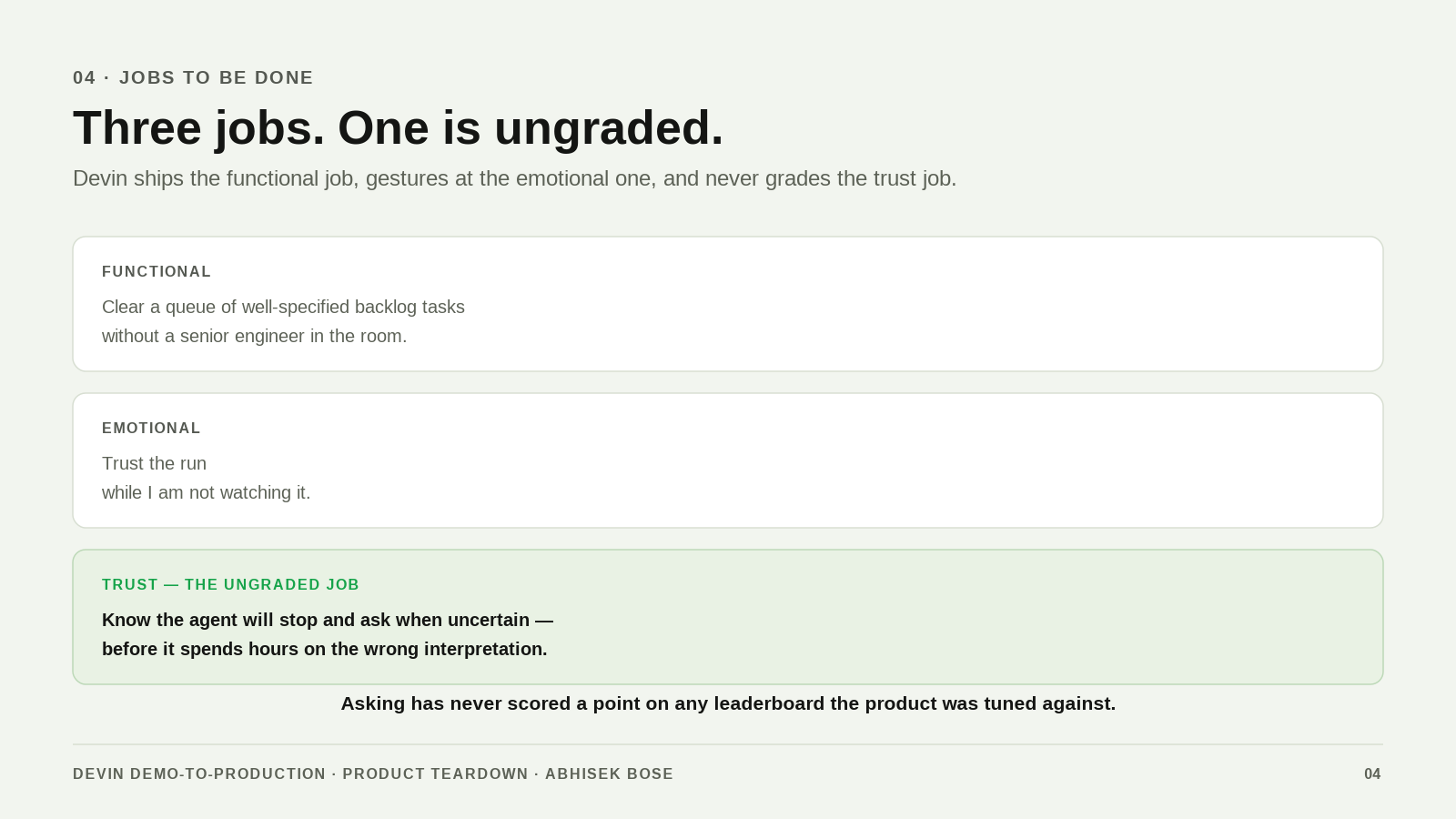
The ungraded job — stop and ask when uncertain — is the one delegation actually rests on.
05 · How the product works
Devin is real infrastructure, not a demo reel. You assign a task in natural language; it spins up a sandboxed session with a shell, an editor, and a browser; it plans, then executes for a long stretch — commands, edits, test runs, web lookups — and opens a PR at the end. The session is exposed as a live, scrubable record, which is genuinely better than most competitors' chat logs.
Billing is ACUs — Agent Compute Units — consumed per session. The meter runs on effort, not outcome: a run that wanders for hours and produces an unmergeable PR bills the same as a run that ships. Often more, because failure is verbose.
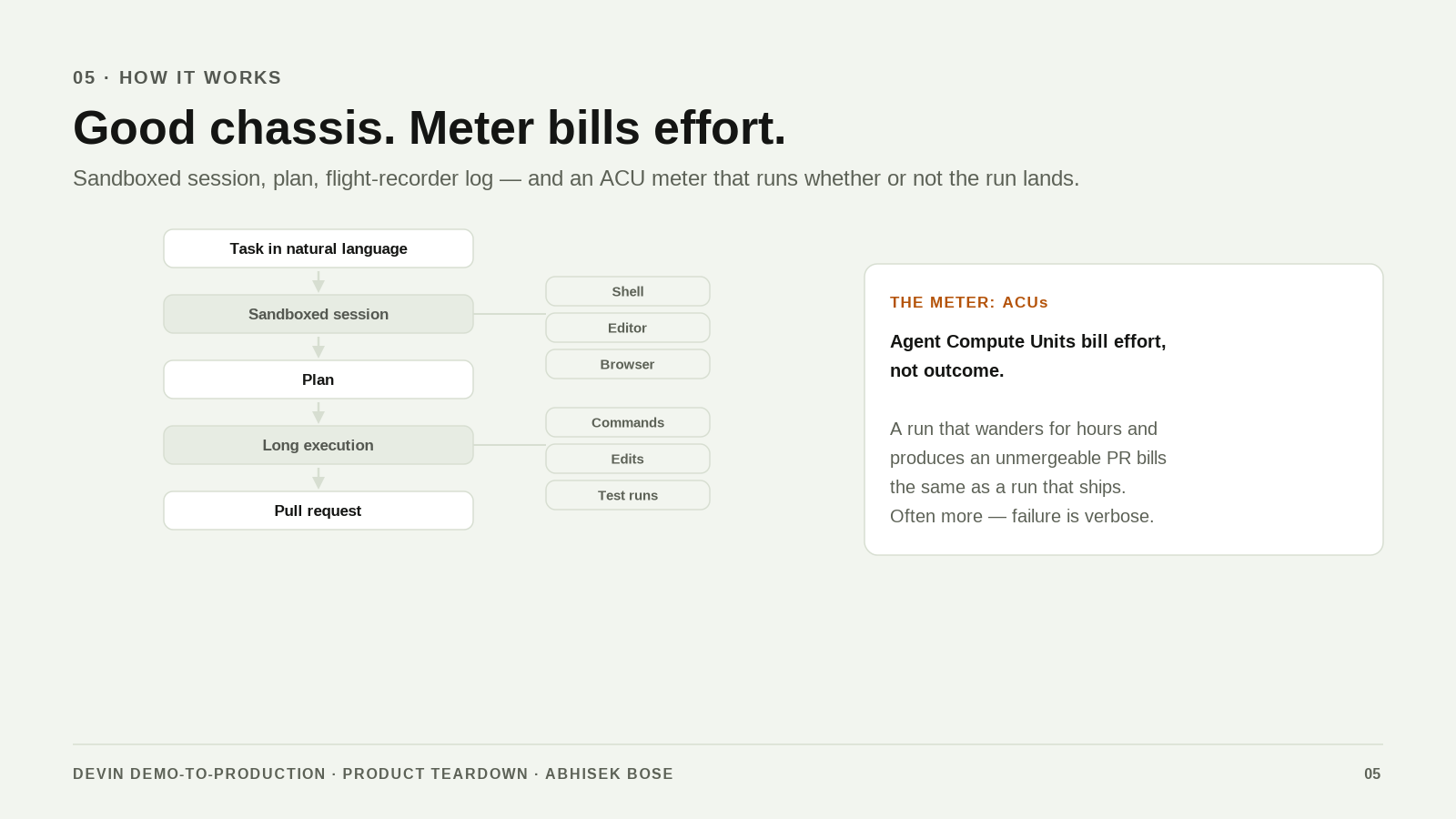
Good chassis: sandbox, plan, flight-recorder session. The meter bills effort whether or not the run lands.
06 · Where trust actually lives
Map the trust decisions across one delegated run and the problem becomes visible:
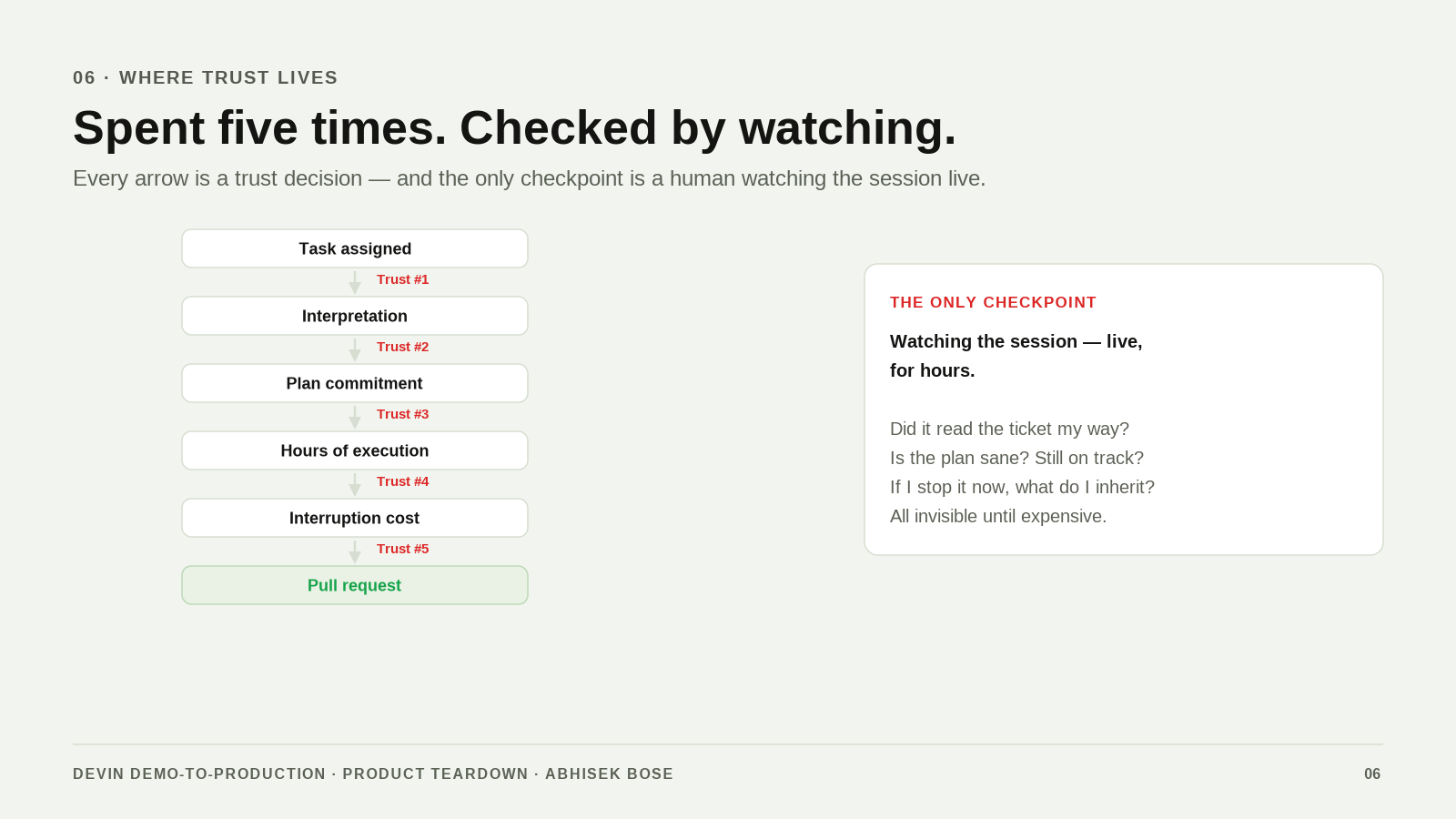
Five places trust is spent. The only checkpoint is watching it — live, for hours.
Trust is spent at interpretation (did it read the ticket the way I meant it), at plan commitment (is this plan sane), across hours of execution (is it still on track), at interruption (if I stop it now, what do I inherit), and at the PR. The product's only checkpoint for the first four is a human watching the session. Supervision isn't overhead on the autonomy — it is the product, and the UI treats it as an edge case.
07 · The real product gap — a concrete scenario
The ticket says: "Migrate the notification service off the legacy queue."
Two valid readings. Reading X: swap the queue client, keep message contracts intact. Reading Y: the migration is the excuse to finally restructure the message contracts.
At minute five, Devin commits to Y. It is thorough about it — new schemas, rewritten consumers, updated tests, hours of diligent execution, ACUs billing the whole way. The work is internally consistent and entirely wrong. Nobody finds out until the PR, or until a senior engineer interrupts at hour three and inherits a half-mutated workspace with no clean rollback point.
The failure isn't capability. It's that the architecture treats ambiguity as something to resolve internally rather than a signal to stop — because every eval it was tuned against rewards finishing, and the meter rewards it too.
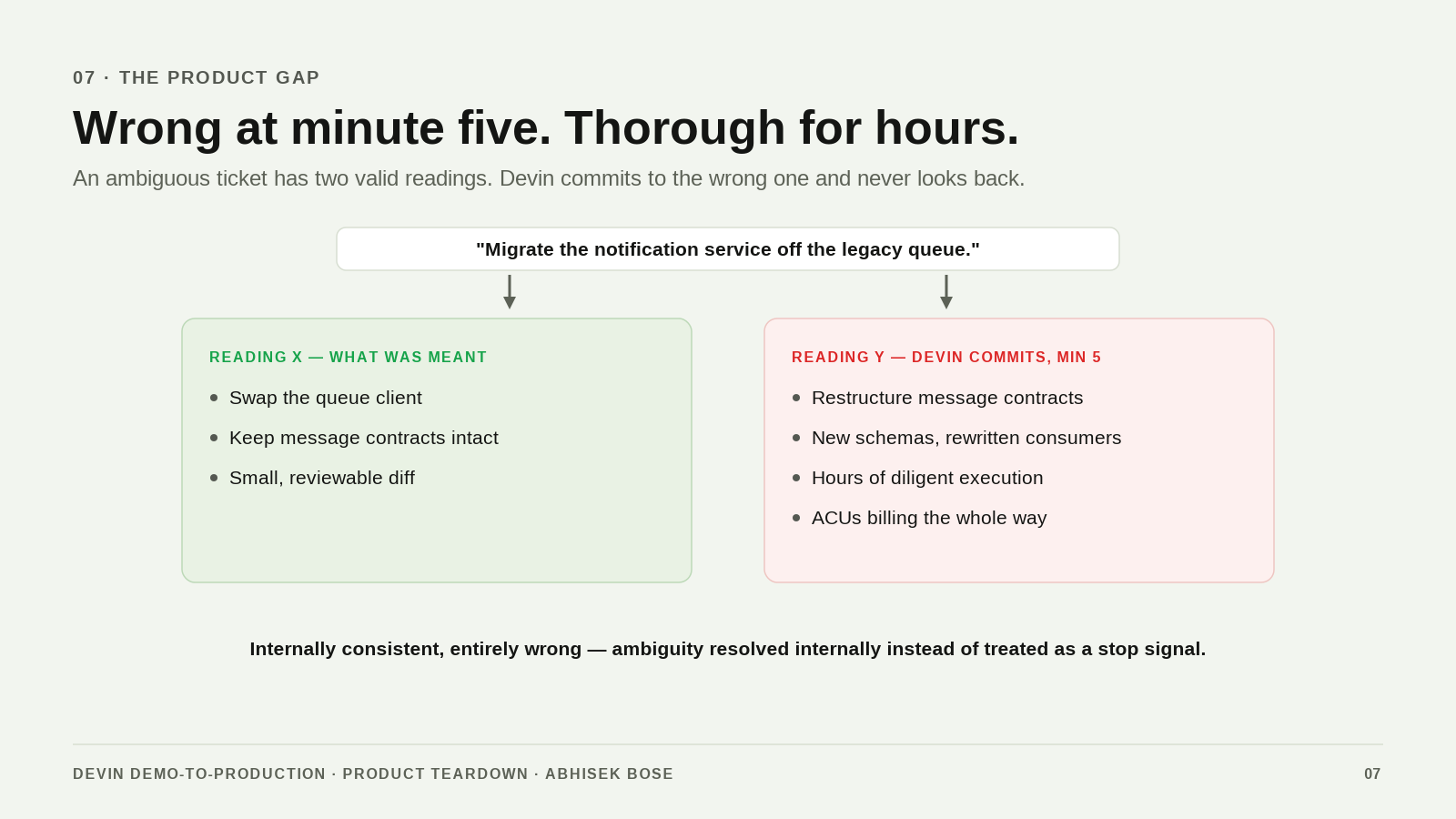
Wrong at minute five, thorough for hours, billed throughout.
08 · Current vs proposed
Current: task → one linear session → hours of execution → PR → human discovers the interpretation mismatch at the most expensive possible moment, with "let it finish" and "start over" as the only clean exits.
Proposed: task → ambiguity gate (the agent states its interpretation and gets it approved) → checkpointed execution at plan-step boundaries → interrupt lands on a checkpoint, not a crime scene → PR that references the interpretation it satisfied.
A benchmark score without a recovery eval is a demo with a bibliography.
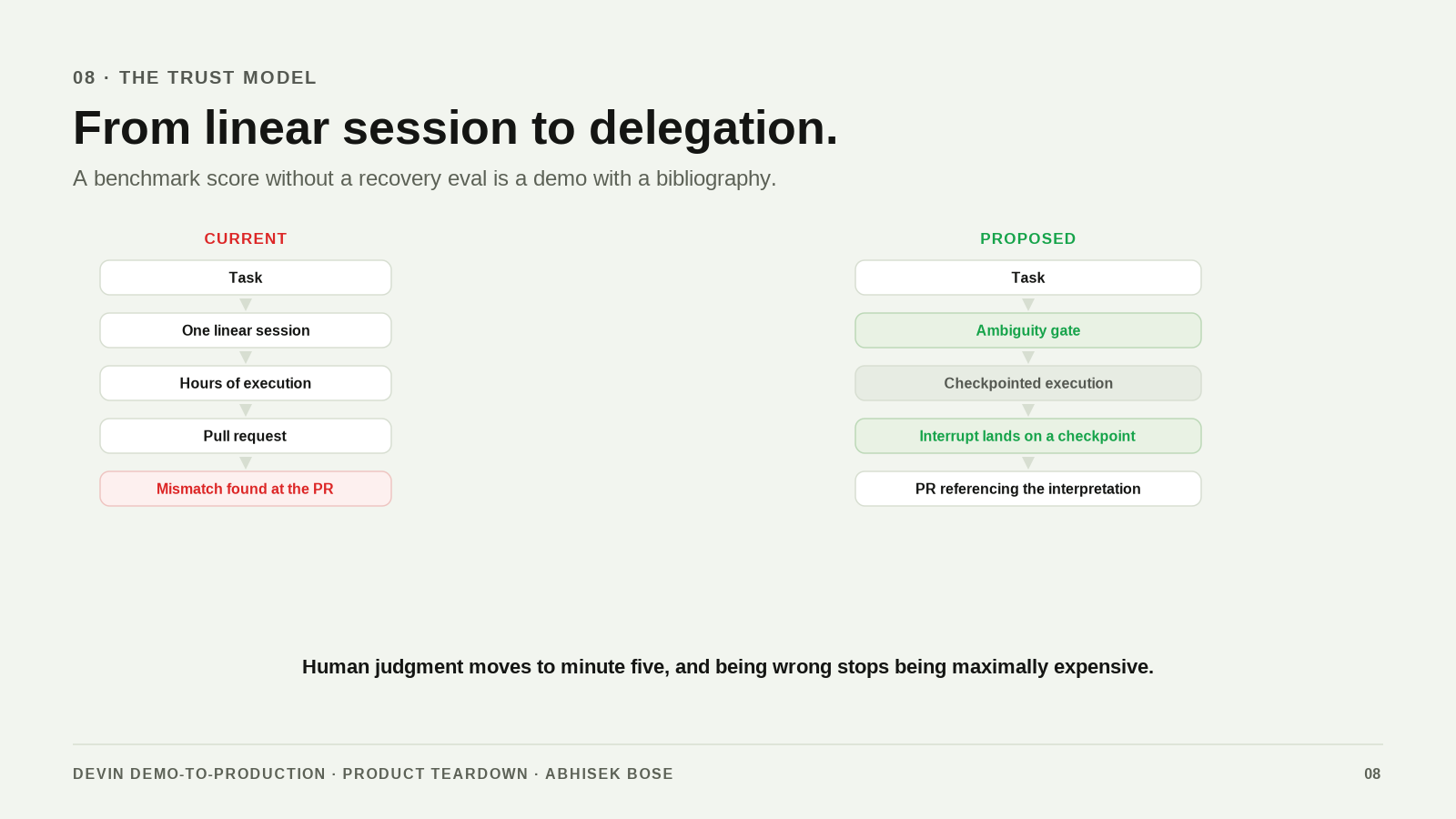
From a linear session you can only watch, to a checkpointed delegation you can steer.
09 · The artifact: the ambiguity gate
"Make it ask" is hand-waving unless you design the object. This is the interpretation card — shown before any run projected past a threshold, small enough to answer in under a minute:
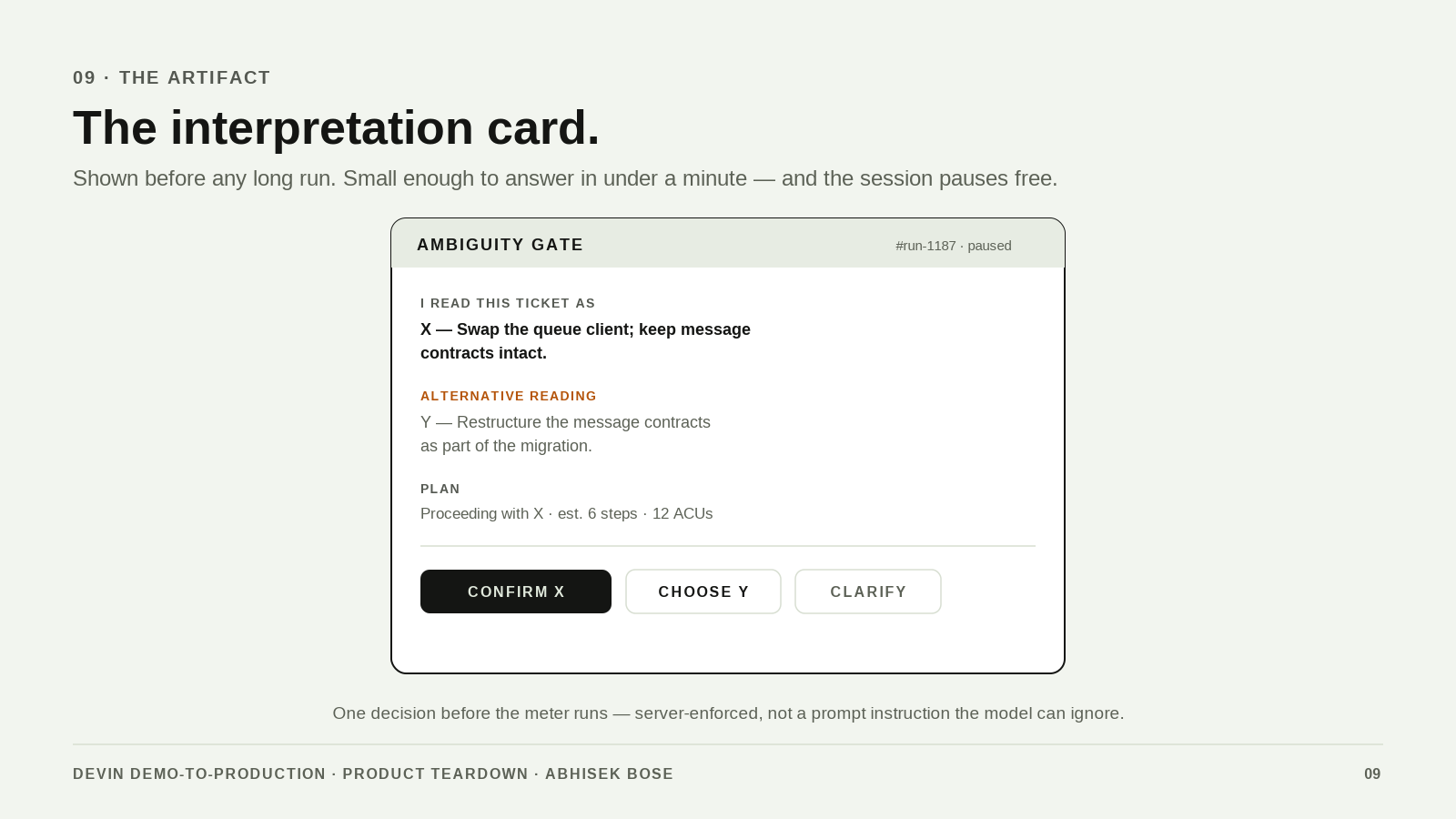
The interpretation card: reading X, alternative Y, one decision before the meter runs.
The card states: "I read this ticket as X. There's an alternative reading, Y. I'm proceeding with X — confirm, choose Y, or clarify." Proceeding past the gate on low confidence requires explicit approval, and the session pauses for free while it waits. I build this exact pattern in my DeepAgents project: agents must state their plan for human approval before executing, enforced by two server-side gate layers — not a prompt instruction the model can ignore — with every run traced in Langfuse. The gate is buildable today; what's missing at Cognition is the product decision to make asking a first-class move instead of a benchmark penalty.
10 · The interaction: checkpoint rollback
The second primitive: the run is a tree, not a tape. Devin checkpoints at plan-step boundaries, and when a run goes wrong, the user doesn't interrupt into a mutated workspace — they branch:
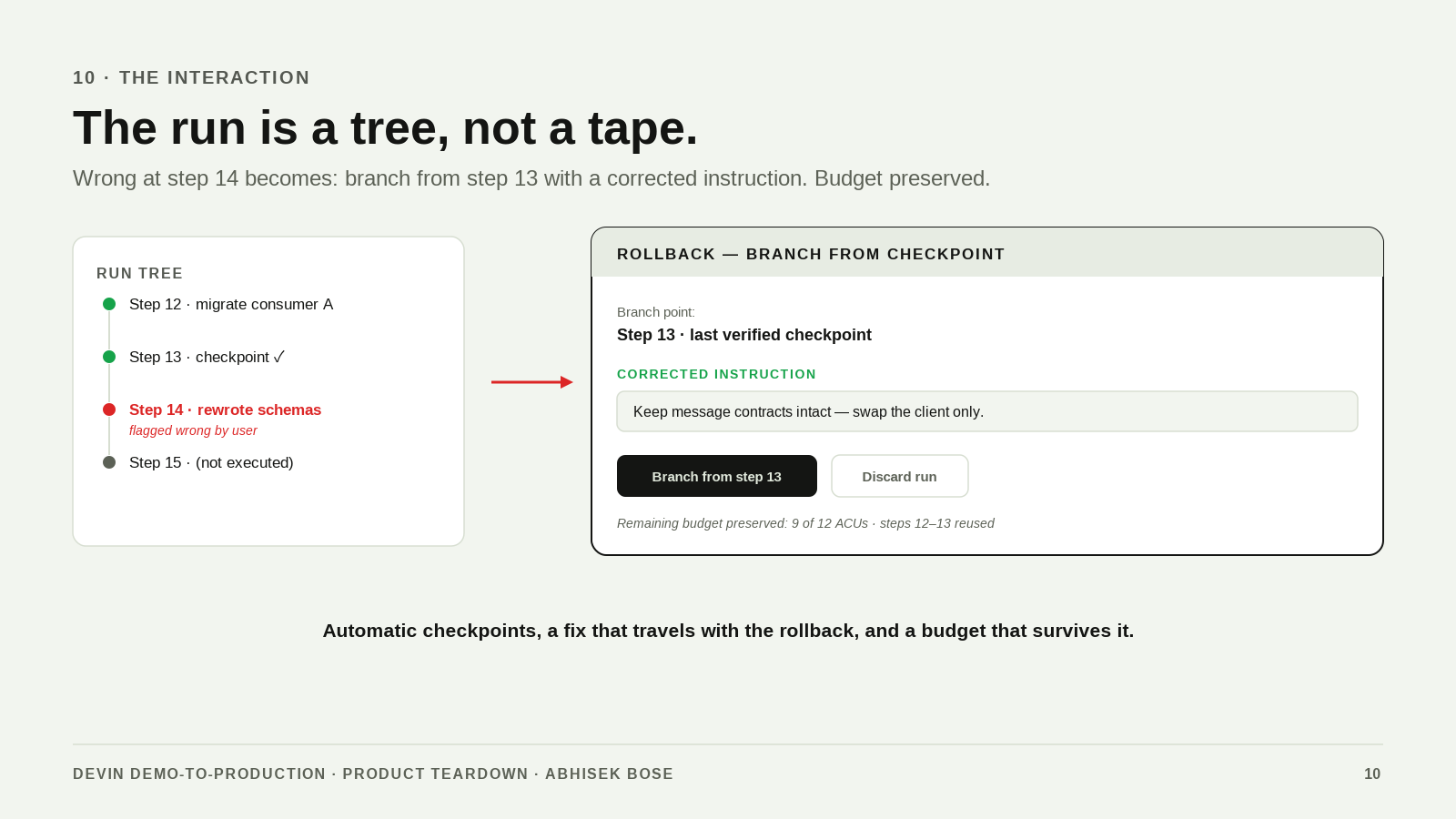
"Wrong at step 14" becomes "branch from step 13 with a corrected instruction" — budget preserved.
Three properties matter: checkpoints are automatic (plan-step boundaries, no user ceremony), branching carries the corrected instruction (the fix travels with the rollback, so the agent doesn't repeat the mistake), and the remaining ACU budget is preserved (rolling back must not cost more than pushing forward, or nobody will ever roll back). This turns every failure from maximally expensive into a routing decision.
11 · Category view: eval regimes, not agents
Comparing Devin vs Claude Code vs OpenHands feature-by-feature misses the point. Compare what each eval regime actually certifies:
| Eval regime | What it certifies |
|---|---|
| Benchmark rank | First-attempt success on frozen, well-specified tasks |
| Demo reel | That a happy path exists |
| Supervised-tool evals | Usefulness with a human at the wheel |
| Recovery-rate evals | Behavior when wrong: asks, checkpoints, recovers cheaply |
Everyone in the category competes on the first row and markets with the second. The fourth row — recovers legibly when wrong, measured and published — is the open position. Nobody owns it, and the company that publishes recovery evals before benchmark scores reframes the whole category around the number only they can show.
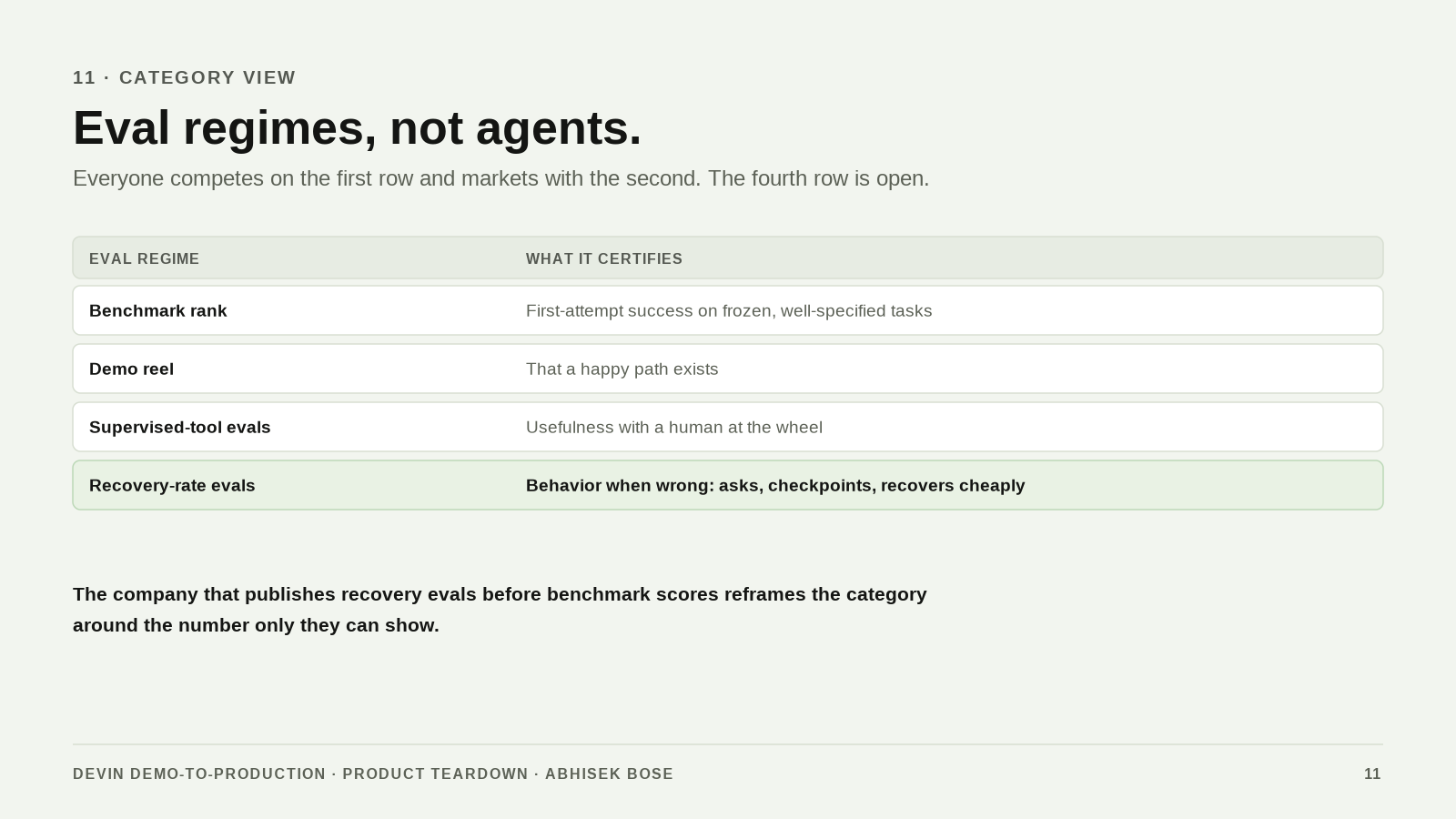
The open position in the category: certified recovery, not certified first attempts.
12 · Metrics that prove the thesis
Not benchmark deltas. A measurement system where each metric tests one link in the delegation loop:
- Completion-without-rescue rate — of runs started, how many reach a merged outcome with zero human takeover. The honest autonomy number; the one the marketing claim actually asserts.
- Cost per merged outcome — ACUs plus human minutes, per PR that ships. The only number the buyer's finance team ultimately cares about.
- Time-to-first-escalation on ambiguous tasks — an agent that asks in minute five is worth ten that confess in hour three.
- Rollback usage on interrupted runs — whether checkpoints made failure cheap; high interrupts with low rollback means the primitive missed.
- Task-scope ceiling over time — whether accounts delegate progressively harder work or retreat to trivia. The leading indicator of trust, and of renewal.
- ACU waste on abandoned runs — effort billed on runs that end in abandonment. The number the pricing model currently hides, and the one an honest company would rebate.
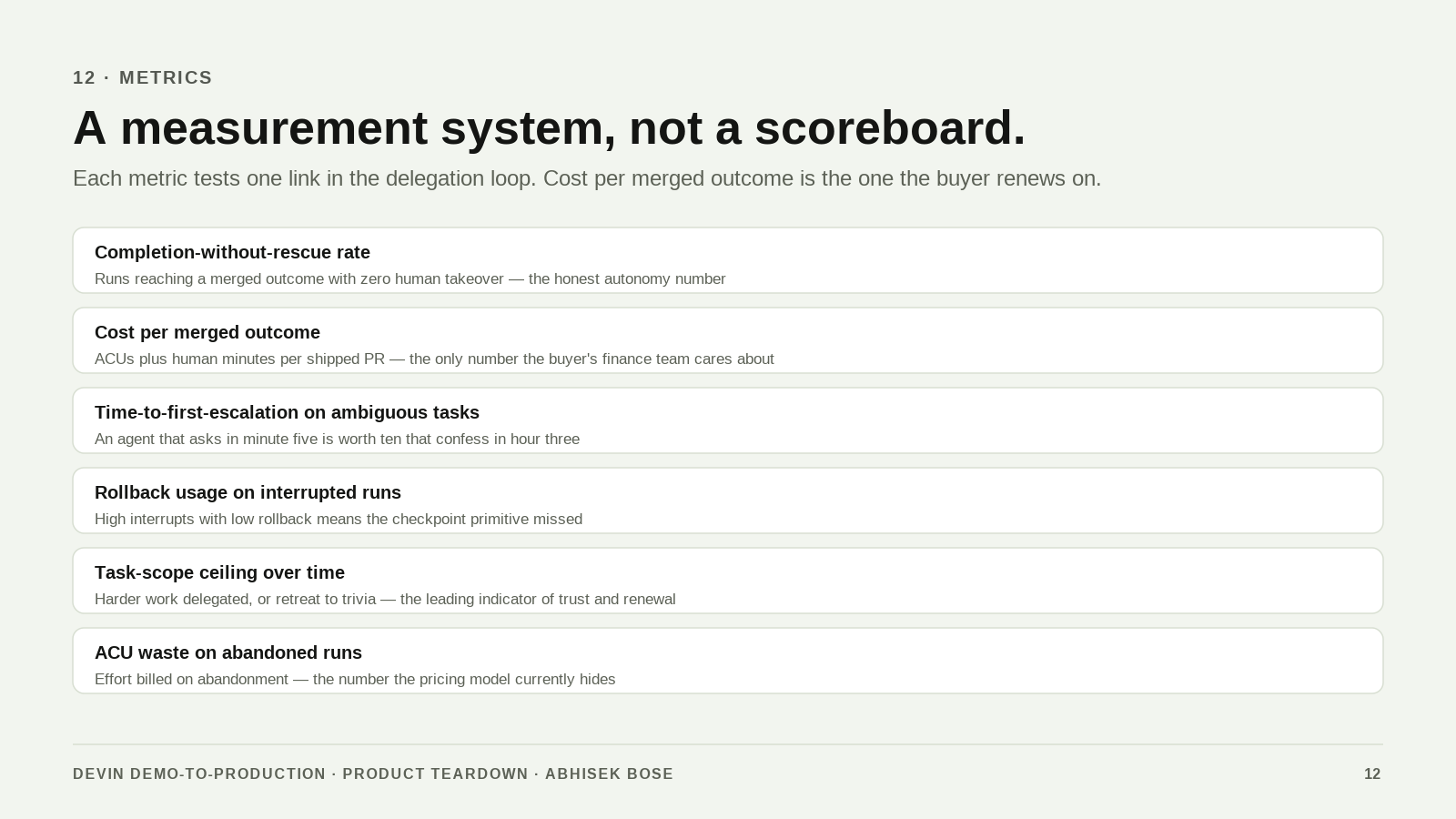
Six instruments on one loop — cost per merged outcome is the one the buyer renews on.
13 · The experiment
Don't build it on conviction. Run the test:
Control: current sessions — task → linear run → PR. Treatment: ambiguity gate before long runs + checkpoints at plan-step boundaries.
Hypothesis: the gate raises completion-without-rescue rate and cuts cost per merged outcome, because interpretation failures get caught at minute five instead of hour three.
Primary metric: completion-without-rescue rate. Secondary: cost per merged outcome, time-to-first-escalation, rollback usage, ACU waste. Guardrail: time-to-start must not balloon — if every trivial task now waits on a confirmation click, the gate is bureaucracy, not product.
Kill criterion: if failed runs turn out to be dominated by raw capability gaps rather than interpretation and drift, the recovery investment is premature and execution quality is still the right bet.
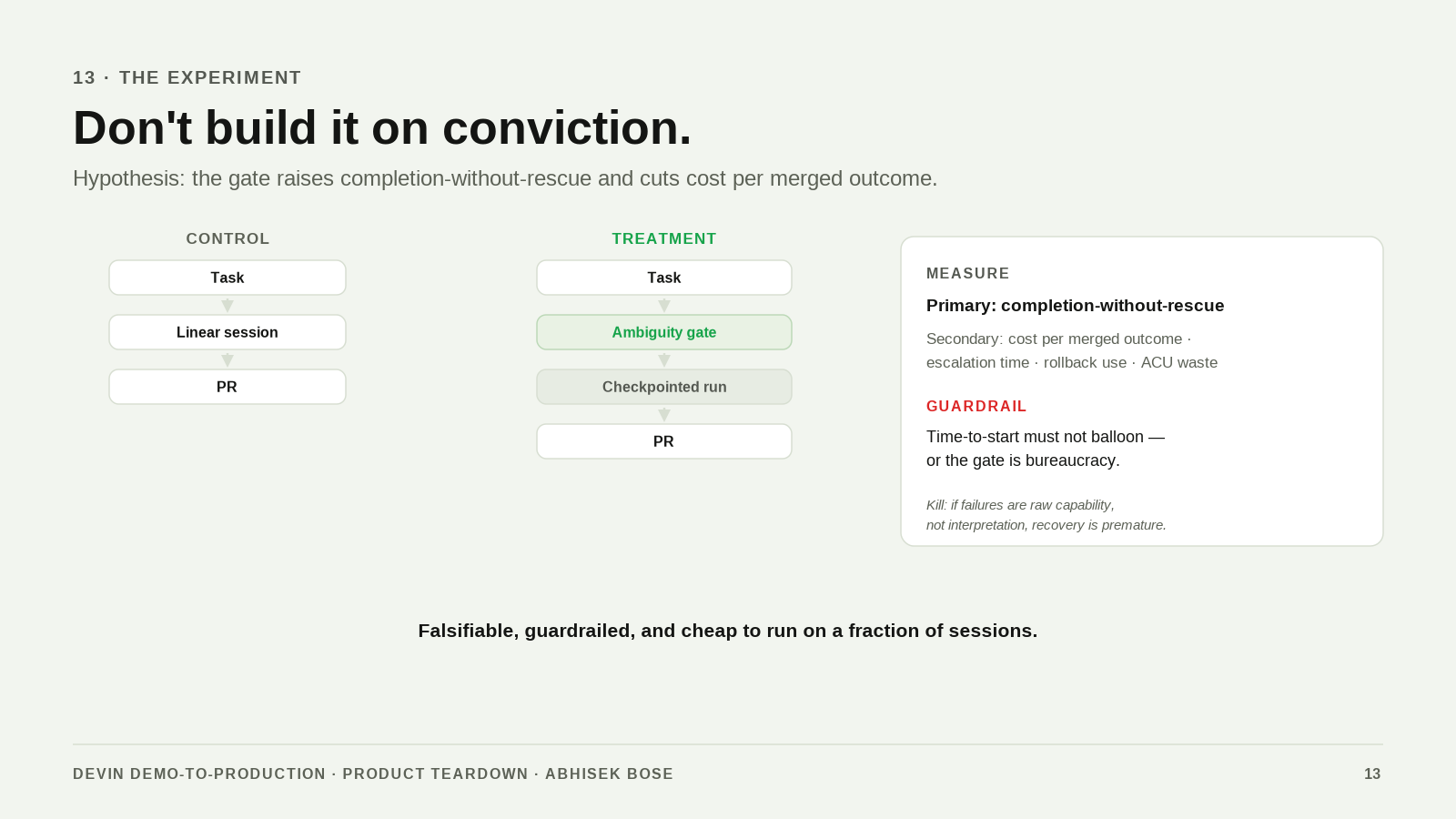
Falsifiable, guardrailed, and cheap to run on a fraction of sessions.
14 · What I'd build first
| Feature | Impact | Effort | Priority |
|---|---|---|---|
| Ambiguity gate (interpretation card) | High | Medium | P0 |
| Checkpoints at plan-step boundaries | High | Medium | P0 |
| Per-run ACU budget with pause-on-overrun | High | Low | P1 |
| Branch-from-checkpoint with corrected instruction | High | High | P1 |
| Recovery eval suite as internal release gate | High | Medium | P1 |
| ACU rebates on abandoned runs · rescue-rate dashboard | Medium | High | P2 |
The P0 pair ships the thesis: catch the wrong interpretation before it's expensive, and make being wrong recoverable when it slips through. The eval suite is P1 only because it needs the primitives to exist before it can grade them — sequencing, not importance.
15 · Final thesis
Devin's harder problem isn't autonomy. It's construct validity: a supervised tool certified by unsupervised benchmarks.
The product opportunity isn't a higher benchmark score. It's making failure legible and recovery cheap — an agent that states its interpretation, checkpoints its work, and asks at minute five instead of confessing at hour three. The company that publishes its recovery evals before its benchmark scores wins this category, because trust in delegation is built where the agent is wrong, not where it is right.
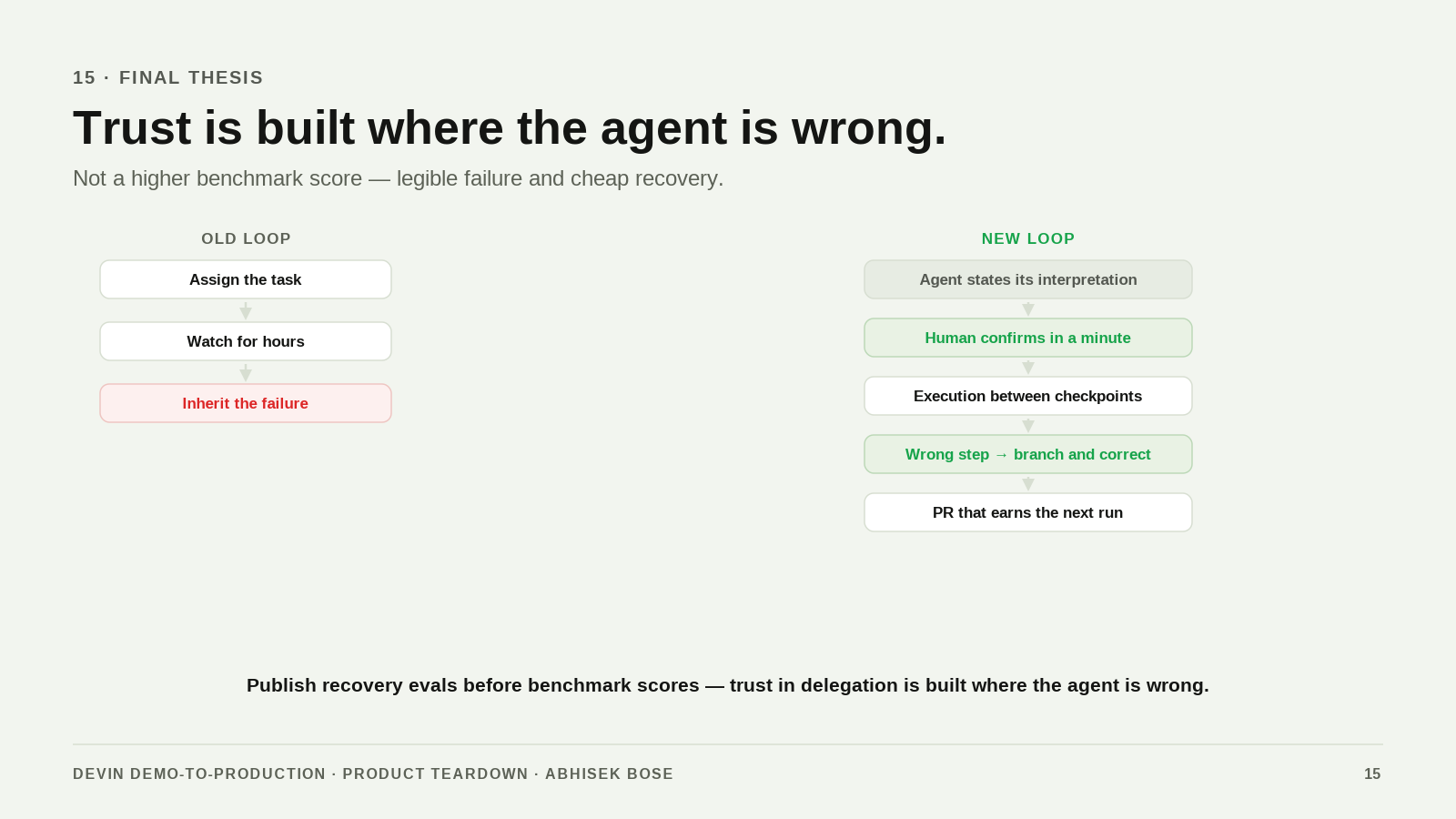
Old loop: trust graded where the agent is right. New loop: trust built where it is wrong.
Sources
Observed claims in this teardown draw on:
- Introducing Devin, the first AI software engineer — Cognition's launch claims, including SWE-bench framing and the Upwork demo
- SWE-bench technical report — the 13.86% resolved-issues result and methodology
- Devin failed 86% of its benchmark tasks, and then what — the Internet of Bugs demo debunking and the independent 20-task evaluation (3 satisfactory, 14 failures)
Everything else is inferred product analysis or marked (illustrative estimate) inline.