Scenario: Tear down Cursor (Anysphere) through a unit-economics lens — a flat-price subscription sitting on metered frontier-model token costs, and the pricing architecture that fixes the inversion.
01 · The thesis
Cursor built the best-loved product in its category. Its pricing architecture punishes the people who love it most.
What's true: product quality and gross margin point in opposite directions. Cursor sells a flat subscription while its cost of goods is metered per token by suppliers who are also competitors. Every improvement that makes agent mode more useful increases tokens burned per user per month — so marginal cost per user rises with product quality. In normal SaaS, your best users are your most profitable. Here, they're your most expensive.
The product problem: users can't see cost, Cursor can't afford to keep hiding it, and rate limits split the difference in the worst possible way — invisibly.
My thesis: stop selling the illusion of unlimited intelligence. Sell honestly metered agent capacity — visible per-task estimates, a budget you can see, capacity you can buy.
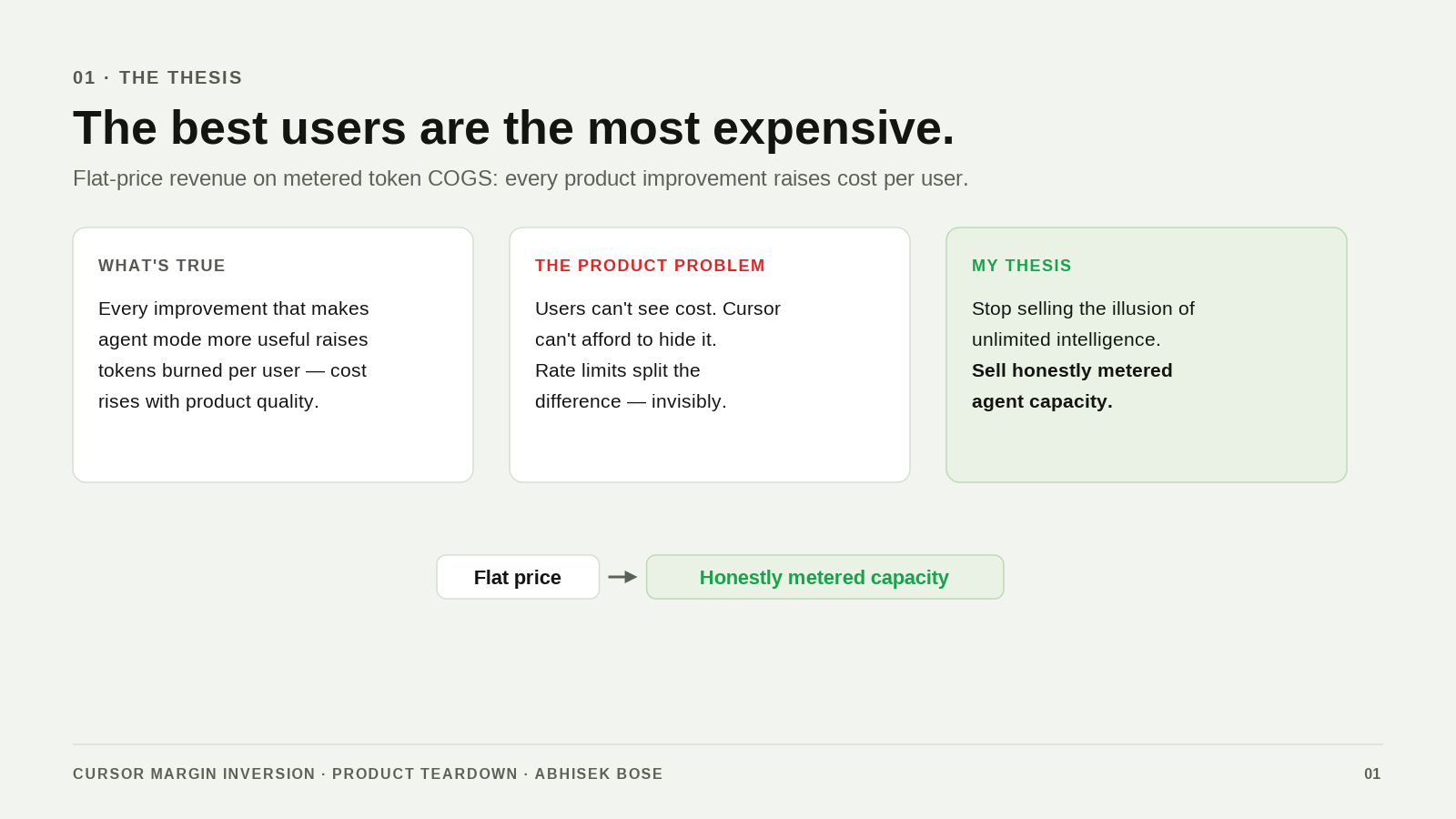
One screen: the margin inversion, and the pricing architecture that resolves it.
02 · Product evolution
Cursor's own history is the argument. Each step changed the user's job — and quietly changed what one unit of cost has to cover:
| Era | User does | AI does | Cost unit |
|---|---|---|---|
| Tab | Writes | Completes | Tokens per line |
| Chat | Asks | Answers | Tokens per response |
| Composer / agent mode | Delegates | Plans, edits, tests | Tokens per task |
| Background agents | Orchestrates | Runs concurrently | Tokens per fleet |
The cost unit grew from a line to a fleet. The pricing unit — a flat monthly fee — never changed. That gap is this teardown.
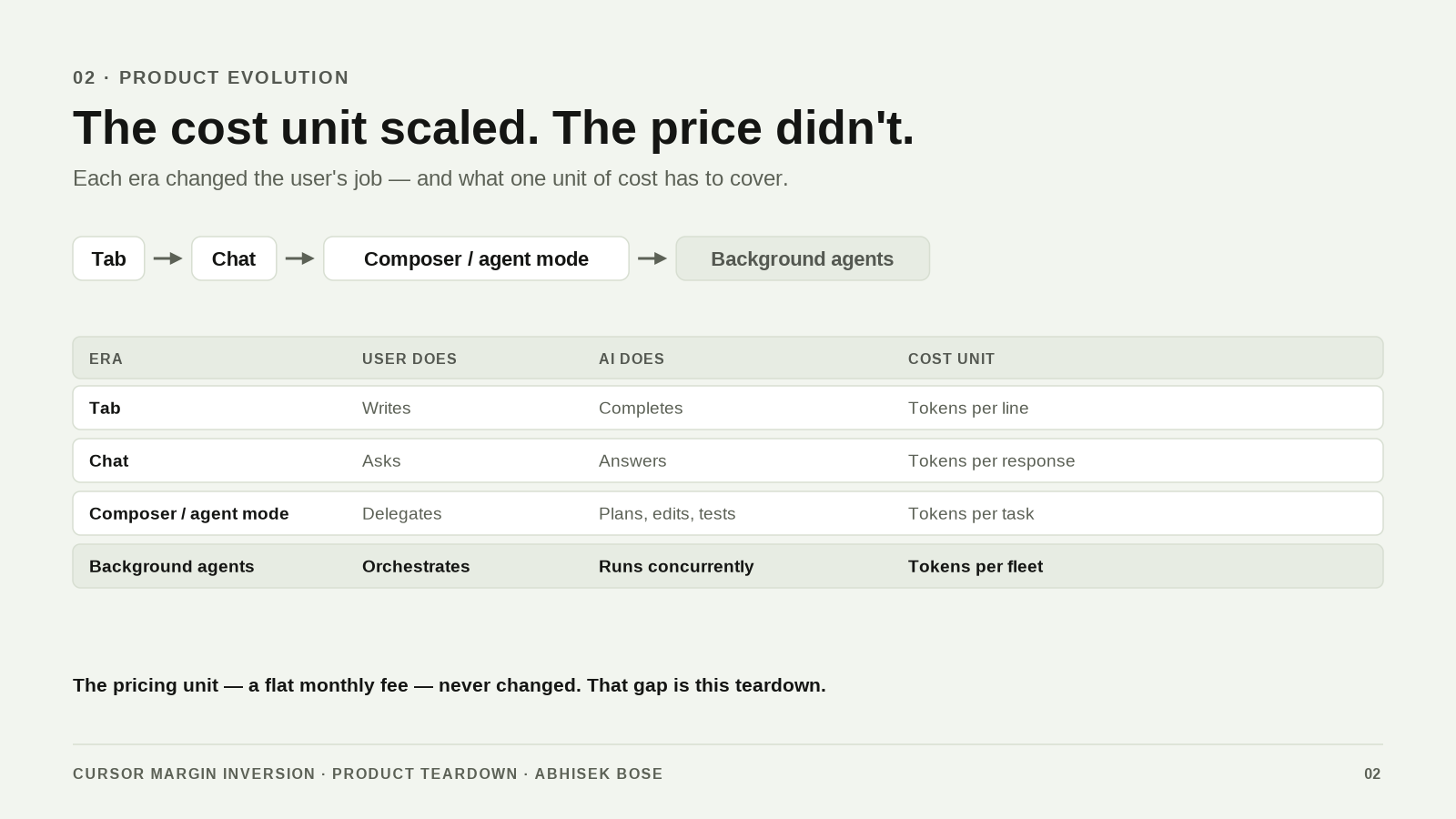
The cost unit scaled four times; the pricing unit didn't move once.
03 · Who actually has this problem
Not "developers." Three personas, three very different cost exposures:
- Hobbyist on Tab — job: better autocomplete while learning and building side projects. Consumption: trivial. Cost exposure: low — this user is profitable ballast under any pricing model.
- Staff engineer running agent fleets — job: delegate multi-file work to concurrent agents while she reviews. Consumption: heavy, frontier models, all day. Cost exposure: high — she is the margin-negative cohort and the backlash cohort.
- Engineering leader budgeting a team — job: forecast spend for twenty seats without surprise. Consumption: pooled and spiky. Cost exposure: extreme — one un-forecastable line item and the tool loses the renewal conversation.
The pattern: the more value a user extracts from agents, the less Cursor can afford them — and the less they can plan around Cursor. The current model serves the first persona and quietly taxes the two who decide whether this becomes an enterprise business.
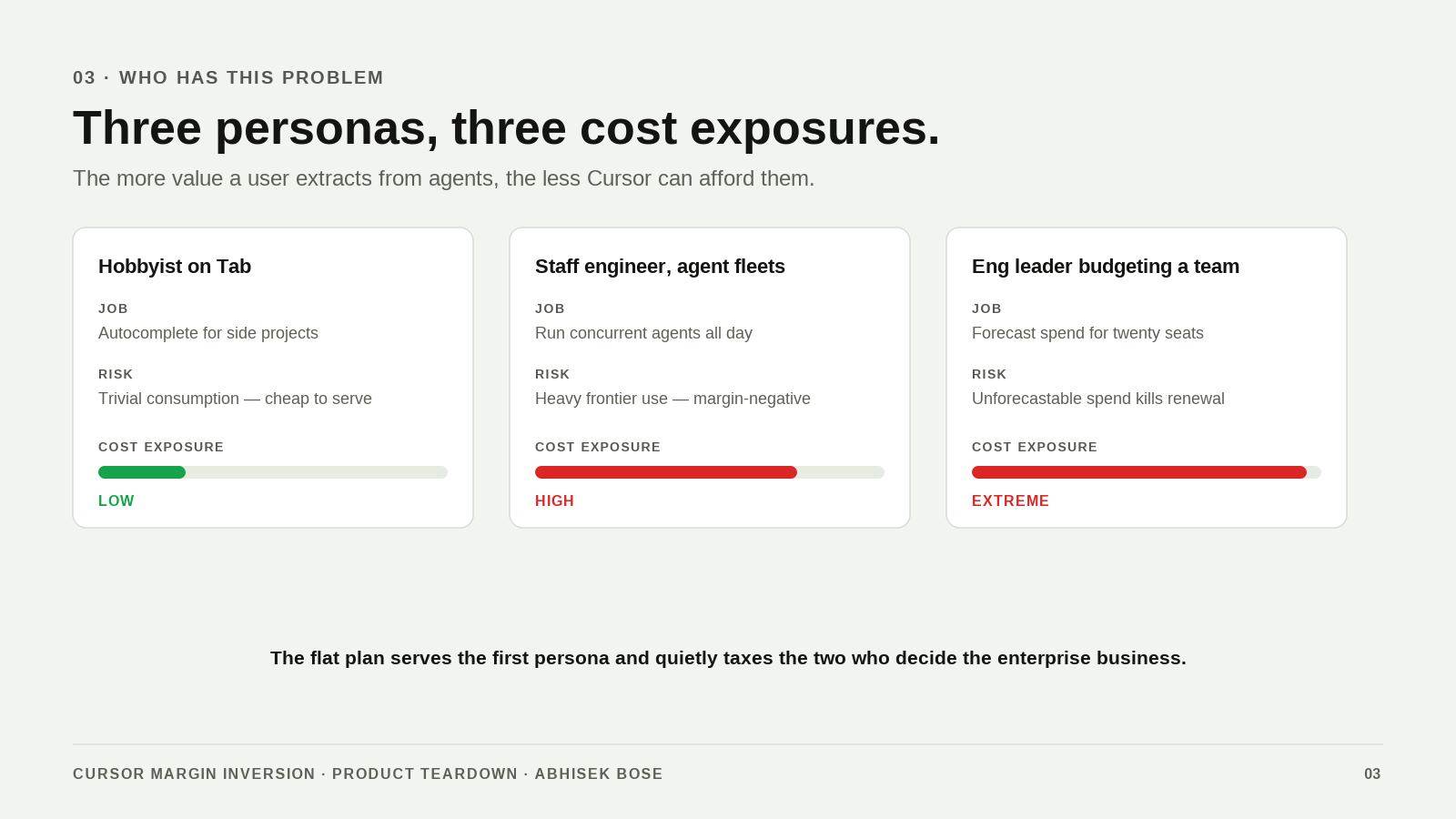
Cost exposure rises with delegated value — and so does the demand for predictability.
04 · Jobs to be done
Functional JTBD: when I have engineering work, I want agents to ship it faster than I could alone.
Emotional JTBD: I want the tool to feel unlimited — no meter anxiety while I'm in flow.
Trust JTBD: I need to know what a task will cost before I run it.
The third one is the unpriced job. Cursor ships the functional job brilliantly, sells the emotional job as the pricing model itself — and has no product surface at all for the trust job. The 2025 backlash was the trust job going unserved at scale: the emotional promise ("feel unlimited") collided with the economic reality (metered COGS), and users experienced the collision as betrayal.
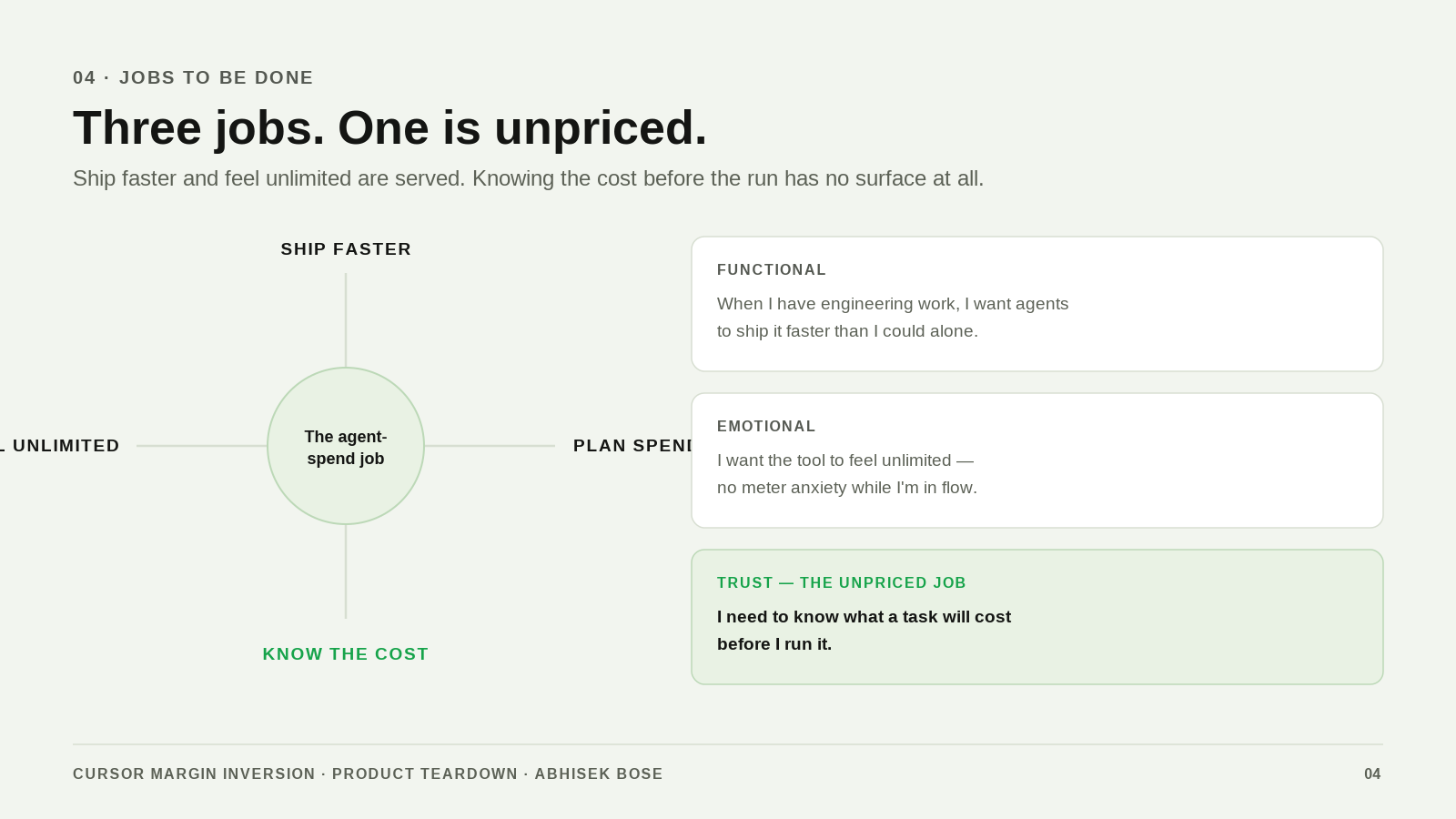
Two jobs served, one sold as an illusion — and the trust job left unpriced entirely.
05 · How the product actually works
Follow the money and the mechanism is plain. The user pays Cursor a flat monthly fee. The fee bundles model usage. Cursor pays Anthropic and OpenAI per token — suppliers who ship Claude Code and Codex, direct competitors running on internal cost rather than list price. Cursor is a reseller with a retail margin competing against manufacturers selling at wholesale. The only lever left to protect gross margin is the rate limit — a COGS control dressed as nothing at all.
Then 2025 made the mechanism visible. In June, the Pro plan quietly moved from 500 fast requests to roughly $20 of API-rate usage. Heavy users hit unexplained limits mid-work. The threads filled up, the CEO apologized, and refunds went out. That wasn't a communication failure. It was the inverted margin curve surfacing as product behavior.
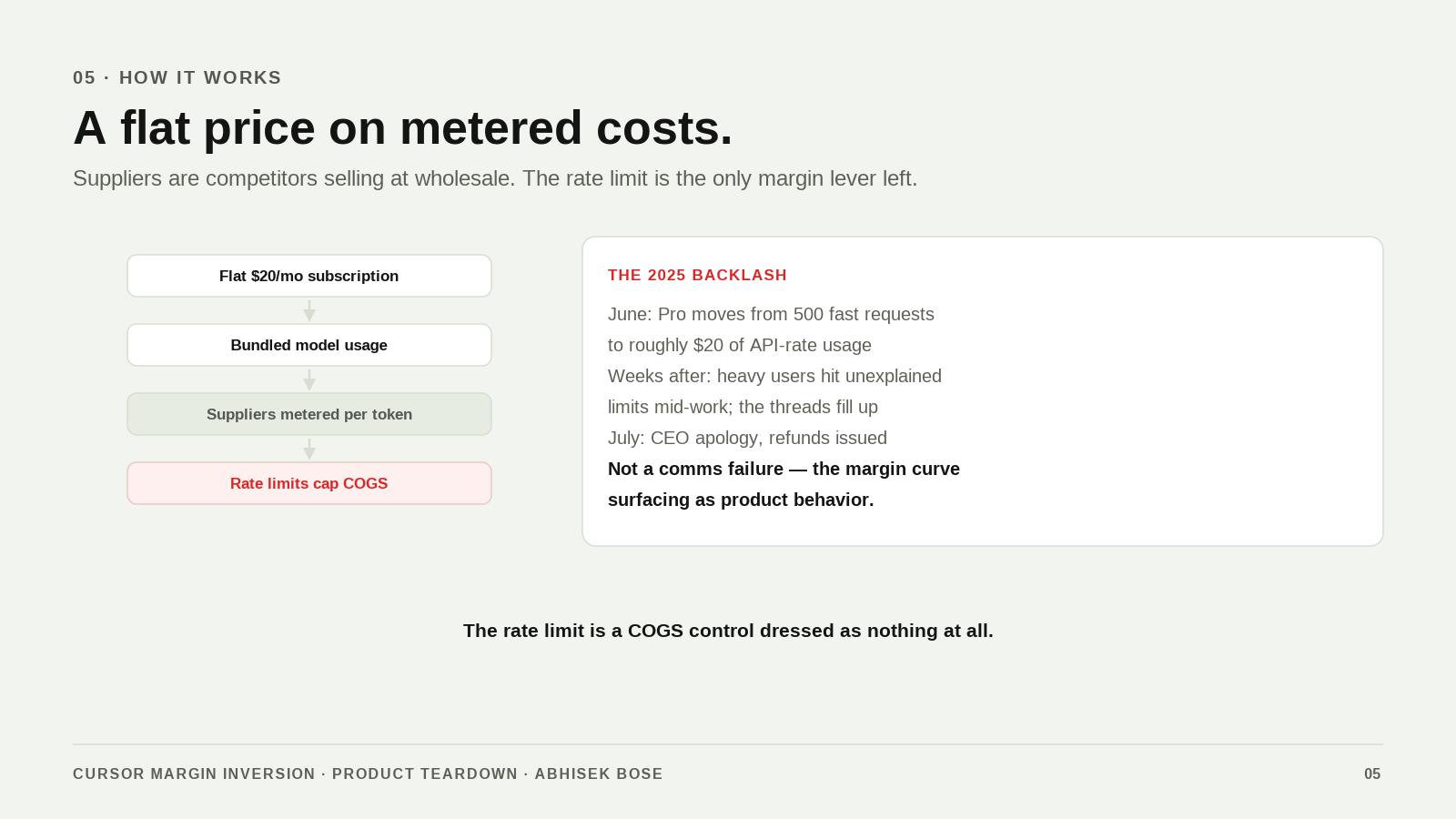
The chassis is a flat price on metered costs. The rate limit is the hidden shock absorber — and in 2025 it snapped in public.
06 · Where cost lives
Map token consumption across the product surface and the problem becomes visible:
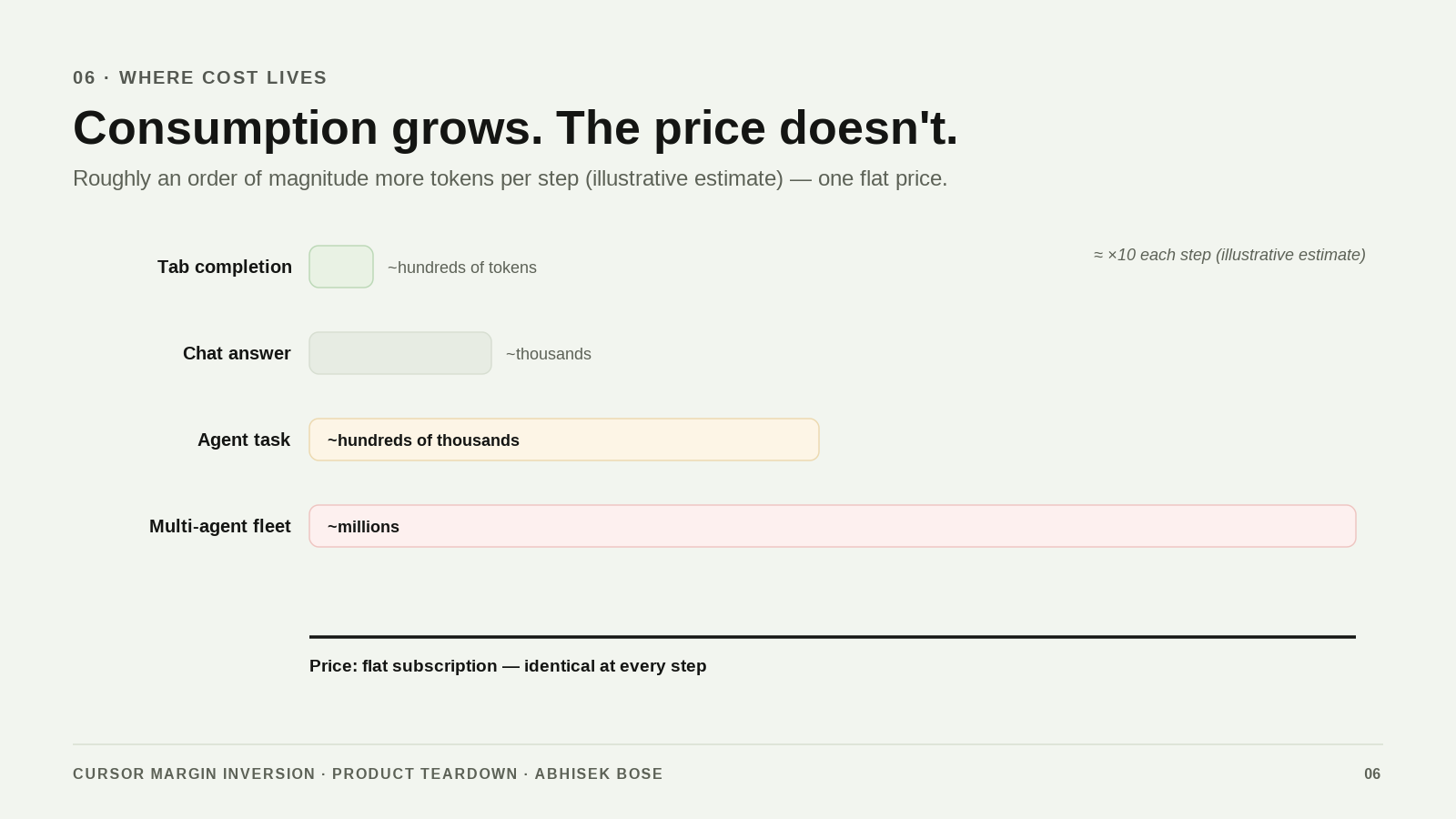
Consumption grows roughly an order of magnitude per step (illustrative estimate). The price line doesn't move.
A Tab completion is a few hundred tokens (illustrative estimate). A chat answer with context is an order of magnitude more (illustrative estimate). An agent task that reads context, plans, edits multiple files, runs tests, and retries can burn hundreds of thousands of tokens (illustrative estimate). A fleet of concurrent background agents multiplies that again (illustrative estimate). Four product surfaces, four orders of magnitude of cost — one price. Tab is quietly the margin engine; the fleet is quietly the margin fire.
07 · The real product gap — a concrete scenario
A staff engineer at a Series B startup runs four concurrent agents all week. She's doing exactly what the product was built for: delegating a service migration while she reviews the diffs. Consumption per day is enormous, and she has no idea — the product shows her no estimate, no meter, no receipt.
Mid-sprint, the agents start throttling. No warning, no explanation of what consumed the budget, no way to see which tasks were expensive. She loses an afternoon assuming it's a bug. Then she finds the pricing-change threads and concludes the product is being quietly degraded.
Here's the part that matters: her constraint was never money. Her team expenses far larger cloud bills without blinking. Her constraint is predictability — she championed Cursor to her VP of Engineering, and every opaque limit spends her internal credibility. She would happily pay metered prices for guaranteed capacity. Cursor offered her neither the meter nor the guarantee. Just a flat price and a surprise.
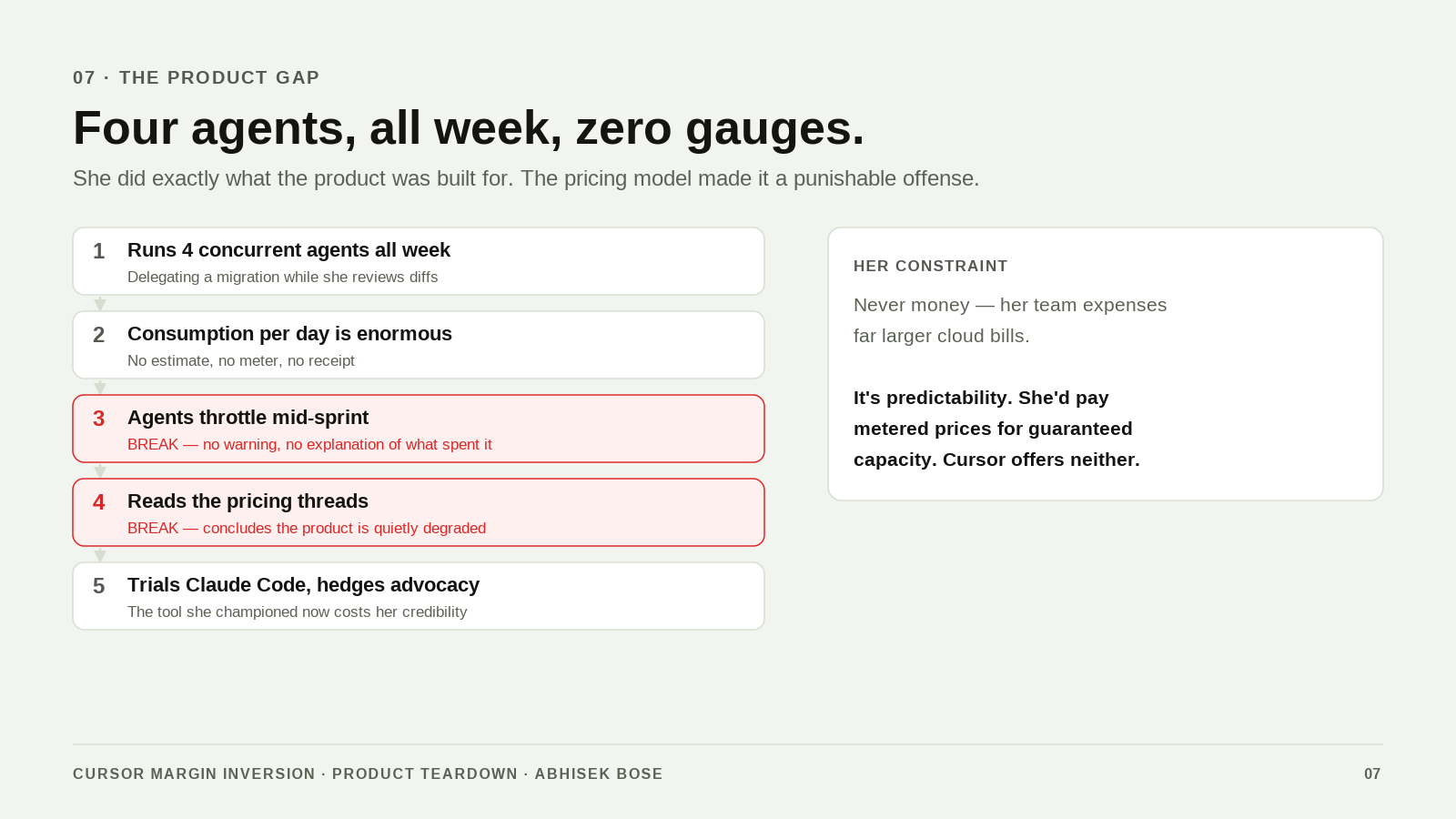
The user did what the product asked. The pricing model made it a punishable offense.
08 · Current vs proposed
Current: an opaque flat plan — bundled usage, undisclosed limits, enforcement the user discovers mid-sprint, overage pricing bolted on after the backlash.
Proposed: transparent budgeted capacity — a base subscription that buys the editor, plus a visible monthly agent-compute budget with pre-flight estimates, per-task receipts, cost-aware routing, and prepaid top-ups.
Cursor's power users are not a growth story. Under this pricing architecture, they are a liability line item that renews monthly.
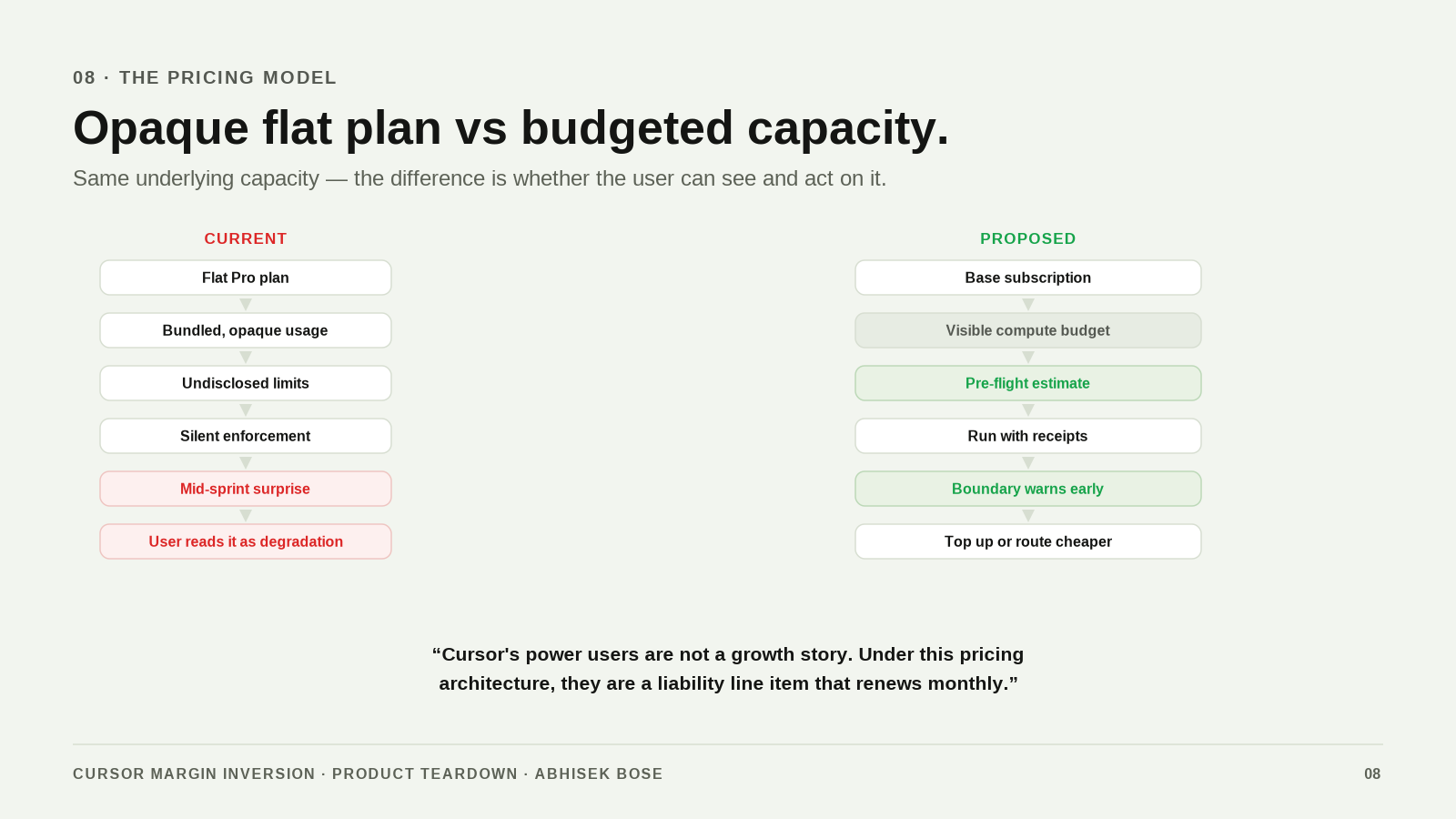
From selling the illusion of unlimited to selling capacity the user can see, plan, and buy.
09 · The artifact: the pre-flight cost estimate
"Show users the cost" is hand-waving unless you design the object. This is the actual artifact — glanceable before every agent run, honest about uncertainty:
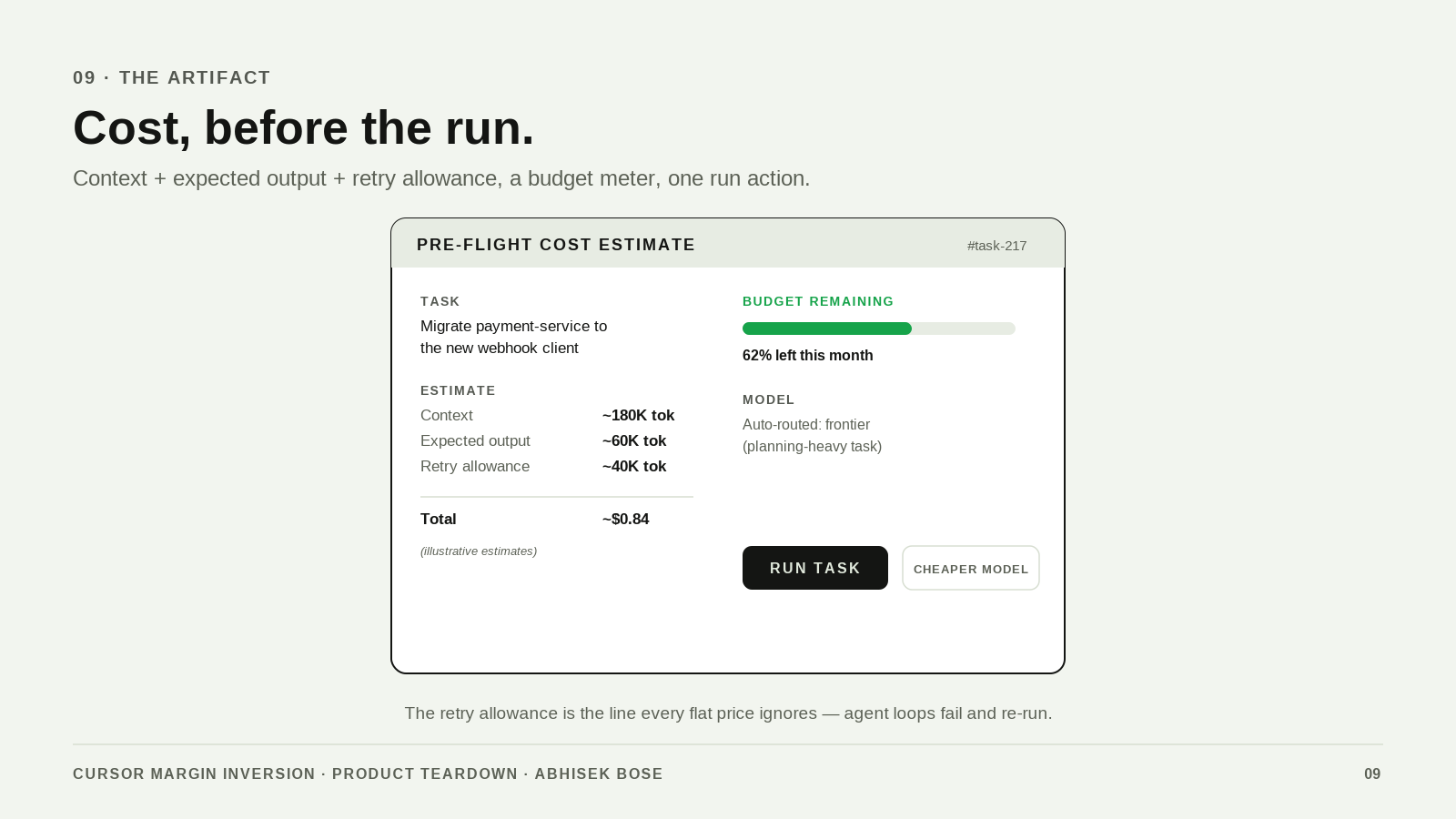
The estimate object: context + expected output + retry allowance, a budget meter, one run action.
Every field earns its place: context is the input tokens the task will load, expected output is the generation cost, retry allowance admits agent loops fail and re-run — the line every flat price ignores. The budget meter turns an invisible shared constraint into a gauge the user can self-regulate against. I build with this discipline in Ultipad, where I track input and output token costs per AI-built feature — and the lesson is consistent: spend management follows the dashboard. You can't manage cost you can't see, and neither can your users.
10 · The interaction: the budget boundary
The budget isn't a number in settings, it's a runtime boundary. When a run would push spend near the line, the product pauses and asks — with receipts:
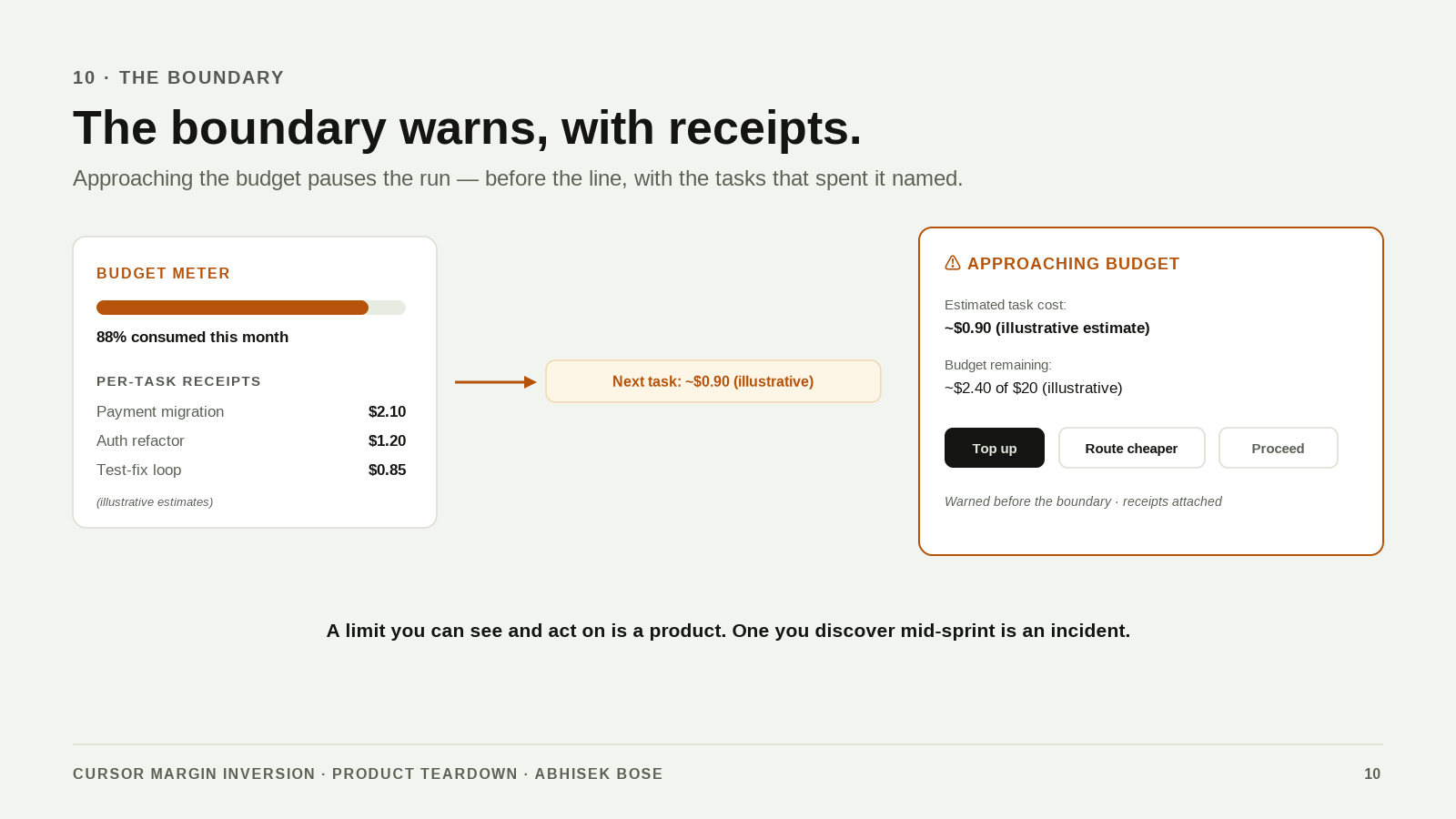
The boundary becomes a decision with information — top up, route cheaper, or proceed — instead of a silent throttle.
Three properties matter: the warning arrives before the boundary (agency, not autopsy), the receipts show which tasks spent what (so the meter reads as fair, not arbitrary), and every option keeps the user in motion — top up if the work justifies it, route to a cheaper model if it doesn't, proceed knowingly if the budget allows. A limit you can see, understand, and act on is a product. A limit you discover mid-sprint is an incident.
11 · Category view: cost models, not feature lists
Comparing Cursor vs Claude Code vs Copilot feature-by-feature misses the point. Compare the cost model each pattern ships:
| Product pattern | Cost model |
|---|---|
| Vertically-integrated model owner | Tool priced as demand driver; COGS at internal cost |
| Bundled enterprise suite | Margin absorbed by a trillion-dollar balance sheet |
| Flat-price reseller | Retail margin on wholesale competitors; limits hide the gap |
| Transparent metered capacity | User sees cost; margin scales with usage — the open position |
Cursor currently occupies the worst square: a flat-price reseller whose suppliers underprice it with their own first-party tools. It can't win the integration game or the balance-sheet game. But nobody has claimed the fourth square — making the cost of an agent task a first-class, user-visible product surface. The best-loved product in the category is the one with permission to try.
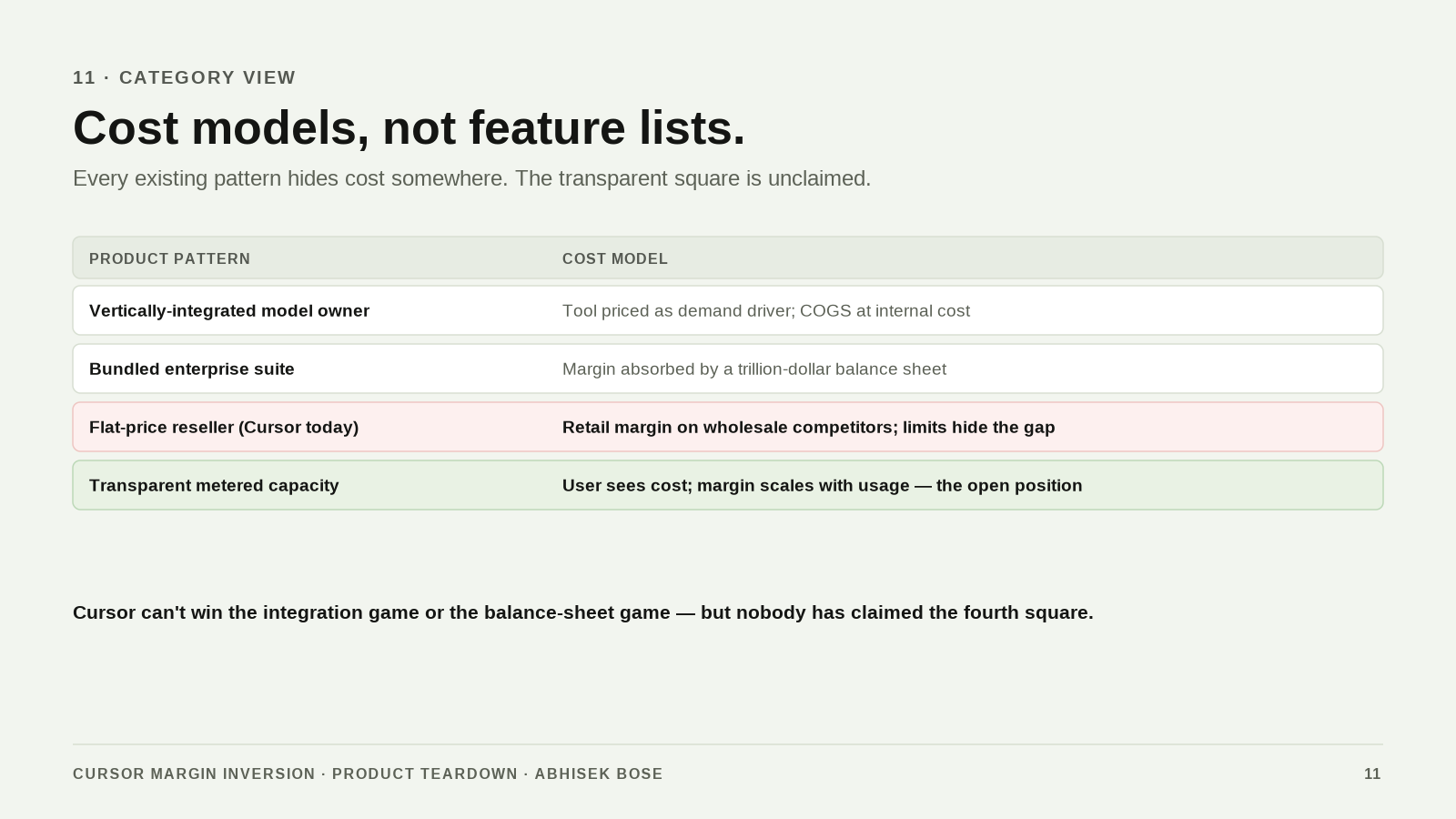
The open position in the category: cost made visible and sold honestly.
12 · Metrics that prove the thesis
Not engagement. A measurement system where each metric tests one link in the margin-repair loop:
- Gross margin per user by usage decile — the metric the whole teardown exists to move; the top decile must trend toward positive, not away.
- % of agent tasks with the estimate viewed — tests whether cost visibility is used or ignored.
- Token cost per accepted diff, by model tier — the real unit-economics number; falling means routing works without quality loss.
- Voluntary top-up rate among heavy users — the whole strategic bet in one number: do power users buy capacity when it's honest?
- Churn within 30 days of hitting a boundary — tests whether the boundary reads as a fair meter or a betrayal.
- Repeat agent-task rate — the metric that can't be gamed: users burned by the meter stop delegating.
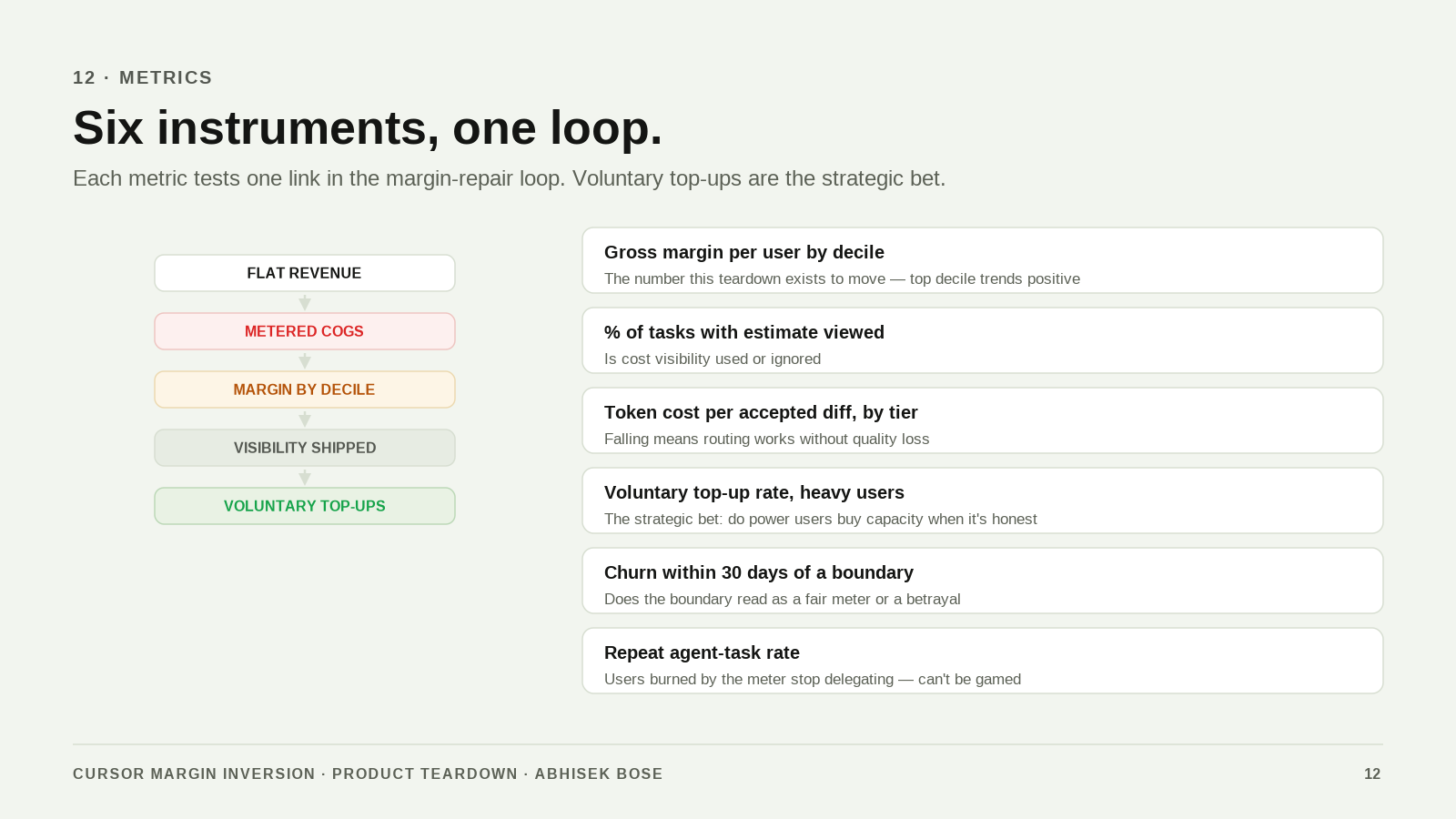
One loop, six instruments — voluntary top-up rate is the one the others exist to earn.
13 · The experiment
Don't reprice on conviction. Run the test:
Control: current model — hidden limits, silent enforcement. Treatment: visible budget, pre-flight estimates, per-task receipts. Same underlying capacity.
Hypothesis: cost visibility raises retention of heavy users without reducing usage — predictability beats the illusion of unlimited.
Primary metric: heavy-user retention at 60 days. Secondary: estimate view rate, voluntary top-ups, churn after boundary events, token cost per accepted diff. Guardrail: agent task volume must not fall — if the meter suppresses usage, visibility became friction, not trust.
Kill criterion: if power users reject any visible metering regardless of guarantees, honest budgets don't sell — and flat pricing with quiet limits is the only sellable shape, margin inversion included.
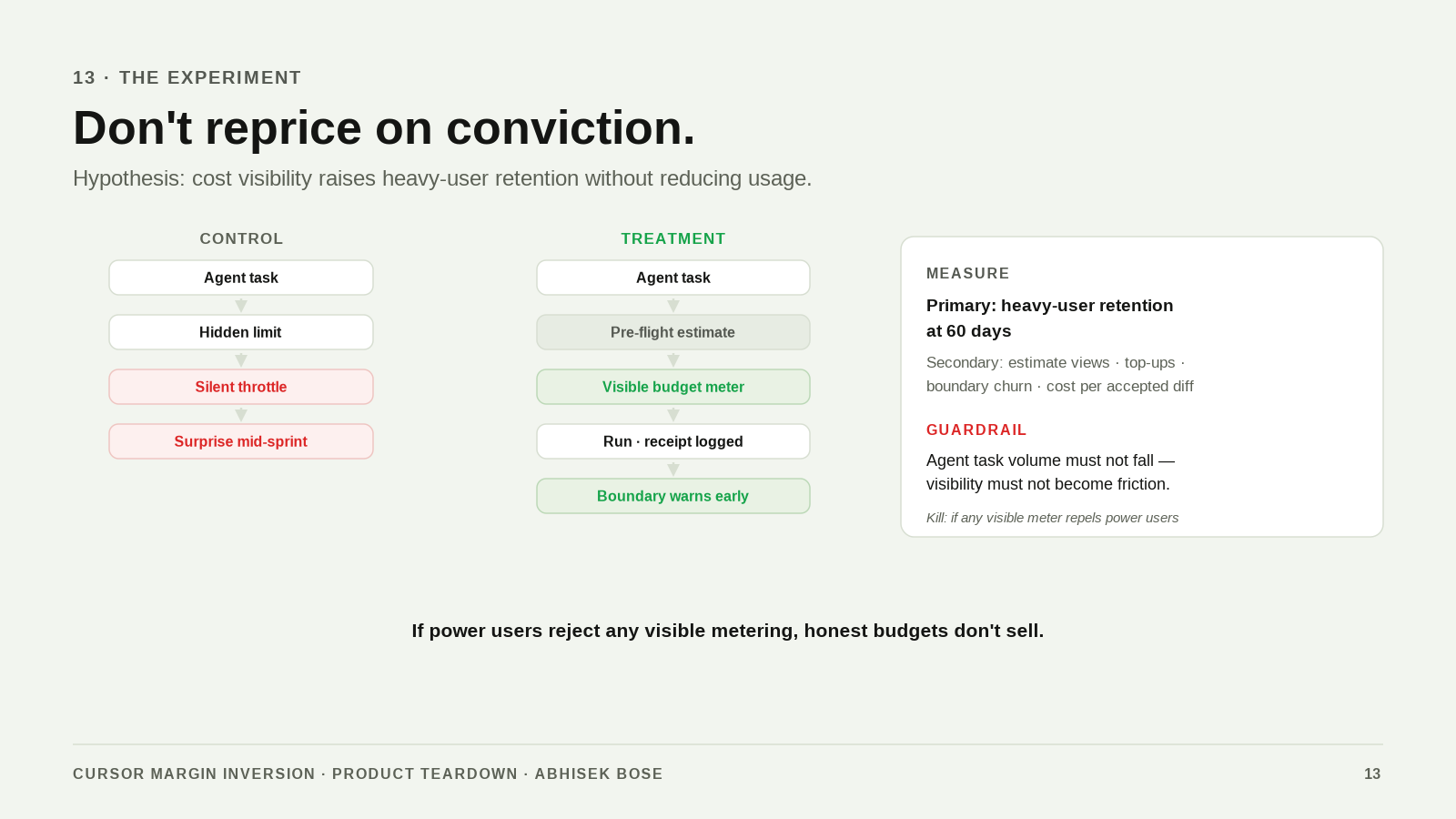
Falsifiable, guardrailed, and cheap to run on a slice of Pro signups.
14 · What I'd build first
| Feature | Impact | Effort | Priority |
|---|---|---|---|
| Pre-flight cost estimate | High | Medium | P0 |
| Per-task receipts + budget meter | High | Low | P0 |
| Budget boundary flow (warn / top up / route) | High | Medium | P1 |
| Cost-aware model routing by default | High | High | P1 |
| Prepaid top-ups with rollover | Medium | Medium | P2 |
| Enterprise pooled budgets + spend analytics | Medium | High | P2 |
The P0 pair ships the thesis with zero pricing change: let users build a mental model of cost before you ask them to pay for it. The boundary flow is P1 because it needs the meter to exist first — sequencing, not importance.
15 · Final thesis
Cursor's crisis is not pricing communication. It's that product excellence and gross margin currently point in opposite directions, and every quarter of product progress makes the inversion worse.
The fix isn't cheaper models or quieter limits. It's making agent compute visible, budgetable, and honestly priced — so the users who consume the most become the customers worth the most.
The company that does this first owns the users everyone else is rate-limiting.
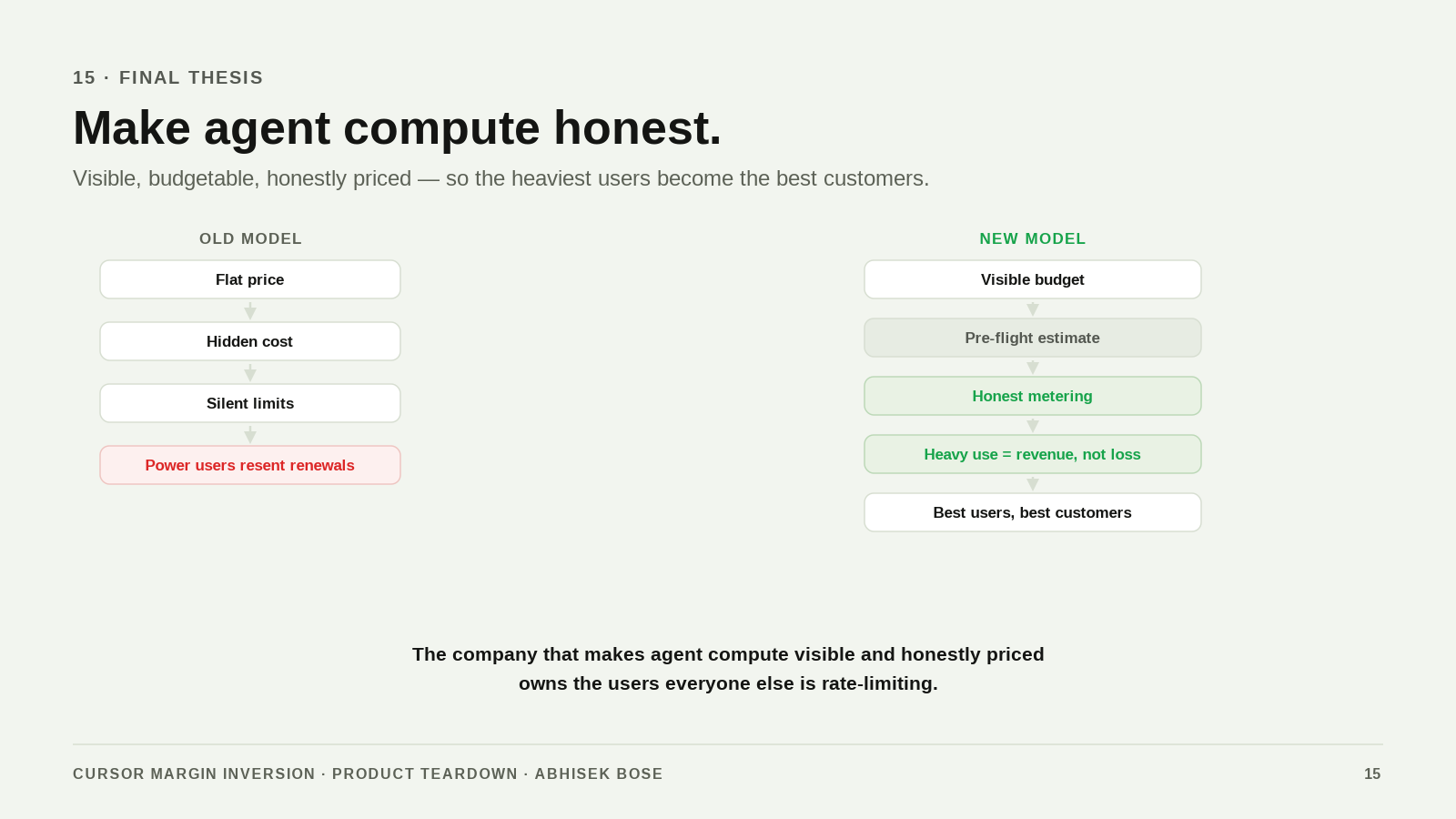
Old model: the best users are a cost problem. New model: they're the revenue line — because they can finally see what they're buying.
Sources
Observed claims in this teardown draw on:
- Cursor apologizes for unclear pricing changes that upset users — the June 2025 Pro plan change, rate-limit backlash, CEO apology, and refunds
- Cursor faces backlash over Pro plan pricing shift — user-facing impact of moving from 500 fast requests to $20 of API-rate usage
- Did Cursor raise prices? The 2025 controversy explained — timeline of the pricing model changes
Everything else is inferred product analysis or marked (illustrative estimate) inline.