That is becoming one of the more interesting failure modes of AI coding.
The code compiles. The tests pass. The PR looks clean. And the agent still built the wrong thing.
We ran into exactly this while building UltiPad. The problem wasn't whether the AI could write working code. It was whether the code was aligned with what we actually approved.
So we changed the question. Instead of:
"Did the commit work?"
we started asking:
"Did the agent build what we asked it to build?"
The idea
Every AI-generated commit now goes through an intent check against the idea's approved product specification. The flow is simple:
Approved Spec → AI Agent → Commit → Intent Check → Feedback
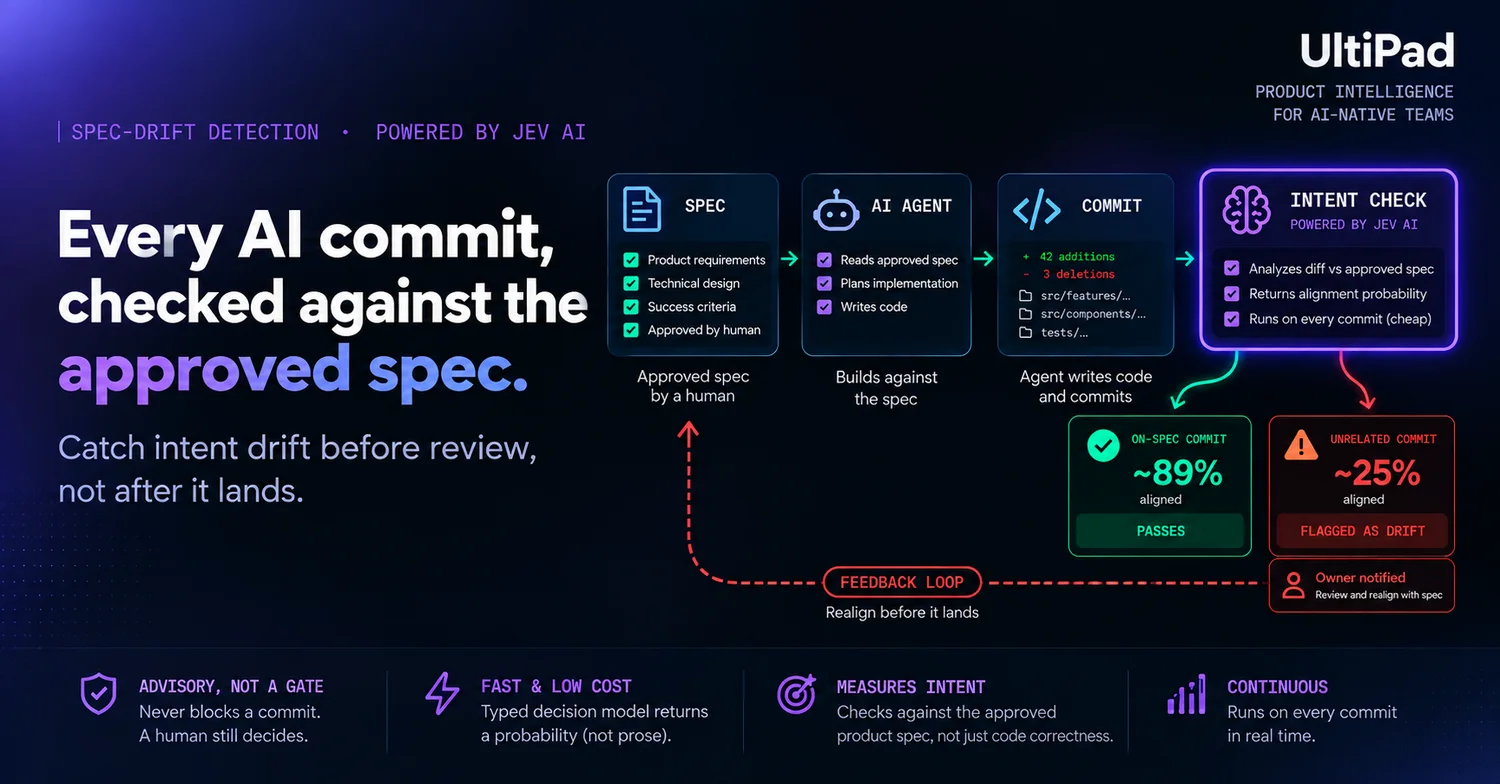
The interesting part is what happens inside the Intent Check.
The obvious implementation would be an LLM judging every commit. We deliberately didn't do that. AI agents can commit frequently. Putting a full LLM into that loop would introduce unnecessary latency and cost.
Instead, we're using Jev AI as a typed decision model. It doesn't generate an explanation. It returns an alignment probability. That makes the check lightweight enough to run continuously on every commit.
And we're already seeing a useful separation in the beta:
- On-spec commit → ~89% aligned → passes
- Unrelated commit → ~25% aligned → drift flagged → owner notified
But there is one design decision I care about more than the score.
It doesn't block the agent
The Intent Check is advisory, not a gate. A low score doesn't prevent the commit. A human still decides what happens next.
The system's job is simply to surface a potential mismatch before code review instead of after it.
That distinction matters. We're not trying to replace engineering judgment with another AI model. We're trying to give humans an earlier signal that the agent may have crossed the boundary of the approved intent.
This changed how I think about AI coding
The hard problem isn't:
Can AI write code?
It clearly can. The harder problem is:
Can we continuously measure whether the AI is building the right thing?
That's a product problem, not just a coding problem.
And it leads to a broader principle I'm increasingly convinced about: reliable AI products don't start with a better model. They start with a clear definition of what good looks like. Then you build the evaluation into the workflow.
For an AI coding agent, "good" isn't simply:
valid code + passing tests
It's:
valid code + passing tests + alignment with approved product intent
That's the gap we're experimenting with in UltiPad. AI can produce perfectly valid code that is completely wrong for the product.
The next generation of AI-native development needs systems that can catch that gap continuously — while keeping the human in control.
Originally published as a LinkedIn article. See the Intent Guard in the Ultipad case study.