①Self-written plans
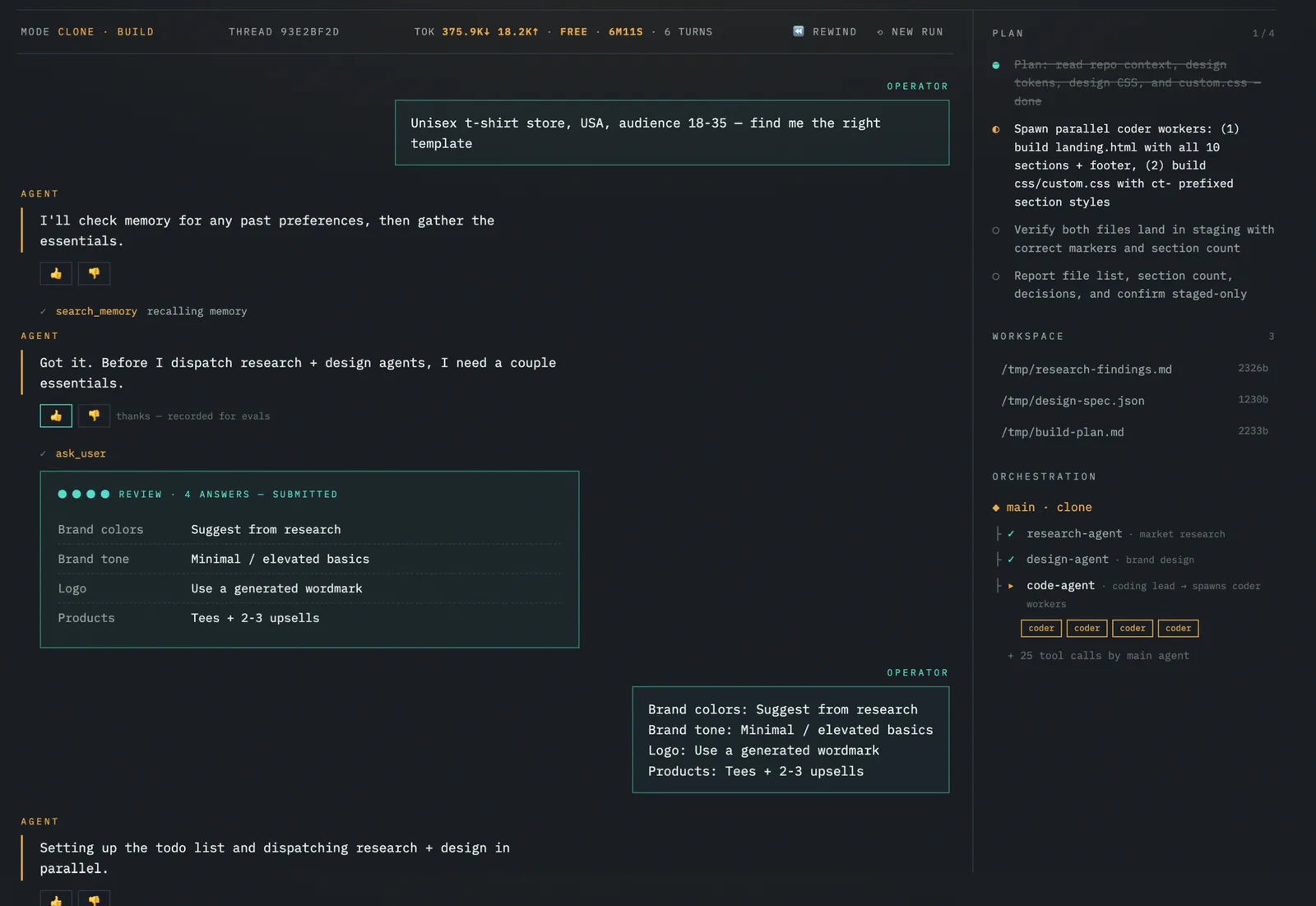
The agent maintains its own todo list (write_todos); the PLAN panel renders it live — pending ○, in-progress ◐, done ●.
②Native human-in-the-loop
interruptOn pauses the graph at all 17 mutating tools. Approve / edit / reject from the UI; the run resumes from its checkpoint via Command. A second deterministic gate sits underneath — defence in depth.
③Context engineering
Virtual filesystem (WORKSPACE panel) for offloading bulky catalogs; built-in summarization past 60k tokens; subagent isolation; 12k tool-result truncation; 345 tools curated to ~35.
④Durable memory, 3 layers
Checkpoints (threads survive restarts) · virtual files (task-scoped) · long-term save_memory/search_memory across sessions.
⑤Time travel
Every step checkpointed → ⏪ rewind lists history; the next message forks the conversation from any chosen checkpoint.
⑥JSON subagents + skills
Subagents return strict JSON the parent consumes — and they run on any free tool-calling model (no forced-tool_choice dependency that excludes free tiers). Domain knowledge ships as a SKILL.md loaded on demand — progressive disclosure, not prompt bloat.
⑦An agent that spawns agents
The code-agent is a nested deep agent: it gathers business context, writes its own plan, and decides how many parallel coder workers to spawn. Claude-Code-style coding, inside the SaaS.
⑧Staged code, human-reviewed
Coders never touch git. Writes are staged per thread, pass a protected-region validator (builder tags, forms, payment/product markup, shrink limits), surface as a full diff for review, and push only through the interrupt gate.
⑨Live orchestration graph
The ORCHESTRATION panel renders the agent hierarchy in real time — main → research / design / code-agent → coder workers — nodes lighting up as work fans out. The multi-agent structure, visible.
⑩Click-to-answer wizard
The agent never dumps questions as prose — it opens a step-by-step wizard (progress, one question at a time, option cards, free-text, review → submit/cancel). The operator clicks, never re-types.
⑪Cost & budget transparency
Live tokens in/out, wall-time, and an estimated $ cost per session in the runbar — turning red past a budget. On free/cloud models it reads $0: a full autonomous build at zero LLM cost.
⑫Closed feedback→eval loop
A 👎 on any message captures the triggering request straight into the eval dataset (learned-cases.jsonl). Failing scenarios become replayable regression tests — the system learns from its mistakes.
⑬Crash-proof & resumable
Every step is checkpointed; a flaky model can't crash the server (guarded), and a reload auto-resumes the exact thread — history, plan, and files restored. Eight-minute runs survive interruptions.
⑭Compose-your-own agents
The agent kinds are data, not hard-code. A frontend builder lets anyone compose a new Unify V6 agent — pick from the 345 MCP + direct tools, toggle sub-agents, write the instructions — saved as a card, no deploy. Presets for code-only, flowboard-only, tester. Approval gates apply to any composed agent automatically (they key off tool names).
⑮Self-improving — reflective memory
Every failure signal — turn errors, repeated tool calls, rejected gates, 👎 comments — is distilled into a short lesson, deduped and counted per agent-kind + niche, and written to an auto-generated lessons-learned skill the agent reads at the start of each run. Recurring mistakes are flagged ⚠️ so it stops repeating them. Verbal reinforcement — no fine-tuning, works on any BYOK model.
⑯Loop mode — hill-climbing loop
Opt-in via a setup wizard (⟳ loop). Fast loop: every turn is graded; a low-scoring turn auto-retries once with the grader's critique injected — never on turns that ran a mutating tool. Slow loop: after N low turns an engine-analysis agent reads the accumulated scores + feedback and proposes prompt-overlay updates — shown as a diff card, applied only on your approval, revertible anytime. The agent climbs; the human holds the gate.